The Nordiska Museet (Nordic Museum) is Sweden’s largest museum of cultural history, holding roughly 1.5 million objects that document how people in Sweden — and more broadly the Nordic region — have lived, dressed, worked and furnished their homes from the 1520s to the present day. It occupies a purpose-built, castle-like structure on the island of Djurgården in Stockholm.
Who founded the Nordiska Museet, and why?
The museum was founded by Artur Hazelius, a schoolteacher and philologist who spent much of the late nineteenth century collecting everyday objects from Swedish farms and households before they disappeared under industrialisation. Hazelius opened his first collection to the public in 1873, and it grew into the institution now on Djurgården. He later founded Skansen, the open-air museum, as a companion project in 1891 — a point of connection covered in detail in Access Stockholm’s explanation of what Skansen is and how it works.
Hazelius worked from a conviction, common among European folklorists of his generation, that rural material culture was vanishing and needed to be documented systematically rather than left to chance. The Nordiska Museet’s own historical material describes his method as fieldwork-based collecting: buying, cataloguing and sometimes recording the people who had used the objects, not simply gathering curiosities.
What does the Nordiska Museet building look like, and why?
The building was designed by the Swedish architect Isak Gustaf Clason in a heavy Nordic Renaissance-revival style, deliberately built to resemble a Danish or Swedish castle rather than a conventional exhibition hall. Construction began in the 1890s and the main building opened to the public in 1907, decades after Hazelius had begun collecting.
The scale of the building was itself a statement: Hazelius wanted a national monument to everyday life, built with the same architectural weight usually reserved for royal or ecclesiastical buildings. The result is a long red-brick and sandstone facade with towers and stepped gables, standing close to the Vasa Museum on the same stretch of Djurgården.
What does the Nordiska Museet actually collect?
According to the museum’s own published collection overview, its holdings cover the material culture of Sweden — and, to a lesser extent, the other Nordic countries — from around 1520 onward. That starting point corresponds roughly to the reign of Gustav Vasa and the emergence of Sweden as a unified early modern state.
The collection is organised less around individual masterpieces than around categories of daily life. Broadly, it includes:
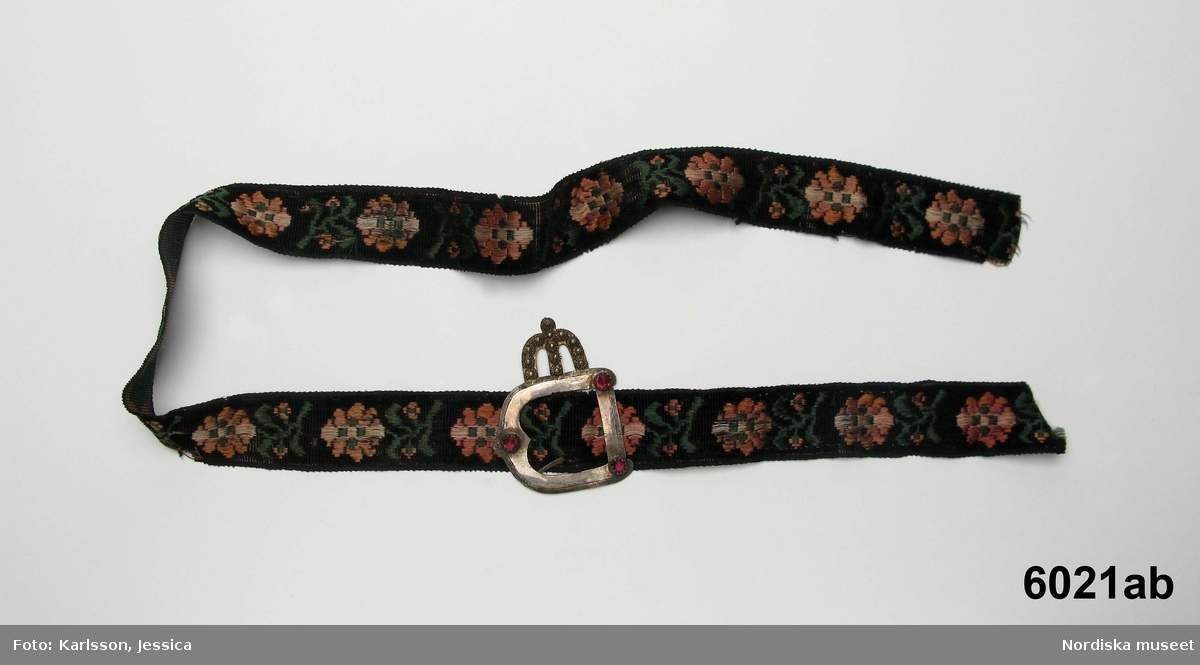
- Folk costume and regional dress, including textiles, weaving and embroidery from across Swedish provinces
- Furniture and interiors spanning farmhouse rooms to twentieth-century apartments
- Bridal crowns, jewellery and items connected to marriage customs
- Toys, dolls and dollhouses, one of the museum’s most visited sections
- Photographs, portraits and a large photographic archive documenting Swedish life since the mid-1800s
- Tools, trade objects and material connected to fishing, farming and craft occupations
- Sami cultural material, collected over more than a century
The through-line across all of these categories is documentation of ordinary domestic and working life rather than fine art or royal treasure — a deliberate contrast with institutions such as Nationalmuseum, which collects painting and design on different terms.
What is the statue in the entrance hall?
The Nordiska Museet’s Main Hall is dominated by a large seated statue of King Gustav Vasa, carved in oak by the sculptor Carl Milles and completed in the early twentieth century. It is one of the most recognisable single objects in the museum, positioned to be visible from the entrance and used consistently in the museum’s own promotional and archival photography.
The statue functions as a kind of foundation stone for the museum’s chosen timeframe: by placing Gustav Vasa at the physical centre of the building, the museum anchors its collecting period — 1520 onward — in a single, recognisable historical figure.
.jpg)
How does the Nordiska Museet relate to Skansen and the Vasa Museum?
All three institutions sit on or near Djurgården, and two of them share a founder, but they are legally and administratively separate today. The Nordiska Museet is run by its own foundation, Stiftelsen Nordiska museet. Skansen, which Hazelius opened afterward as an open-air complement — moving historic buildings from around Sweden onto one site rather than displaying their contents in cases — is covered separately in Access Stockholm’s guide to what Skansen is and how it’s organised.
The Vasa Museum, a short walk from the Nordiska Museet’s front doors, is an unrelated institution built around a single object: the seventeenth-century warship Vasa, raised from Stockholm harbour in 1961. Access Stockholm’s separate article sets out what is inside the Vasa Museum and how the ship ended up there. Visitors sometimes assume the three museums are one complex because of their shared location on Djurgården; in practice each has its own governance, collection remit and ticketing.
Does the Nordiska Museet hold Sami cultural objects, and is that contested?
Yes. The museum holds a substantial collection of Sami material — clothing, tools, ritual and everyday objects — gathered mainly during the same nineteenth- and twentieth-century collecting drives that built the rest of the collection. In recent years, the museum’s own public statements have acknowledged that some items were acquired under conditions that would not meet current ethical standards, including objects taken from Sami communities without clear consent.
The museum has stated publicly that it is engaged in dialogue with Sami institutions, including Ájtte, the Swedish Mountain and Sami Museum, over questions of repatriation and shared stewardship. Readers researching this specifically should consult the Nordiska Museet’s own published statements on its Sami collections rather than assume the position described here reflects the current state of any single negotiation, since positions and agreements are still developing.
Is the Nordiska Museet part of a wider network of Stockholm museums?
It sits within Stockholm’s broader concentration of cultural-history and art museums, many of them within walking distance of one another on Djurgården and the surrounding waterfront. Access Stockholm’s Museums & Galleries hub covers this wider landscape, including institutions that collect art, maritime history and design rather than everyday domestic life.
Within that landscape, the Nordiska Museet’s specific role is documentary rather than curatorial in the traditional sense: it exists to record how life was actually lived, at scale, across five centuries, rather than to assemble a canon of significant works. That distinction is worth keeping in mind when comparing it to other entries on the same museums and galleries hub.
How is a visit to the Nordiska Museet organised in practice?
The museum occupies a single large building on Djurgårdsvägen, on Djurgården, reachable by tram, bus or the seasonal ferry services that serve the island from central Stockholm. Because the collection is arranged thematically rather than chronologically in a single line, visitors typically move between floors covering costume, furniture, photography and folklife rather than following one continuous narrative.
Opening hours, ticket prices and any free-entry windows are set by the museum itself and change over time, including seasonal adjustments and closures. The museum’s own website is the only reliable source for current admission terms, and Access Stockholm recommends checking it directly before planning a visit: nordiskamuseet.se.
Because the museum sits close to both Skansen and the Vasa Museum, many visitors combine a visit to two or three of these institutions on the same day, though each requires its own separate admission and operates on its own schedule. Anyone travelling from outside Sweden should also confirm current entry requirements through their own government’s official travel guidance rather than through third-party sites.
What should a Stockholm resident know that a visitor might not?
For residents, the Nordiska Museet functions less as a one-time attraction and more as a research resource: its archive and library hold genealogical records, historical photographs and folklife documentation used by people researching family or regional history, not only by casual visitors. The museum’s own published information on archive access sets out how these materials can be consulted, typically by appointment rather than as part of a general exhibition visit.
The building also hosts temporary exhibitions that rotate through the year, addressing specific themes within Swedish cultural history — a wedding-custom exhibition one season, a design-history show the next. Because these are genuinely dated events rather than a fixed permanent display, the museum’s own site and press materials are the only dependable source for what is currently on show.
Access Stockholm is an independent guide written from published, checkable sources. We have not visited the places described here and we do not publish personal recommendations or invented ‘local favourites’ — where something is singled out as notable, we say who says so. Opening times, fares, closures and prices change at short notice, so treat everything here as a starting point and confirm with the museum, operator or venue directly before building a day around it. We give no advice on visas, insurance, health or safety; use your own government’s official guidance for those.
Featured image: Photo by Elisabeth Eriksson, source, CC BY 4.0

Related reading
Living in Stockholm, Stockholm, Practically, What Is Millesgården? Carl Milles’s Sculpture Garden.