The Stockholm metro — the Tunnelbana — is called the world’s longest art gallery because roughly 90 of its approximately 100 stations contain permanent artwork: sculpture, mosaic, painting and carved or painted bedrock, installed since the 1950s and paid for as part of the transport system’s own budget rather than added on afterward.
This is not marketing shorthand for “a few nice murals.” SL, the regional operator that runs the network (Storstockholms Lokaltrafik, under Region Stockholm), documents and maintains the collection as a matter of policy, and describes the network using that phrase — “the world’s longest art gallery” — in its own materials. The claim rests on scale and continuity: it is one of the largest single public art programmes of the twentieth century, built into a working transit system rather than displayed in a building set aside for the purpose.
How did the metro end up covered in art?
The Tunnelbana opened in 1950, but the systematic decoration of stations began in earnest through the 1950s and accelerated through the 1970s, when the network’s blue line was built. Rather than finishing tunnel walls smooth, engineers on several blue-line stations left the excavated bedrock exposed, and artists then worked directly onto that rough rock surface — painting it, carving into it, or setting mosaic and relief into the stone.
This coincided with a broader Swedish postwar idea that public infrastructure — housing, schools, transport — should include art as a matter of course, not as decoration bolted on at the end. Region Stockholm’s public art body has continued commissioning work in each phase of expansion since, meaning the collection has grown continuously rather than being a fixed installation from one era.
Which stations are considered the most significant?
A handful of stations are consistently singled out by SL and by Sweden’s cultural institutions as the collection’s centrepieces, because of scale, technique or the way the artwork defines the space itself.
- T-Centralen — the central interchange station, where the blue-line platform hall has a blue-and-white vine motif painted directly onto the vaulted rock ceiling, by Per Olof Ultvedt.
- Kungsträdgården — built around fragments of demolished buildings and archaeological references, treating the platform as an excavation of the city above it.
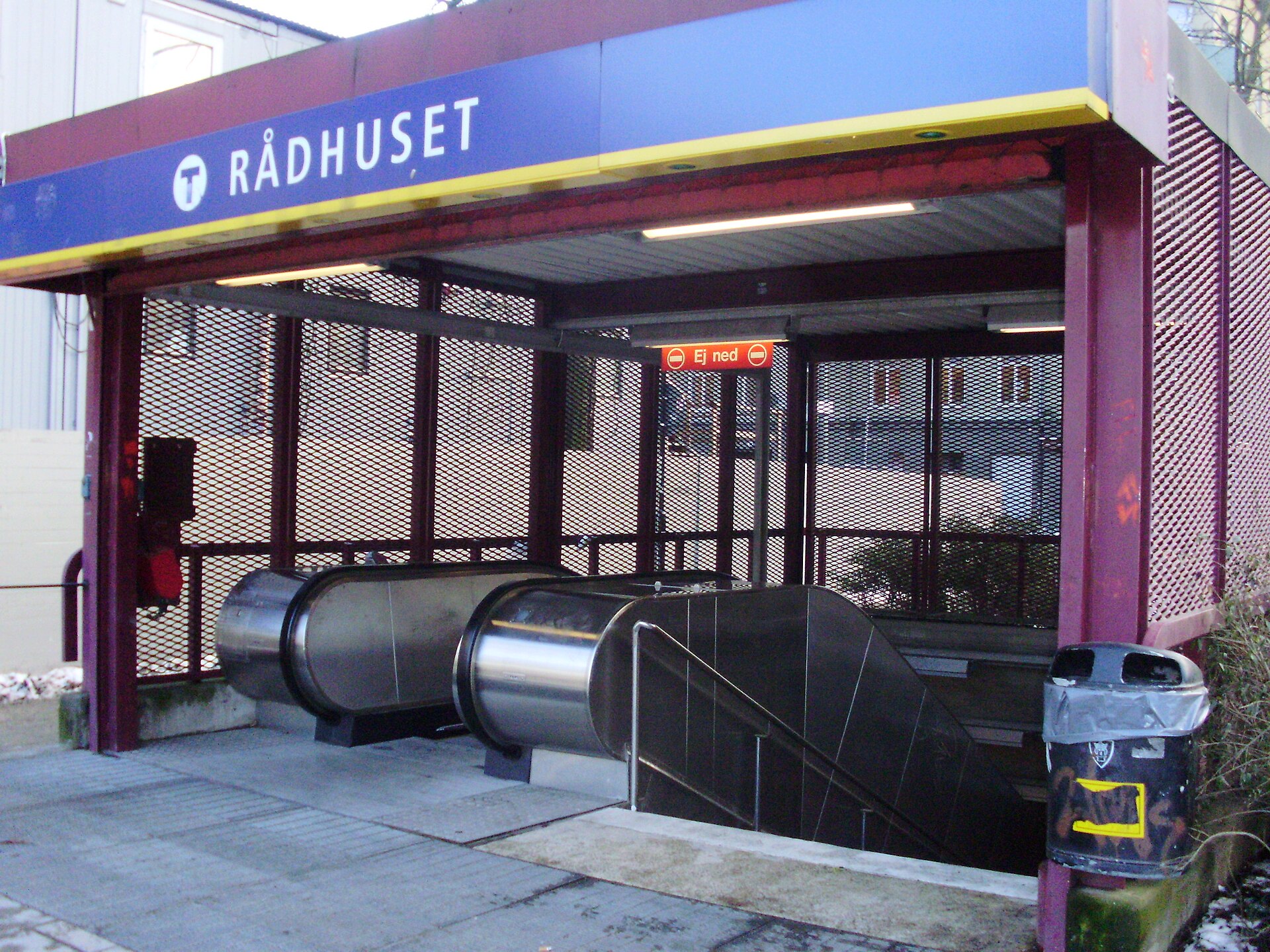
- Rådhuset — left as raw, unpainted rust-coloured bedrock, with sections cut back to resemble a construction site rather than a finished interior.
- Stadion — a rainbow arcs across the cavern ceiling, connecting the station to the Stockholm Olympic Stadium it serves.
- Solna Centrum — a deep-red, forest-lined ceiling addressing rural depopulation and environmental themes, one of the network’s most overtly political works.
These stations sit on lines that also serve the city’s museum island and historic core, which is one reason the metro’s art is often discussed alongside Stockholm’s more conventional collections — see how the guide covers the city’s museums and galleries more broadly.
How much of the network is actually art, and how much is just infrastructure?
SL’s own documentation puts the figure at roughly 90 of the network’s approximately 100 stations containing some form of permanent artwork, involving more than 150 artists over the network’s history. That leaves a meaningful minority of stations that are functional rather than decorated — plain tiled or concrete platforms built to a standard transit specification, mostly on sections added or rebuilt for pure capacity reasons.
The three lines differ in character. The blue line, built last, has the most exposed rock and the most large-scale interventions. The red and green lines, older, tend toward mosaic, tile work and painted surfaces rather than raw stone. Anyone trying to see a representative slice of the collection in one trip is better served by riding a stretch of the blue line through the interchange at T-Centralen than by trying to cover the whole system.
Is the art free to see?
Seeing the art requires a valid ticket to enter the metro system, in the same way any journey does — there is no separate admission charge for the art itself, and no gallery-style entry gate. A single fare, or a period pass loaded onto Region Stockholm’s travel card, covers movement through as many stations as a rider chooses to pass through within the ticket’s validity window.
How that fare structure works — zones, single tickets versus period cards, and what counts as one journey — is covered in detail in the guide’s explanation of Stockholm’s metro zones and fares, and separately in how the Stockholm travel card works across metro, bus and ferry. Fares and validity periods change; the operator’s own site (sll.se or SL’s own ticketing pages) is the source to confirm current figures against, rather than any number repeated secondhand.
SL has, at various points, run guided art tours of selected stations aimed specifically at visitors interested in the collection. Whether these are currently running, their route and any charge attached to them should be checked directly on SL’s own site, since seasonal programming of this kind is exactly the sort of detail that goes out of date fastest.
Who decides what gets commissioned, and who pays for it?
Commissioning sits with Region Stockholm’s public art function, which has operated continuously since the postwar decades and treats the metro as an ongoing rather than finished project. Funding for new work is generally built into the capital cost of each station or line extension, following the same postwar Swedish principle that shaped decisions in public housing and civic buildings of the same era — that a percentage of a public building project’s budget goes toward art as a matter of course, rather than being raised separately afterward.
This is one reason the collection reads so differently by decade. Stations built or rebuilt during the mass housing expansion of the 1960s and 1970s — the era covered in the guide’s explainer on Stockholm’s Million Programme suburbs — often carry art that reflects the optimism, and later the anxieties, of that building programme directly on their walls, in a way city-centre stations from an earlier decade generally do not.
Does the collection still grow?
Yes. Each significant extension of the network has continued the practice, meaning new stations added in the 2020s carry newly commissioned work rather than being left plain. This matters for how the collection should be understood: it is not a fixed set of 1970s murals being preserved, but an active commissioning programme that keeps pace with where the city itself is expanding — including into newer districts on the network’s outer edges, well beyond the postcard core of the inner city.
That distinction — between the historic centre and the newer, expanding parts of the transit network — is also a useful way to understand Stockholm as a whole. The guide’s explainer on the difference between Stockholm’s inner city and its suburbs covers how differently these two parts of the city were built, and the metro’s art collection maps onto that split fairly directly: older, denser decoration near the centre, and newer commissions further out as the network has extended.
How does the metro’s art fit alongside Stockholm’s actual museums?
Stockholm’s conventional art institutions — the Moderna Museet, the Nationalmuseum, Thielska Galleriet and others — hold and display collections behind admission control, in buildings purpose-built or converted for the task. The metro’s collection works on the opposite principle: it is unticketed beyond the price of a transit fare, distributed across a working transport network rather than concentrated in one building, and encountered incidentally by commuters rather than sought out deliberately by visitors.
That contrast is part of why the “world’s longest art gallery” description has stuck as more than a slogan. It describes a genuinely different model of how a city can hold public art — as infrastructure, rather than as an institution. For a wider sense of how Stockholm organises its museums, and why so many of the city’s major collections sit on one island in particular, the guide’s coverage of why so many of Stockholm’s museums are on Djurgården is a useful companion piece, as is the broader guide to Stockholm’s museums, landmarks and neighbourhoods for anyone building a wider itinerary around the city’s collections. For the practicalities of moving around the network itself, the getting around Stockholm archive covers the transport system in more detail.
Access Stockholm is an independent guide written from published, checkable sources. We have not visited the places described here and we do not publish personal recommendations or invented ‘local favourites’ — where something is singled out as notable, we say who says so. Opening times, fares, closures and prices change at short notice, so treat everything here as a starting point and confirm with the museum, operator or venue directly before building a day around it. We give no advice on visas, insurance, health or safety; use your own government’s official guidance for those.