Junibacken is a children’s cultural centre on the island of Djurgården in Stockholm, built around the world of Swedish author Astrid Lindgren — creator of Pippi Longstocking, Emil of Lönneberga and Karlsson-on-the-Roof. It combines a narrated train ride through scenes from her books, a full-size reconstruction of Pippi’s house, a stage for children’s theatre, and a large children’s bookshop. It opened in 1996 and is aimed squarely at families with young children.
What is Junibacken, exactly?
Junibacken is not an art museum or a historical archive; it is a purpose-built attraction created to bring Swedish children’s literature to life for a young audience. Its centrepiece is Sagotåget (the Story Train), a slow-moving indoor train ride that carries visitors through a series of staged scenes drawn from Astrid Lindgren’s stories, narrated aloud along the way. Around that ride sit a theatre space used for children’s performances, a walk-through model of Villa Villekulla — the house Pippi Longstocking shares with her horse and monkey in the books — and a bookshop that Junibacken itself describes as one of the largest dedicated to children’s literature in Sweden.
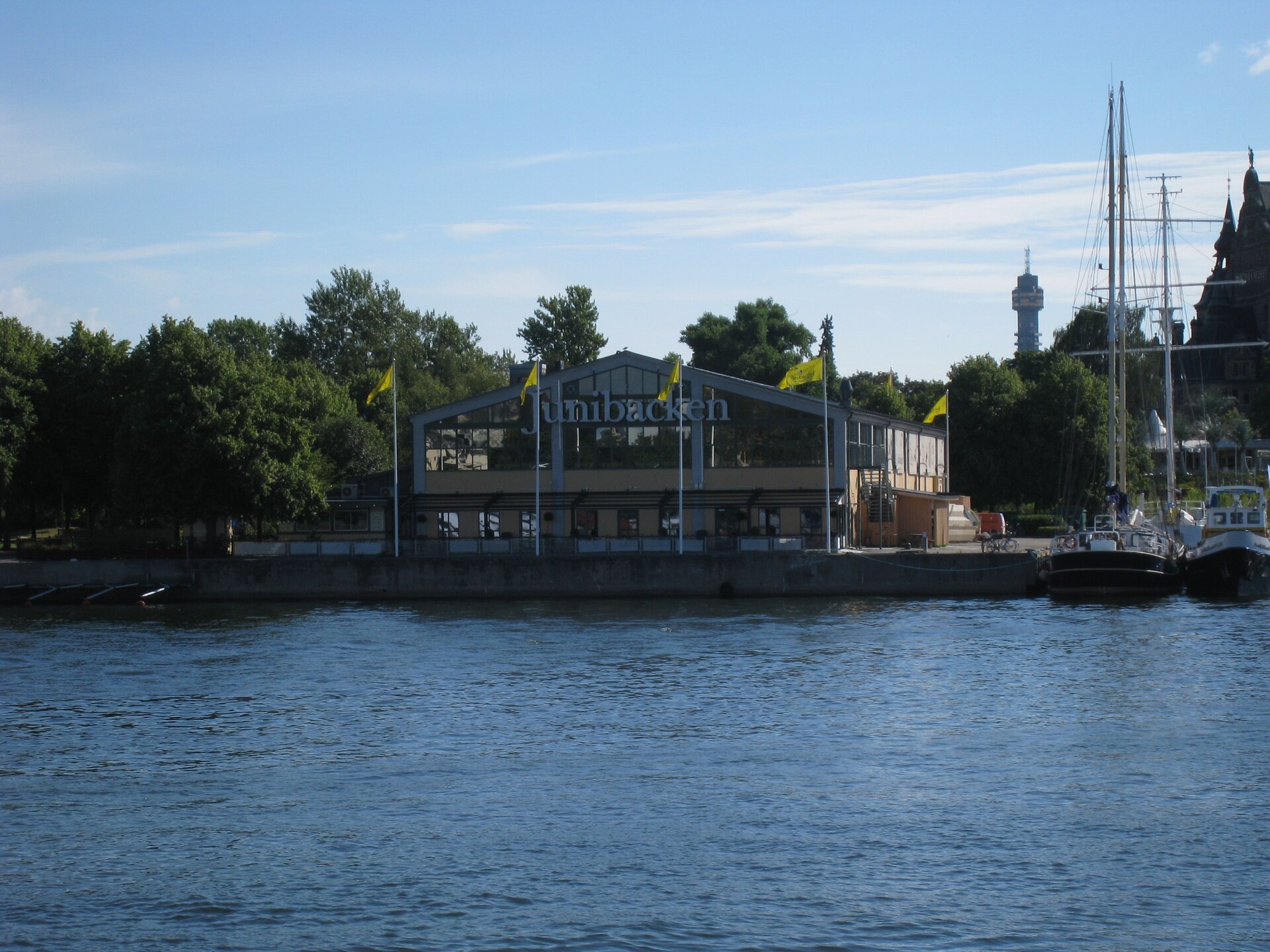
The building sits on the Djurgården waterfront, close to the Vasa Museum and other major institutions on the island, and functions as a discrete cultural venue rather than a wing of a larger museum. It is a private, non-profit foundation, and its programming — the Story Train script, the theatre schedule, the shop stock — is built specifically around Lindgren’s body of work and Swedish children’s literature more broadly, not around a general collection.
Who is Junibacken actually for?
Junibacken is built for children roughly of pre-school and early primary-school age, and for the adults accompanying them. It is not designed as a stop for adult visitors travelling without children, and readers weighing up a limited day on Djurgården should treat it as a family-specific attraction rather than a general Stockholm sight in the way the Vasa Museum or Skansen are.
That said, its appeal has a specific edge for anyone with a prior connection to the books. Astrid Lindgren’s stories have been translated into more than 100 languages according to her official estate, and Pippi Longstocking in particular is recognisable well beyond Sweden. Adults who read the books as children — Swedish or otherwise — are part of the audience Junibacken is built to reach, even without a child in tow, though the physical experience (a train ride sized and paced for small children, a theatre programme aimed at young audiences) is unmistakably designed around them rather than around adult nostalgia alone.
What happens on the Story Train?
The Story Train, or Sagotåget, is a fixed-route ride in small train-shaped cars that moves through a sequence of built sets depicting scenes from Astrid Lindgren’s books — including Pippi Longstocking, Emil of Lönneberga, Karlsson-on-the-Roof, and others from her wider body of work. A recorded narration accompanies the ride, and Junibacken has historically offered the narration in multiple languages, a detail worth confirming on the operator’s own site before a visit given how often such details change.
The ride is not a rollercoaster or a thrill attraction; it is closer in spirit and pace to a narrated diorama tour, built to be manageable for very young children and to hold their attention through storytelling rather than motion.

What else is inside Junibacken?
Beyond the Story Train, Junibacken’s building contains several distinct spaces:
- Villa Villekulla — a full-scale walk-through reconstruction of Pippi Longstocking’s house, built as an explorable set rather than a display behind glass.
- A theatre stage — used for scheduled children’s performances and storytelling sessions; the programme changes and should be checked directly with Junibacken rather than assumed from a general description.
- A bookshop — stocked with children’s literature, described by Junibacken as among the largest specialist children’s bookshops in Sweden.
- Café and general visitor facilities sized for family groups, though specific current offerings are best confirmed on the operator’s site.
The combined effect is closer to a small, themed cultural centre than a conventional single-gallery museum — the equivalent, in scale and purpose, of a dedicated children’s theatre attached to a literary shrine.
Where is Junibacken, and how does it sit among Djurgården’s museums?
Junibacken stands on Djurgården, the royal island east of central Stockholm that holds a dense cluster of the city’s major cultural institutions. It sits within walking distance of the Vasa Museum, and on the same island as Skansen, the ABBA Museum, and — further along the shoreline — Prins Eugens Waldemarsudde and Thielska Galleriet.
For visitors planning a day around Djurgården’s museums, Junibacken is usefully understood as the family-specific stop in that cluster: where the Vasa Museum holds a 17th-century warship raised largely intact, and Skansen is an open-air museum of historical Swedish buildings and a zoo, Junibacken is the one built entirely around a children’s literary world. Families splitting a day between these sites often use Junibacken as the anchor for younger children, with the more historically dense museums slotted in around it. Readers building a fuller Djurgården itinerary can browse the wider set of options on the site’s Museums & Galleries archive.
Is Junibacken only about Pippi Longstocking?
No. Pippi Longstocking is the most internationally recognisable of Astrid Lindgren’s characters and Villa Villekulla is Junibacken’s most photographed feature, but the Story Train and the wider programming draw on Lindgren’s full body of work — Emil of Lönneberga, Karlsson-on-the-Roof, the Children of Noisy Village, and others among the roughly 30 children’s books she published across a career running from the 1940s into the 1970s. Swedish readers in particular arrive with a much broader set of references than Pippi alone, since several of these characters are as embedded in Swedish childhood culture as she is.
How does a visit to Junibacken get shaped by the calendar?
Like most attractions aimed at families, Junibacken sees its heaviest demand during Swedish school holidays — the summer break running roughly from mid-June to mid-August, and the shorter autumn, winter and spring breaks (höstlov, jullov, sportlov) that punctuate the Swedish school year. Weekday mornings in term time tend to be quieter than weekends and holiday periods, when local families and visiting families overlap.
December brings an additional seasonal layer, as Junibacken — like several Djurgården institutions — has historically built holiday-specific programming around the Swedish Christmas season. Specific dates, holiday programming and any seasonal closures should always be confirmed directly with Junibacken, since none of this is fixed from year to year.
How does Junibacken work differently for residents than for visitors?
For a family living in Stockholm, Junibacken tends to function less as a one-off destination and more as a recurring stop — a rainy-day option, a birthday outing, or a venue tied to a specific theatre performance rather than a single “must-do” visit. Locally based families are also more likely to already own or have borrowed the books the attraction is built around, which changes how a child experiences the Story Train compared with a visitor encountering the stories for the first time on the ride itself.
For a visiting family, particularly one with limited days in the city, Junibacken is more likely to be a single deliberate stop slotted alongside the Vasa Museum or Skansen on a Djurgården day, often as the one attraction chosen specifically because a child in the group already knows Pippi Longstocking from translation. Either way, the practical planning is the same: check current opening times, ticket structure and any language options for the Story Train narration directly with Junibacken before travelling, since none of these details are fixed long-term.
What should a reader confirm before visiting?
Opening hours, ticket prices, the Story Train’s language options and the theatre’s current performance schedule are all points that change and are not reliable if repeated from an old source. Junibacken’s own website is the authoritative reference for all of these, and is the appropriate place to check before planning a visit, particularly around Swedish school holiday periods when hours and demand shift.
Readers assembling a broader children’s-literature or Djurgården-focused itinerary may also find it useful to compare Junibacken against the island’s other institutions — from the maritime history held at the Vasa Museum to the folk-life collections at the Nordiska Museet and the open-air historical buildings at Skansen — to see how a single-purpose family attraction like Junibacken sits alongside Stockholm’s larger, general-audience museums.
Related reading
What Is the Spritmuseum? Stockholm’s Drinks Museum, Living in Stockholm, Stockholm, Practically
Access Stockholm is an independent guide written from published, checkable sources. We have not visited the places described here and we do not publish personal recommendations or invented ‘local favourites’ — where something is singled out as notable, we say who says so. Opening times, fares, closures and prices change at short notice, so treat everything here as a starting point and confirm with the museum, operator or venue directly before building a day around it. We give no advice on visas, insurance, health or safety; use your own government’s official guidance for those.
Featured image: Photo by Holger Ellgaard, source, CC BY-SA 3.0
