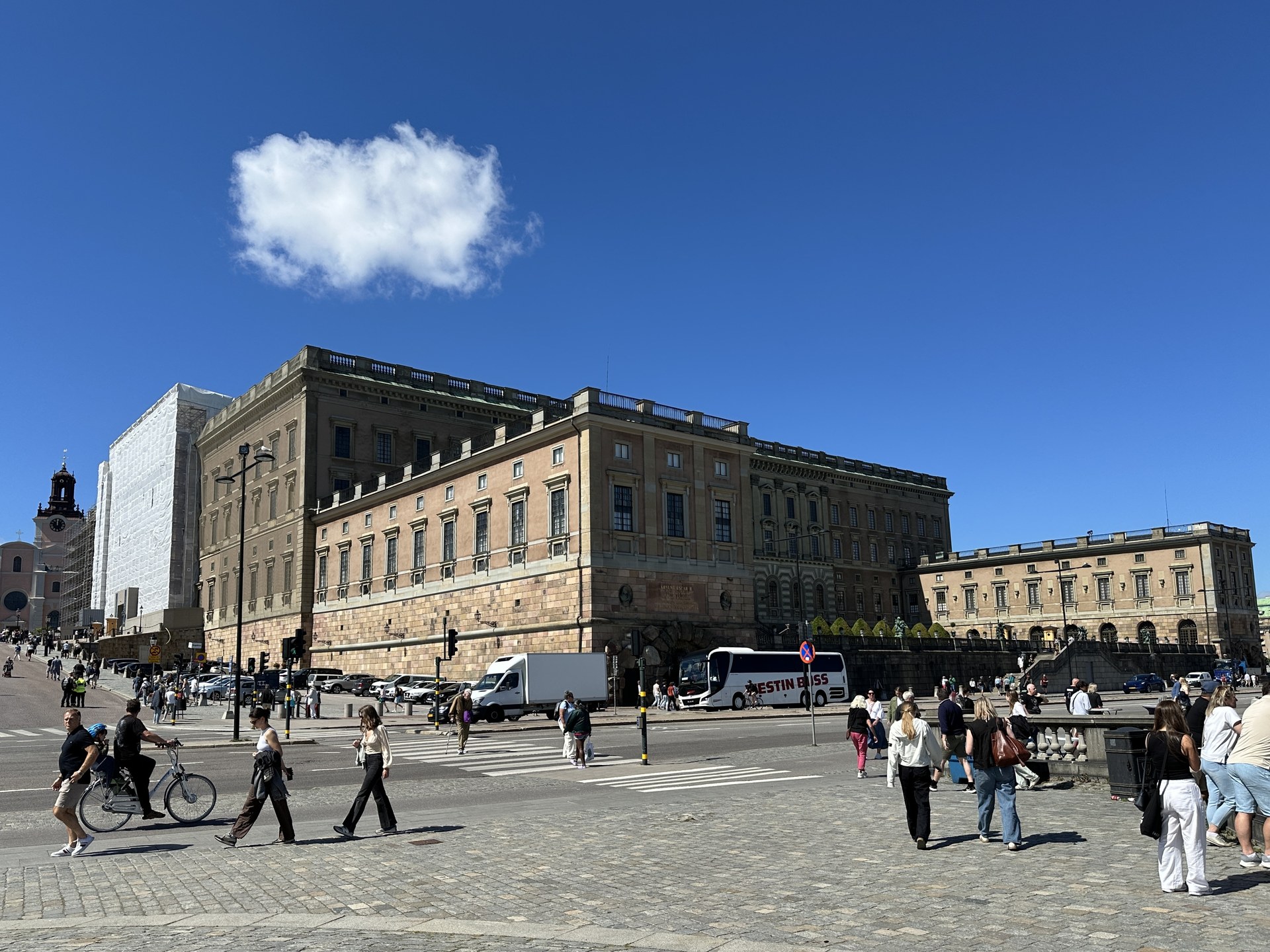
The Royal Palace of Stockholm (Kungliga slottet) is the official residence of the Swedish monarch and the seat of the Swedish royal household’s official functions. It is not a private home in the usual sense — the King and Queen live at Drottningholm — but the building where state ceremonies, receptions and official duties take place, and several of its wings are open to the public as museums.
Where is the palace, and is it still in use?
The palace stands on Stadsholmen, the island that forms the core of Gamla Stan, Stockholm’s old town, on the site of the medieval Tre Kronor castle. It is still very much in use. It houses the offices of the Swedish royal household, hosts state visits and official receptions, and is the venue for events tied to the monarchy’s constitutional role, even though the King’s family resides at Drottningholm Palace outside the city.
The current building replaced the earlier Tre Kronor (“Three Crowns”) castle, which burned down in 1697. Reconstruction began under the architect Nicodemus Tessin the Younger, working in an Italian-influenced Baroque style, and continued in stages through the 18th century. The result is one of the largest palace buildings in Europe still functioning as a working royal residence, with a footprint the Swedish royal court’s own materials describe as running to several hundred rooms.
What can actually be visited inside?
The palace is organised as several separately ticketed sections rather than one single museum, and the Swedish royal court manages access and hours through its own site. Broadly, the public areas fall into these groups:
- The Royal Apartments (De Representationsvåningarna) — the state rooms used for official functions, including ceremonial halls, the Hall of State and rooms tied to the order of chivalry.
- The Treasury (Skattkammaren) — the regalia store.
- The Tre Kronor Museum — an exhibition built around the remains of the medieval castle that stood on the site before the 1697 fire.
- Gustav III’s Museum of Antiquities (Antikmuseum) — a collection of classical sculpture assembled by the king on his travels in Italy in the 1780s.
- The Royal Armoury (Livrustkammaren) — technically a separate institution, occupying part of the palace’s ground floor.
Not every section is open on every day, and some are seasonal — the royal court’s own site is explicit that opening patterns change between summer and winter, and that state functions can close rooms at short notice. This is worth checking directly rather than assuming a fixed timetable.

What is the Treasury (Skattkammaren)?
The Treasury holds the regalia of the Swedish monarchy — crowns, sceptres, orbs and ceremonial swords used historically at coronations and now displayed as state property rather than personal possessions of the monarch. Sweden last used a full coronation ceremony in the 19th century; the objects remain part of the constitutional apparatus of the monarchy and are shown as historical and ceremonial artefacts. The vault sits below the palace’s state apartments, a placement the royal court’s own descriptions tie directly to the objects’ security and symbolic weight.
What is the Tre Kronor Museum?
The Tre Kronor Museum occupies the surviving cellar vaults of the medieval castle that predates the current palace. It is built around the physical remains of that earlier building — stonework, foundations and salvaged fittings — and around objects recovered after the 1697 fire that destroyed most of it. It functions as the palace’s own account of its site’s history before the Baroque rebuilding, distinct from the ceremonial rooms above it.
What is the Royal Armoury (Livrustkammaren)?
The Royal Armoury is Sweden’s oldest museum, tracing its holdings back to armour and weapons kept as royal property from the 16th century onward. It occupies part of the palace but is administered separately, under Sweden’s national museums structure rather than as a royal-household exhibit. Its collection includes ceremonial and functional armour, ceremonial coaches, and clothing connected to specific Swedish monarchs, including garments associated with Gustav II Adolf and Gustav III. Its own published materials position it as a collection of political and military history as much as royal decoration — closer in spirit to institutions such as the Historiska Museet than to a palace gift shop.
What is the changing of the guard?
The changing of the guard at the palace is a recurring military ceremony — the Swedish Armed Forces’ Guard, not a costumed re-enactment — that takes place on a recurring schedule outside the palace’s outer courtyard. It marks the handover of the guard responsible for the palace and other royal properties, and it draws crowds in the outer courtyard facing the water. Timing varies by season and by day of the week, and the Swedish Armed Forces publish the current pattern on their own site; it is not fixed enough to state a specific time here with any confidence.
How does the palace fit with the rest of Gamla Stan?
The palace anchors the northern edge of Gamla Stan, facing the water across from Skeppsholmen and close to Stockholm’s cathedral, Storkyrkan. It sits a short walk from Stortorget, the old town’s main square and the site of the 1520 Stockholm Bloodbath, which places the palace within the same compact medieval street grid rather than as an isolated monument. Anyone exploring the wider old town on foot will pass close to it more or less by default; it is not a detour.
For context on how the palace compares with Stockholm’s other preserved interiors, the Hallwyl Museum offers a useful contrast — a private late-19th-century townhouse preserved intact, rather than a working state building still in ceremonial use. Both fall under Stockholm’s broader pattern of house-museums and preserved interiors, alongside institutions covered in the site’s museums and galleries archive.
Does a museum pass or free-entry scheme cover the palace?
Sweden’s national free-entry policy for state museums, which the site covers separately in its explainer on how free entry works at Sweden’s national museums, applies to institutions under the national museums framework — which is why the Royal Armoury, as a nationally administered collection, can fall under different terms than the Royal Apartments or Treasury, which are managed by the royal household itself. The two are genuinely separate ticketing systems housed in the same building, and combined tickets are sometimes offered directly by the palace — again, a detail to confirm on the official site rather than assume.
Is the palace worth treating as a single visit?
Because the Royal Apartments, Treasury, Tre Kronor Museum, Antikmuseum and Royal Armoury are separately curated and separately ticketed, a single ticket rarely covers everything, and each section rewards a different kind of attention — ceremonial rooms, medieval remains, classical sculpture, and military and court history are not the same visit. Anyone planning a day around Gamla Stan’s landmarks might reasonably treat the palace as more than one stop rather than one, in the same way the city’s wider landmarks and sights often turn out to be several distinct things sharing an address. For orientation on the surrounding district itself, the site’s neighbourhoods archive covers how Gamla Stan and its neighbours are organised.
Current hours, ticket prices and seasonal closures for all sections of the palace are published directly by the Swedish royal court at kungligaslotten.se, and the Royal Armoury publishes its own separately at livrustkammaren.se. Because state functions can close rooms without much notice, checking directly before a visit is the only reliable approach.
Access Stockholm is an independent guide written from published, checkable sources. We have not visited the places described here and we do not publish personal recommendations or invented ‘local favourites’ — where something is singled out as notable, we say who says so. Opening times, fares, closures and prices change at short notice, so treat everything here as a starting point and confirm with the museum, operator or venue directly before building a day around it. We give no advice on visas, insurance, health or safety; use your own government’s official guidance for those.