What is Storkyrkan?
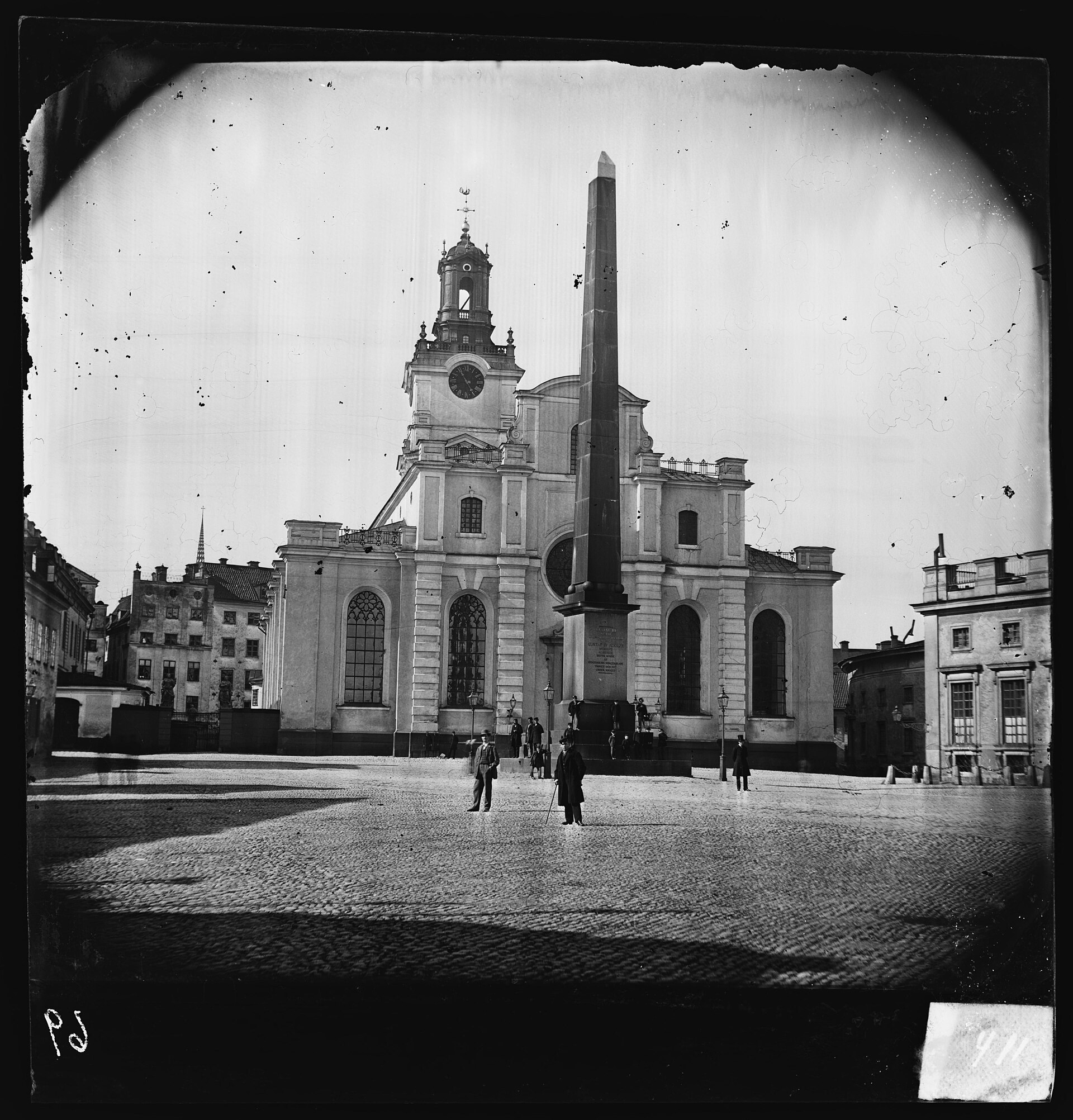
Storkyrkan is Stockholm’s oldest church, standing in Gamla Stan next to the Royal Palace. Formally named Sankt Nikolai kyrka, it has been the city’s cathedral (domkyrka) since 1942 and remains an active parish church of the Church of Sweden, used for royal weddings, christenings and state services as well as ordinary worship.
How old is Storkyrkan, and how has it changed?
The church is first mentioned in written records from 1279, though a place of worship on the site is generally believed to be older still. What stands today is largely the product of a Gothic rebuilding carried out through the 15th century, when the original structure was widened and given the tall brick vaulting still visible inside.
The exterior seen from Stortorget and Slottsbacken today is largely 18th-century: the current baroque façade was added in the 1740s under the architect Johan Eberhard Carlberg, wrapping a much older core in a newer skin. This layering — medieval interior, baroque exterior — is typical of buildings in Gamla Stan, where centuries of rebuilding sit on top of one another rather than replacing what came before.
What is inside Storkyrkan?
The best-known object inside is a large wooden sculpture of Saint George and the Dragon (Sankt Göran och draken), carved in 1489 by the German sculptor Bernt Notke. It was commissioned by the regent Sten Sture the Elder to commemorate the Swedish victory over Danish forces at the Battle of Brunkeberg in 1471, and it remains one of the most significant surviving works of late-medieval Nordic sculpture.
Alongside it hangs the Vädersolstavlan, or “Sun Dog Painting” — the oldest known depiction of Stockholm’s skyline. The painting on display is a 1636 copy by Jacob Elbfas; the original, from 1535, is lost, but the copy is treated as a historical record of how the city looked in the 16th century.
- Elaborately carved royal pews (kungliga bänkarna), used by the monarch and court during services.
- A baroque pulpit and a silver altar among the church’s fittings.
- Gothic brick vaulting and pillars from the 15th-century rebuilding.
- A working organ and a programme of church music and concerts held through the year.
Why does Storkyrkan matter to Sweden’s monarchy?
Storkyrkan has hosted coronations, royal weddings and royal christenings for centuries, owing to its position immediately beside the Royal Palace. Sweden’s last coronation, of Oscar II, took place there in 1873; coronations were later discontinued as a constitutional ceremony. More recently, the marriage of Crown Princess Victoria and Daniel Westling was held at Storkyrkan in 2010. Current royal ceremonial arrangements are documented by the Swedish Royal Court on its own site, kungahuset.se.
The church’s proximity to the palace is not incidental — the two buildings, along with Stortorget, form the historic civic and religious core of medieval Stockholm, predating the wider expansion of the city onto the surrounding islands.
Is Storkyrkan a cathedral or a church?
It is both. Storkyrkan functions as an ordinary parish church — Sankt Nikolai — serving its Gamla Stan congregation, but it has also been the domkyrka, or cathedral, of the Diocese of Stockholm since 1942, making it the seat of the Bishop of Stockholm within the Church of Sweden.
This dual role is common among Swedish cathedrals: the “cathedral” designation describes an administrative and ceremonial function layered onto a building that continues to operate as a working local church, rather than a separate category of structure.
Where is Storkyrkan, and how does it fit into Gamla Stan?
Storkyrkan stands on Trångsund, wedged between the Royal Palace and Stortorget, at what is effectively the highest and oldest point of Gamla Stan’s street layout. Anyone walking between the palace and the square passes directly alongside it.
Because of this position, Storkyrkan is usually visited as part of a wider pass through the old town rather than as an isolated stop — alongside the Royal Palace, the site of the 1520 Stockholm Bloodbath at Stortorget, and the medieval remains documented at the Medeltidsmuseet, which sits beneath the nearby Riksdag approach and explains what lies under the streets of this part of the city.
Can visitors go inside, and what does a visit involve?
Storkyrkan is generally open to visitors outside of services, though as an active church it closes to the public during weddings, funerals, concerts and regular worship, and its hours vary by season. Because these details change, readers should confirm current opening times, any entry arrangements and the concert schedule on the parish’s own site, svenskakyrkan.se/storkyrkan, rather than relying on a fixed figure here.
There is no dress code beyond the ordinary expectations of a working church, and photography policies can differ depending on whether a service or event is underway. Visitors intending to see the Notke sculpture or the Vädersolstavlan specifically should check ahead if visiting outside standard hours, since both are part of the church’s permanent fittings rather than a rotating display.
How does Storkyrkan relate to Stockholm’s other historic sights?
Storkyrkan is usually grouped with the handful of buildings that define the oldest layer of the city — the palace, the square, and the surviving medieval street pattern of Gamla Stan — rather than with the newer museum district on Djurgården. Readers building a broader picture of the old town’s history can find related context in the site’s coverage of Gamla Stan’s age and layout, the Royal Palace’s rooms and functions, and the wider Landmarks & Sights archive, which covers other fixed monuments across the city in the same register — what they are, not what they feel like.
For readers more interested in how Stockholm’s districts function day to day, the Neighbourhoods hub covers Gamla Stan and the surrounding areas as living parts of the city rather than as a single historic set piece, and the Museums & Galleries archive covers the collections — including the medieval material at the Medeltidsmuseet and the Historiska museet’s Gold Room — that fill in the periods Storkyrkan itself spans.
Access Stockholm is an independent guide written from published, checkable sources. We have not visited the places described here and we do not publish personal recommendations or invented ‘local favourites’ — where something is singled out as notable, we say who says so. Opening times, fares, closures and prices change at short notice, so treat everything here as a starting point and confirm with the museum, operator or venue directly before building a day around it. We give no advice on visas, insurance, health or safety; use your own government’s official guidance for those.
Featured image: Photo by Johan Bakker, source, CC BY-SA 4.0
