Medeltidsmuseet — the Museum of Medieval Stockholm — is a museum built directly around archaeological remains uncovered beneath the city centre in the late 1970s. It sits underground, beneath the bridge Norrbro, between Gustav Adolfs Torg and the Riksdag (the Swedish parliament building). Rather than removing what was found, the city built the museum in place, around a stretch of medieval town wall, a merchant ship, and the foundations of a medieval hospital.
What is the Medeltidsmuseet exactly?
Medeltidsmuseet is a municipal history museum operated as part of Stockholm’s city museum group, focused specifically on the medieval and early-modern city — roughly the 13th through 16th centuries. Its subject is Stockholm before it became the planned, expanding capital that later museums like the Nordiska museet document. Where the Nordiska museet covers Swedish life from the 16th century onward across the whole country, Medeltidsmuseet is narrower and more local: it is about the walled town on the water, and it exists because that town’s physical remains turned up, intact, a few metres below street level.
Why is a museum built underground near the Riksdag?
The location is not decorative. In 1978, construction crews began digging an underground car park for parliamentary staff in the open space beneath Norrbro, in the strip of land and water between Gustav Adolfs Torg and Helgeandsholmen — the small island on which the Riksdag stands. The dig hit substantial, well-preserved medieval structures almost immediately.
Work stopped. The city and national heritage authorities carried out a large excavation between 1978 and 1980, and the decision that followed was to keep the finds where they were discovered and build a museum around them instead of completing the garage as planned. Medeltidsmuseet opened to the public in 1986, and its lower galleries still sit at the depth and, in places, the exact footprint of the original 1978 excavation trench.
What was actually found under the city?
The excavation produced several distinct groups of remains, and the museum is structured around them rather than around a chronological narrative told through labels and glass cases alone.
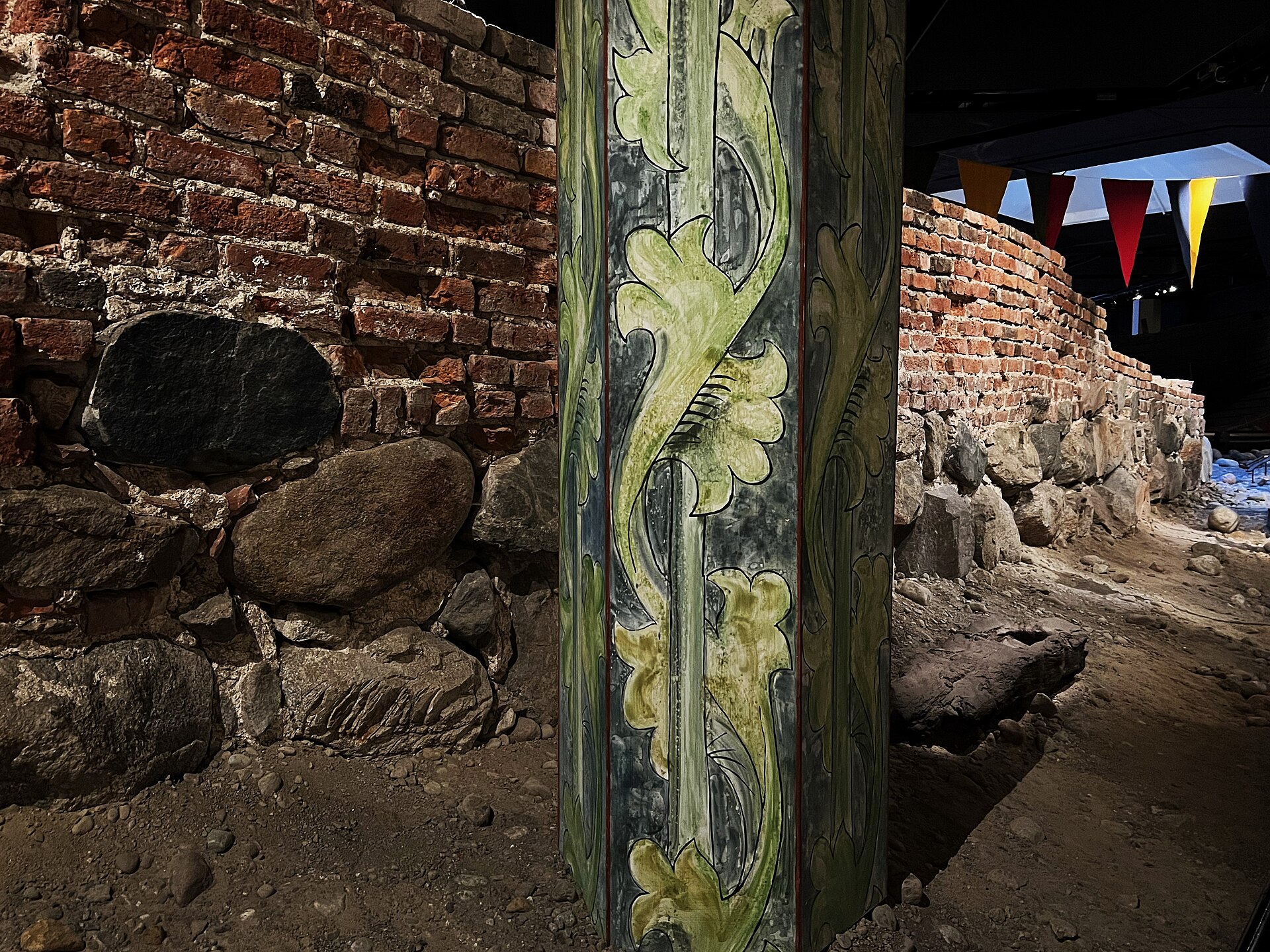
- A stretch of Stockholm’s town wall — a section of the fortification built on royal order in the 1530s under Gustav Vasa, during a period when the city was re-fortifying against threats from the sea and from rival Nordic powers. Visitors walk alongside a real, in-place segment of it rather than a reconstruction.
- The foundations of Helgeandshuset, a medieval hospital and hospice that gave the neighbouring island Helgeandsholmen (“Isle of the Holy Spirit”) its name. Helgeandshuset cared for the sick, the poor and the elderly from the 14th century, and its stone footings were among the clearest structures the 1978 dig exposed.
- Timber quay structures and pilings from the medieval harbour that once ran along this shoreline, evidence of how close the working waterfront came to what is now dry, paved central Stockholm.
- Human remains from a burial ground associated with the hospital site, later examined and displayed as part of the museum’s account of everyday life, illness and death in the medieval town.
- A well-preserved medieval cargo ship, discussed separately below, since it is the single object most closely identified with the museum.
None of this was expected before 1978. Stockholm’s medieval core, Gamla Stan, was known to sit on old foundations, but nobody digging a car park anticipated finding an intact defensive wall and a hospital’s stone base a few steps from the seat of government.

What is the Riddarholm ship?
The museum’s best-known single object is a merchant vessel generally referred to as the Riddarholm ship (Riddarholmsskeppet), a wooden cargo ship dated to the early 16th century, found near the neighbouring island of Riddarholmen. It is a working trading vessel of the kind that would have moved goods around the Baltic and in and out of Stockholm’s harbour during the period the town wall outside it was built.
It is a smaller, more utilitarian counterpart to the warship displayed at the Vasa Museum across the water on Djurgården — where the Vasa is a royal warship that sank on its maiden voyage in 1628, the Riddarholm ship is an ordinary commercial vessel from roughly a century earlier, and it survives because it, too, ended up buried in harbour sediment rather than lost at sea.
What does the museum look like to visit today?
Medeltidsmuseet’s own displays describe a layout that moves visitors through reconstructed streets, workshops and a stretch of harbourfront built at roughly the scale of the original town, alongside the genuine remains — the wall, the hospital foundations, the ship — left in the positions they were excavated in. The museum’s stated approach, per its own materials, is to let visitors walk through a model of the medieval town while standing next to authentic 16th-century structure rather than a replica of it.
This puts it in a different register from a conventional object-and-label museum. It has more in common with an in-situ archaeological site that happens to have a roof over it than with, say, the collection-driven approach of the Nationalmuseum or the contemporary programming of Moderna Museet. The comparison worth making within Stockholm’s own museum landscape is with Skansen, which also reconstructs a lived environment rather than simply displaying artefacts — though Skansen moved historic buildings from across Sweden to one hill on Djurgården, while Medeltidsmuseet builds its reconstruction around remains that never left the ground they were found in.
Is entry free, and what should a reader check before going?
Medeltidsmuseet is one of the group of municipally run Stockholm museums, and free or reduced entry policies for the city’s own museums have applied at various points — but entry conditions, opening days and any temporary closures for building work are exactly the kind of detail that changes without much notice. Readers should confirm current entry terms and opening hours directly on Medeltidsmuseet’s own website before planning a visit, rather than relying on a fixed figure repeated elsewhere online.
The museum is easy to combine with a walk around Gamla Stan and the Riksdag building above it, and its entrance sits at street level near Gustav Adolfs Torg — it is genuinely underground once inside, not merely below-grade.
How does this fit for someone who already lives in Stockholm?
For residents, Medeltidsmuseet functions less as a headline attraction and more as a specific answer to a specific question: what was actually here before the planned, orderly city that exists now. It is a useful stop for anyone trying to understand why Gamla Stan’s street pattern is the shape it is, why Helgeandsholmen carries that name, or why a car park under the Riksdag was never finished as originally designed.
It also sits within a wider pattern worth knowing if visiting more than one museum in a short period: several of Stockholm’s municipal and national museums, including Medeltidsmuseet, periodically adjust free-entry windows and combined-ticket arrangements, and these are announced on the individual institutions’ own sites rather than through a single central listing. The Museums & Galleries section on this site covers the city’s major collections — including the Nobel Prize Museum, Fotografiska and the ABBA Museum — for readers building a longer itinerary, but for opening times and current admission terms, the operator’s own site remains the only reliable source.
Access Stockholm is an independent guide written from published, checkable sources. We have not visited the places described here and we do not publish personal recommendations or invented ‘local favourites’ — where something is singled out as notable, we say who says so. Opening times, fares, closures and prices change at short notice, so treat everything here as a starting point and confirm with the museum, operator or venue directly before building a day around it. We give no advice on visas, insurance, health or safety; use your own government’s official guidance for those.
Featured image: Photo by Sinikka Halme, source, CC BY-SA 4.0
