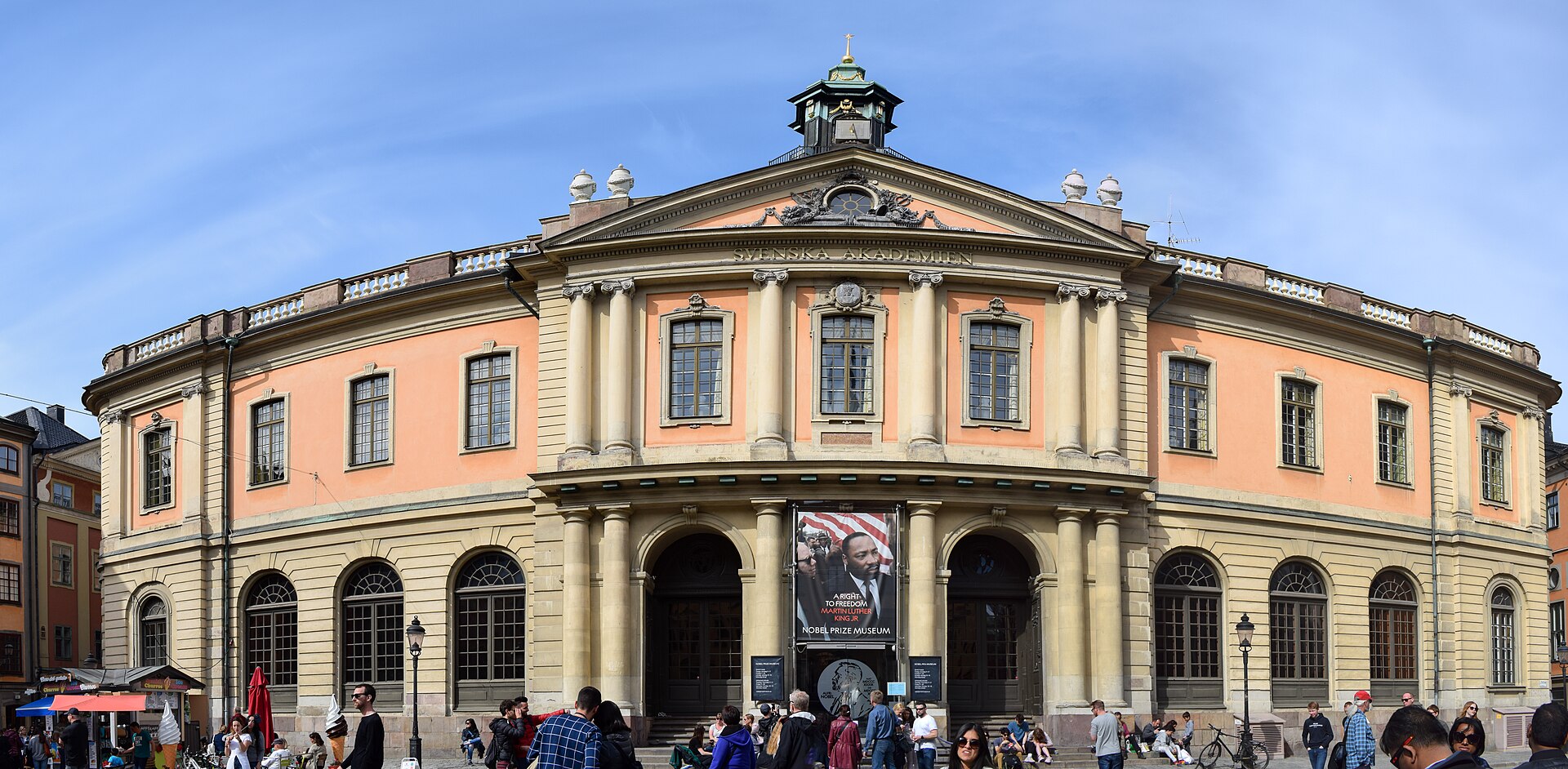
The Nobel Prize Museum is a museum in Stockholm’s old town dedicated to the history and the recipients of the Nobel Prize. It occupies the former Stock Exchange Building on Stortorget, the main square of Gamla Stan, and its exhibitions explain how the prizes came about, who has won them, and what winning one actually involves — through objects donated by laureates themselves, according to the museum’s own site, nobelprizemuseum.se.
Where is the Nobel Prize Museum located?
The museum stands on Stortorget, the central square of Gamla Stan, Stockholm’s medieval old town on the island of Stadsholmen. Stortorget is also the site of the Stockholm Bloodbath of 1520 and is ringed by the tall, narrow gabled houses that define Gamla Stan’s street pattern. The museum’s position on this square puts it a short walk from the Royal Palace and from Storkyrkan, the cathedral where Swedish coronations historically took place.
What building does the museum occupy?
The museum is housed in the Börshuset, the former Stockholm Stock Exchange building, completed in the late 18th century. The building’s upper floor has, since the 18th century, also been home to the Swedish Academy — the body that awards the Nobel Prize in Literature and that also administers the Swedish dictionary and language prizes. This means the museum shares its address with one of the six institutions actually responsible for choosing Nobel laureates, though the museum and the Academy are separate organisations.
What does the museum actually display?
The core of the museum is a set of exhibitions built around the idea of “creative minds” — the people who have won the prize and the circumstances of their discoveries or work. According to the museum’s own descriptions of its collection, exhibits include:
- Short filmed portraits of individual laureates describing their work in their own words.
- Objects donated by laureates themselves — each recipient is invited to contribute an item connected to their prize-winning work, and these form rotating display cases throughout the museum.
- A permanent chair-signing tradition: laureates who visit the museum’s café sign the underside of a chair, a practice the museum documents as ongoing since the institution opened.
- Material on Alfred Nobel himself — the Swedish chemist and industrialist whose 1895 will established the prizes — including his own account of why he created them.
The museum shop and café operate within the same building, and the café is the specific site of the chair-signing practice noted above.

How does the museum cover the different Nobel Prize categories?
Alfred Nobel’s 1895 will established prizes in five fields: Physics, Chemistry, Physiology or Medicine, Literature, and Peace. A sixth prize, the Sveriges Riksbank Prize in Economic Sciences in Memory of Alfred Nobel, was established separately by Sweden’s central bank in 1968 and is often referred to informally as the Nobel Prize in Economics, though it is administered under different rules from the original five. The museum’s exhibitions treat all six categories together, since laureates across every field are represented in the object displays and short films described above.
One detail that regularly surprises visitors unfamiliar with the prize’s structure: the Peace Prize is not decided or awarded in Stockholm at all. It is selected by the Norwegian Nobel Committee and awarded in Oslo, a separation set out in Nobel’s own will. The Stockholm museum still covers Peace Prize laureates in its collection, but the ceremony itself takes place in Norway.
Why was the museum created in 2001?
The museum opened in 2001, the year marking the centenary of the first Nobel Prizes, which were awarded in 1901. It was established by the Nobel Foundation, the private organisation set up under Nobel’s will to manage the prize funds and coordinate the prize-awarding institutions, as a permanent public-facing counterpart to the annual ceremonies. The Foundation’s own materials describe the museum as intended to make the prize’s history and its laureates’ work accessible outside of the single evening each December when the Stockholm prizes are formally awarded.
Was a larger Nobel Center ever planned?
Yes. A significantly larger building, to be called the Nobel Center, was proposed for a waterfront site at Blasieholmen, near the Royal Palace and the Grand Hôtel. The design, by architect David Chipperfield, was intended to give the museum a purpose-built home with more exhibition space than the Stortorget building allows. The project met sustained local opposition over its scale and its effect on the historic waterfront, and Stockholm’s city council withdrew support for the Blasieholmen site in 2018. As a result, the museum remains in the Börshuset on Stortorget, and any future move would be reported through the museum’s own channels rather than assumed from the cancelled plan.
How does the Nobel Prize Museum fit alongside Stockholm’s other museums?
The museum sits within a dense cluster of national collections that together give Stockholm an unusually high concentration of museums for its size, a pattern covered more broadly on the site’s Museums & Galleries hub. Where the Nobel Prize Museum is about a single institution and its history, other Stockholm museums cover different territory entirely: Nationalmuseum holds Sweden’s national collection of fine art and design, while Moderna Museet focuses on modern and contemporary art. The Vasa Museum, across the water on Djurgården, centres on a single 17th-century warship, and Skansen is an open-air museum of historical Swedish buildings and traditional life on the same island.
For visitors building an itinerary around Gamla Stan specifically, the Nobel Prize Museum is one of relatively few major museums actually inside the old town’s street grid, most of the larger national collections being on Djurgården or in the newer parts of the city centre.
What should residents know that visitors might not?
For anyone living in Stockholm, the museum’s Stortorget location means it sits inside one of the most heavily used public squares in the city, one that hosts a Christmas market each December and functions as a pedestrian route through Gamla Stan year-round. That foot traffic, combined with the square’s role in the annual Nobel Prize ceremonies each December — when laureates and dignitaries process through central Stockholm before the formal award ceremony at Konserthuset — means the immediate area around the museum is busiest in the days surrounding the prize announcements and the December ceremony itself. Outside that period, the square and the museum operate at a considerably quieter pace.
Stockholm residents with an interest in the sciences or the humanities more broadly will also find the museum’s laureate-object displays change periodically as new prizes are awarded each October, meaning the exhibition is not static from one year to the next in the way a purely historical collection would be.
What should a visitor confirm before going?
Opening hours, admission prices, and any age-based or seasonal exceptions are set and changed by the museum itself, and should be confirmed on its own site before a visit rather than assumed from any secondhand listing. The museum’s café and shop operate on the same premises as the exhibition spaces, and any special exhibitions or temporary closures — including around the December prize period, when the building may be used for related events — are also announced through the museum’s own channels.
Readers researching entry requirements or general travel guidance for Sweden should consult their own government’s official travel advice rather than any single museum’s website, since that falls outside what a museum operator is positioned to confirm.
For comparison with Stockholm’s other single-subject museums built around one collection or one historical episode, the site’s coverage of the ABBA Museum and of Fotografiska, the city’s photography museum, and of the Nordiska Museet’s collections on Swedish cultural history, gives a sense of how differently these institutions are organised even within a relatively small city centre.
Access Stockholm is an independent guide written from published, checkable sources. We have not visited the places described here and we do not publish personal recommendations or invented ‘local favourites’ — where something is singled out as notable, we say who says so. Opening times, fares, closures and prices change at short notice, so treat everything here as a starting point and confirm with the museum, operator or venue directly before building a day around it. We give no advice on visas, insurance, health or safety; use your own government’s official guidance for those.
Featured image: Photo by Hajotthu, source, CC BY 3.0
