What is Fotografiska?
Fotografiska is a privately owned museum of photography in Stockholm, housed in a former customs building on the Södermalm waterfront. It opened in 2010 and runs a programme of rotating photography exhibitions rather than holding a single fixed permanent collection. It is not a national or state museum — it is a commercial, ticketed institution.
Where is Fotografiska located, and what is the building?
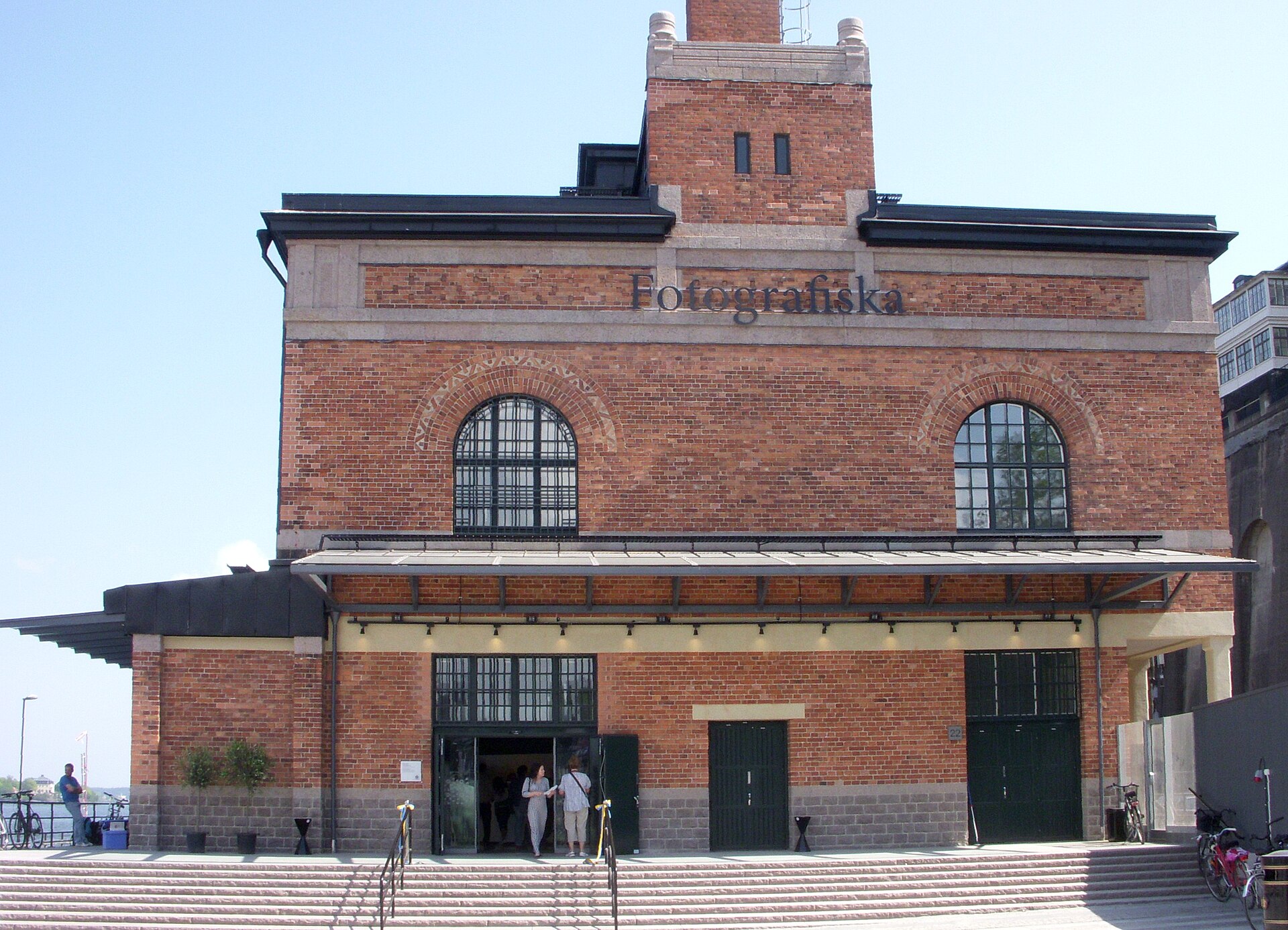
Fotografiska occupies a building at Stadsgårdshamnen, on the harbour side of Södermalm, close to Slussen. The building was constructed in 1906 as a customs house, designed by the architect Ferdinand Boberg in the Art Nouveau style associated with several of Stockholm’s early-twentieth-century industrial and civic buildings. Its brick facade and turreted profile are recognisable along the Stadsgården quay, where Baltic ferries and cruise ships also dock.
The building was converted for museum use when Fotografiska opened, retaining much of its industrial-era shell — high ceilings and large floor plates originally built for customs storage now serve as gallery space.
Does Fotografiska hold a permanent collection?
No. Fotografiska does not maintain a standing permanent collection in the way a national museum does. Its programme is built around temporary exhibitions — typically several running at once, drawn from named photographers and rotated through the year. This is a structural difference from an institution such as Nationalmuseum, which holds and displays a fixed national collection of fine art and design.
Because the exhibition schedule changes, any specific list of what is on view at a given moment is perishable information. Fotografiska publishes its current and upcoming exhibitions on its own website, and that is the source to check before visiting.
What has Fotografiska exhibited in the past?
Since opening, Fotografiska’s programme has included exhibitions built around internationally known photographers, alongside contemporary and emerging names, documentary photography, and fashion and portrait work. The museum’s own archive of past exhibitions, published on its site, is the durable record of what has actually shown there — a more reliable source than any second-hand list, since exhibitions open and close on a rolling basis rather than a fixed annual calendar.

Is Fotografiska a state museum, and how is it funded?
Fotografiska is a private, for-profit company, not a state institution. It was founded by the brothers Jan and Per Broman and operates on ticket revenue, membership, corporate events, and its restaurant and bar, rather than public subsidy. This puts it in a different category from Sweden’s state-funded museums, several of which — including Nationalmuseum, Moderna Museet, and the Nordiska Museet — are publicly funded institutions with free or reduced admission under national museum policy at various points.
Because Fotografiska is privately run, its admission is paid at the door or online, and pricing, membership terms, and any discounted access are set by the museum itself rather than by a public museum-free scheme. Current ticket prices should be confirmed on Fotografiska’s own site rather than assumed from any published figure, since these change.
What else is inside the building?
The Fotografiska building also contains a restaurant and bar, run as part of the same commercial operation as the museum, occupying upper floors with views over Stadsgårdshamnen and the water toward Djurgården and central Stockholm. This is a durable feature of the venue’s design rather than a recommendation — the museum’s own site describes its food and beverage operation as part of the same building, with separate opening hours from the galleries.
Fotografiska is also used as an events and conference venue, a use that follows from its private ownership: the building can be booked for functions outside standard visiting hours, again a matter for the operator’s own site to confirm.
Are there other Fotografiska museums elsewhere?
Fotografiska has expanded beyond Stockholm since its 2010 opening, operating under the same brand in other cities as a network of separately branded but affiliated venues, including a location in New York. The precise list of current international locations changes as the company opens and closes sites, so it is worth checking Fotografiska’s own site for an up-to-date roster rather than relying on any fixed list. The Stockholm site was the original and remains the flagship building.
How do visiting hours and tickets work?
Fotografiska is known for running later opening hours than many of Stockholm’s national museums, several of which close in the late afternoon. Extended evening opening is a structural feature of how the museum positions itself — alongside its restaurant and bar trade — rather than a fixed schedule that can be quoted reliably here. Hours vary by day and by season, and should be checked on Fotografiska’s own site immediately before a visit.
Tickets are sold for timed or general entry and can typically be bought online in advance or at the door, with membership options for repeat visitors. Since Fotografiska is privately operated, it does not participate in any citywide museum pass in the way some state museums do — any pass or discount scheme should be verified directly with the museum.
How does Fotografiska compare to other Stockholm museums?
Fotografiska’s model — private ownership, rotating exhibitions, no fixed permanent collection, a paid restaurant and bar built into the visit — sets it apart from most of the other major museums covered in Stockholm’s museum landscape. State-funded institutions such as Nationalmuseum and Moderna Museet hold standing collections that visitors can expect to see across repeat visits, even as temporary shows rotate alongside them. Open-air and cultural-history museums such as Skansen and the Nordiska Museet document Swedish life and history through fixed holdings rather than a changing photography programme.
The Vasa Museum is a further point of contrast: it is built entirely around a single object, the salvaged seventeenth-century warship Vasa, and holds no rotating exhibition programme at all. Fotografiska sits at the opposite end of that spectrum — no single fixed centrepiece, but a continuously changing set of shows. Readers comparing Stockholm’s museums by type can find the wider set on the site’s Museums & Galleries hub.
How do you get to Fotografiska?
Fotografiska sits on the Stadsgårdshamnen waterfront on Södermalm, within walking distance of Slussen, which is served by the Stockholm metro (Slussen station, on the red and green lines) and by numerous bus routes. It is also reachable on foot from Gamla Stan and from central Södermalm, and by some seasonal boat services that call at the Stadsgården quay. As with all transport detail in Stockholm, current routes and any service changes around Slussen — an area that has been subject to long-running redevelopment — are best checked against SL, the regional transport operator’s own site, before travelling.
Access Stockholm is an independent guide written from published, checkable sources. We have not visited the places described here and we do not publish personal recommendations or invented ‘local favourites’ — where something is singled out as notable, we say who says so. Opening times, fares, closures and prices change at short notice, so treat everything here as a starting point and confirm with the museum, operator or venue directly before building a day around it. We give no advice on visas, insurance, health or safety; use your own government’s official guidance for those.
Featured image: Photo by Bengt Oberger, source, CC BY-SA 4.0
