Nationalmuseum is Sweden’s national museum of fine art and design, standing on the Blasieholmen peninsula in central Stockholm. It holds the state’s collection of paintings, sculpture, drawings, prints, furniture and decorative arts spanning roughly the 16th century to the early 20th, alongside a modern design collection reaching into the present.
Where is Nationalmuseum, and what is the building?
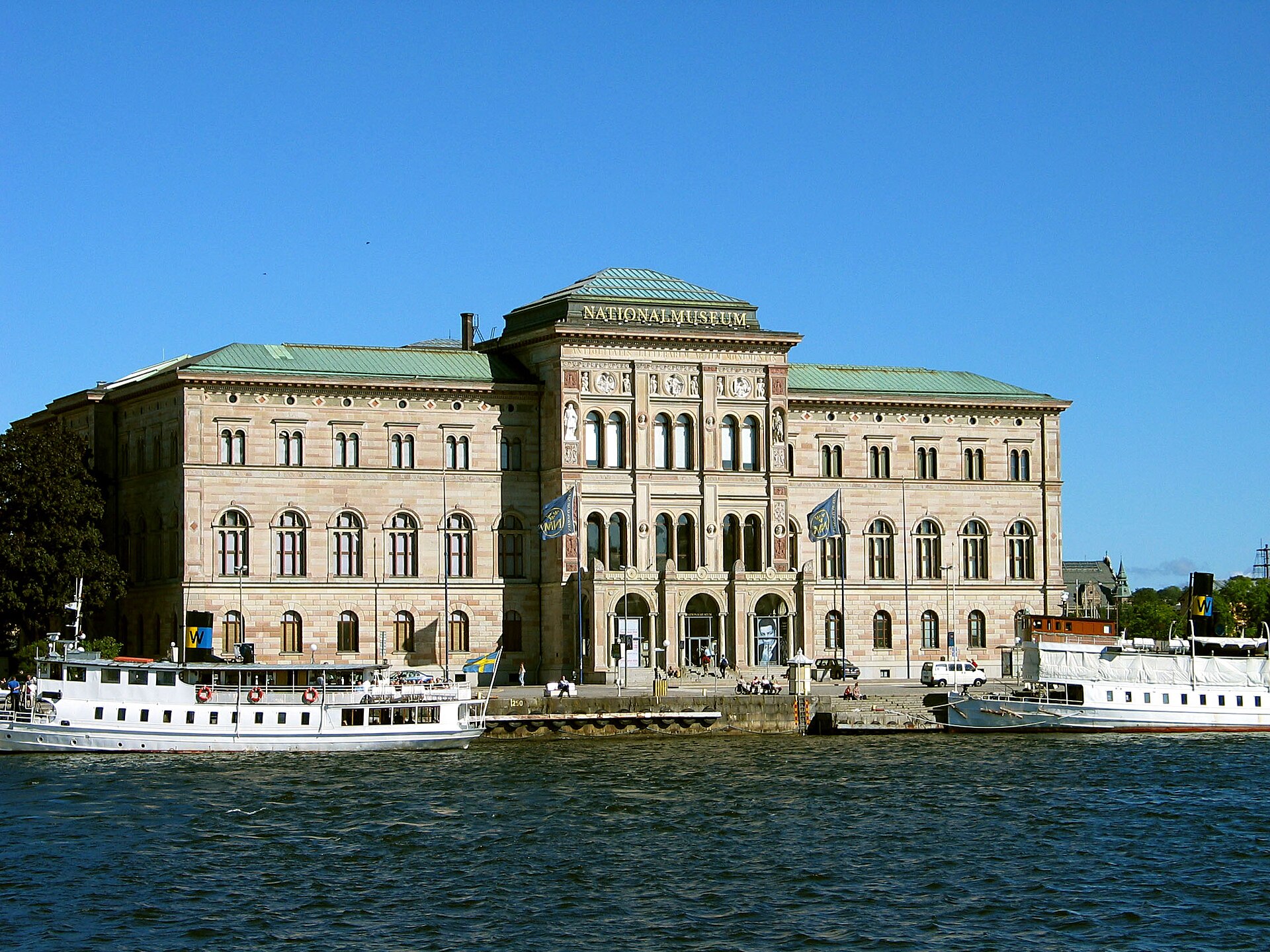
The museum occupies a purpose-built structure on Blasieholmen, a small peninsula between the waters of Norrström and Nybroviken, facing the Royal Palace across the water. The building was designed by the German architect Friedrich August Stüler in a Venetian- and Florentine-influenced Renaissance style, and it opened to the public in 1866, replacing older royal and academy collections that had previously been shown elsewhere in the city.
The building itself is a listed monument and part of the reason the museum is worth understanding as more than a gallery: it was conceived from the start as a national showcase, with grand staircases, a domed stairwell hall, and interior decoration commissioned specifically for the space. A major renovation closed the museum for several years in the 2010s; it reopened in October 2018 with reworked galleries, improved climate control, and a rehung collection. Details of current opening hours and any ongoing works are best confirmed on the museum’s own site, nationalmuseum.se.
What does the Nationalmuseum collection actually contain?
The collection is built around four broad areas: paintings and sculpture, works on paper (drawings and prints), and design and applied arts. Nationalmuseum’s own account of its holdings describes several hundred thousand objects in total, though only a portion is on display at any time — readers wanting an exact current figure should check the museum’s own published collection statistics rather than rely on a fixed number here, since acquisitions and cataloguing continue.
Chronologically, the fine-art collection runs from around 1500 to about 1900, after which Swedish and international modern art is the domain of a separate institution — Moderna Museet, discussed further below. Design and applied arts, by contrast, are not cut off at 1900; the museum’s design galleries extend into 20th- and 21st-century Swedish design, including furniture, ceramics, glass and textiles.
Which artists define the old masters collection?
The painting galleries include Dutch, Flemish, Italian, French and Spanish works from the 16th to 19th centuries. Nationalmuseum’s published collection highlights name works by Rembrandt, Rubens, El Greco and Frans Hals among the older Northern and Southern European holdings, and a group of French 19th-century paintings that includes Renoir, Gauguin, Degas and Cézanne. The museum also holds one of Sweden’s best-known 18th-century portraits, Alexander Roslin’s The Lady with the Veil, painted in 1768 and frequently cited by the museum itself as among its most recognisable single works.
This section of the collection positions Nationalmuseum as the closest Stockholm equivalent to a national gallery of the kind found in other European capitals — a single institution charged with representing the sweep of Western painting through Swedish royal and state acquisition, rather than a collection built around one donor or one period.
What Nordic and Swedish material does it hold?
Alongside the international old masters, Nationalmuseum holds a substantial body of Swedish and Nordic 19th-century art. This includes works by Carl Larsson, Anders Zorn and Ernst Josephson, artists closely associated with a period — roughly the 1880s to 1900s — often described in Swedish art history as a national breakthrough for painting, when artists working abroad, particularly in Paris, brought French plein-air and academic training back into distinctly Swedish subject matter.
This is a useful distinction for a visitor comparing museums across the city: Nationalmuseum’s Swedish holdings are art-historical in focus — paintings, drawings, sculpture — where a museum such as the Nordiska Museet, covered in this guide to the Nordiska Museet’s collections, is organised around cultural history and everyday material culture rather than fine art as such.
What is in the design and applied arts collection?
The design galleries hold furniture, ceramics, glass, silver, textiles and industrial design objects, arranged to show continuity between historical craft production and later Swedish design movements. Nationalmuseum’s own descriptions of this part of the collection frame it as tracing Swedish design from courtly and guild production through to the mass-produced, internationally recognised design work of the 20th century — the period in which Swedish design gained an export identity of its own.
Because this collection is not bound by the same 1900 cutoff as the paintings, it is also the part of the museum most likely to be refreshed with newer acquisitions, and the part where temporary exhibitions on contemporary design are most often staged.
Does Nationalmuseum’s collection exist only inside the building?
No. Nationalmuseum operates a long-standing deposit system, placing selected works from its holdings on long-term loan in other public buildings and institutions around Sweden — a practice the museum itself documents as part of its role as a national, rather than purely Stockholm-based, collection. This means the museum’s reach in the public record extends well beyond what is physically displayed on Blasieholmen at any one time, and researchers or interested visitors should not assume the building holds everything the museum owns.
When is Nationalmuseum open, and what does it cost to visit?
Like most Swedish state museums, Nationalmuseum publishes its own hours and any current admission arrangements on its official site, and these are subject to change — including seasonal variation, closures around public holidays, and periodic free-entry evenings that some Swedish institutions have run at different points. Rather than quote a specific price or hour here, the practical instruction is straightforward: check nationalmuseum.se directly before planning a visit, since admission policy at Swedish national museums has shifted more than once in the past decade.
Many Stockholm museums, Nationalmuseum among them, are closed on Mondays or have reduced hours early in the week — a pattern worth building into any multi-museum day rather than assuming a single standard schedule across the city.
How does Nationalmuseum compare with other major Stockholm museums?
Nationalmuseum’s collection stops, broadly, where Moderna Museet’s begins: 20th- and 21st-century international and Swedish art, including Surrealism, Pop Art and contemporary work, sits at Moderna Museet, on the neighbouring island of Skeppsholmen, not at Nationalmuseum. A visitor interested in the full arc of Swedish and Western art from roughly 1500 to the present is, in effect, looking at two institutions rather than one.
Elsewhere in the city, the distinction is by subject rather than period. The Vasa Museum, detailed in this account of what the Vasa Museum holds, is built entirely around a single 17th-century warship and its recovered contents — a maritime archaeology collection, not a fine-art one. Skansen, described in this guide to Skansen’s open-air museum, is an open-air museum of relocated historical buildings and Nordic wildlife rather than a gallery. Readers building a museum itinerary across Stockholm will find a fuller list of comparable institutions in Access Stockholm’s museums and galleries hub.
How do residents use Nationalmuseum differently from visitors?
For residents, Nationalmuseum functions less as a one-time landmark and more as a rotating resource — the design galleries in particular change enough to reward repeat visits, and the museum’s temporary exhibition programme, run separately from the permanent collection, is where most of the institution’s contemporary relevance sits in any given year. A resident planning several visits across a year benefits from checking the museum’s own exhibition calendar directly rather than relying on a single description of “the collection,” since what is on the walls in the old masters galleries is largely fixed but what surrounds it changes.
For a first-time visitor with limited time, the practical approach suggested by the museum’s own floor plans is to treat the building in three parts — old masters and 19th-century painting, Nordic 19th-century art, and design and applied arts — rather than attempting the whole collection in one pass.
Access Stockholm is an independent guide written from published, checkable sources. We have not visited the places described here and we do not publish personal recommendations or invented ‘local favourites’ — where something is singled out as notable, we say who says so. Opening times, fares, closures and prices change at short notice, so treat everything here as a starting point and confirm with the museum, operator or venue directly before building a day around it. We give no advice on visas, insurance, health or safety; use your own government’s official guidance for those.
Featured image: Photo by Arild Vågen, source, CC BY-SA 4.0
