What is the ABBA Museum?
ABBA The Museum is a permanent exhibition on Djurgården in Stockholm dedicated to the pop group ABBA, built around original stage costumes, instruments, awards and a reconstruction of the band’s recording studio. It opened in May 2013 and is run as a private museum, not by a national or municipal cultural body.
Where is it, and what building is it in?
The museum sits on Djurgården, the island that also holds Skansen, the Vasa Museum and the Nordiska Museet, close to the Gröna Lund amusement park. It occupies a purpose-built structure that also contains the Swedish Music Hall of Fame, so a single ticket generally covers both. Its own site, abbathemuseum.com, is the source to check for current opening hours and ticket prices, since both change.
What is actually inside the ABBA Museum?
According to the museum’s own descriptions of its holdings, the core of the collection is material belonging to the band and its four members — Agnetha Fältskog, Björn Ulvaeus, Benny Andersson and Anni-Frid Lyngstad. The museum states its exhibits include:
- Original stage costumes worn during ABBA’s touring and recording years, including the satin and platform-boot outfits associated with the band’s mid-1970s look
- Gold and platinum records awarded for sales of ABBA’s albums and singles internationally
- A reconstruction of the mixing desk and control room from Polar Studios, the Stockholm studio where the band recorded
- Handwritten lyric sheets and early demo material connected to the songwriting partnership of Andersson and Ulvaeus
- A full-size reproduction of the helicopter from the cover of the 1976 album Arrival
- Personal items and stage props associated with individual band members
The museum describes this material as drawn largely from items the band members themselves lent or donated, rather than from a market of acquired memorabilia — a distinction worth noting, since it means the collection’s authority rests on the museum’s own account of provenance rather than independent curatorial verification of the kind a national museum would apply.
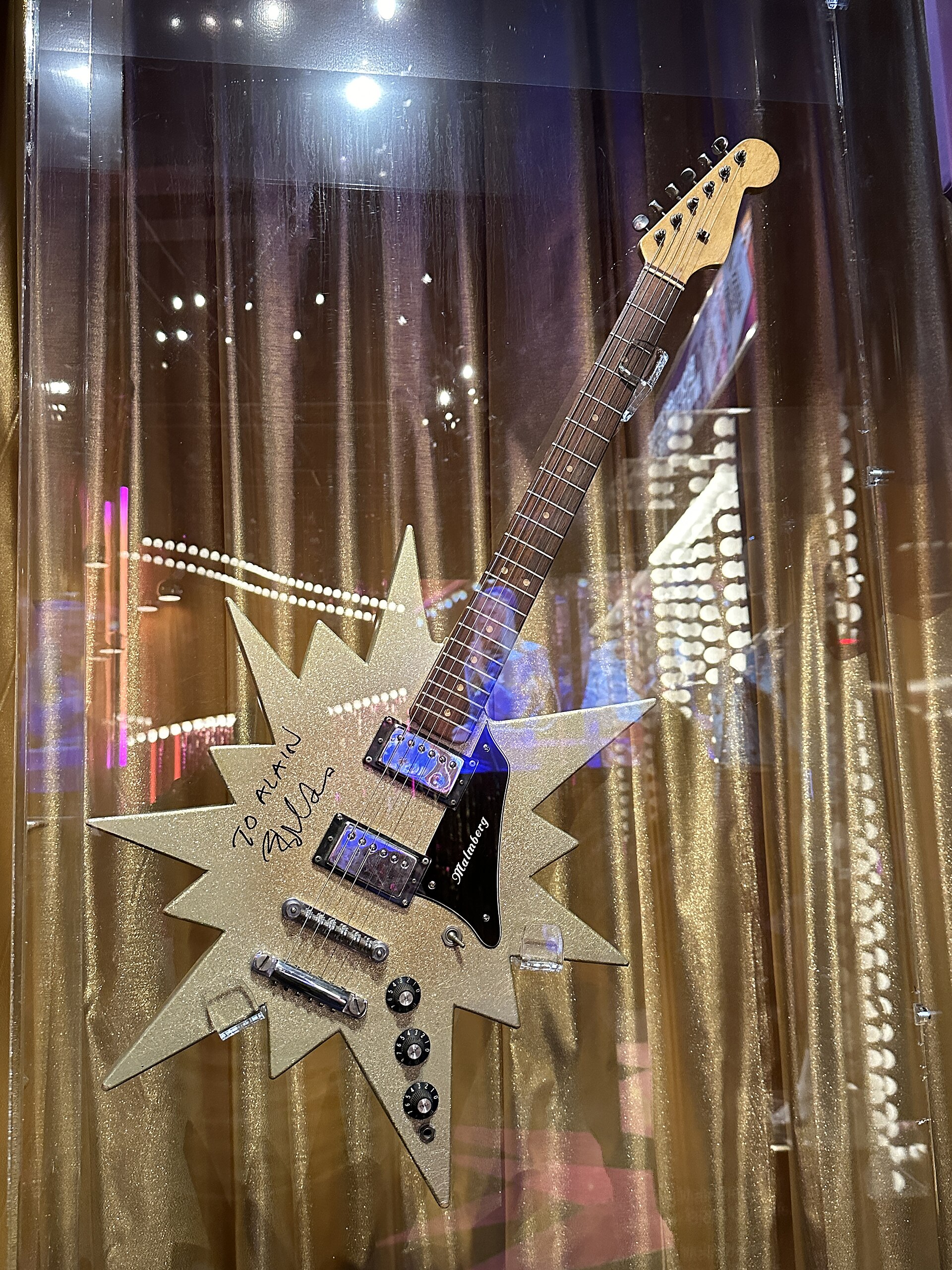

Is it interactive, or just a display of objects?
The museum’s own material describes it as built around participation rather than passive viewing, and this is one of the features that most distinguishes it from a conventional object-based museum. Exhibits described on the operator’s site include a telephone that reportedly only rings when a member of ABBA calls it, a mock stage where visitors can perform alongside projected footage of the band, and a virtual mixing desk that lets a visitor remix a track. There is also a section built around costume and set design connected to Mamma Mia!, the stage musical and films built on ABBA’s songbook, since the museum links the band’s ongoing commercial life to the exhibition rather than treating it purely as a historical record.
What is the Swedish Music Hall of Fame, and why is it here?
The Swedish Music Hall of Fame is a separate exhibition inside the same building, recognising Swedish musicians and industry figures more broadly than ABBA alone. It was established by the Swedish music industry as a way of documenting the country’s recorded-music history, and its inclusion in the same site reflects the fact that ABBA’s commercial success is often treated, in Swedish cultural writing, as a starting point for the country’s modern export-driven music industry rather than an isolated phenomenon. A combined ticket generally admits visitors to both exhibitions, but this should be confirmed on the operator’s own site before a visit.
Is the ABBA Museum affiliated with the band itself?
The museum states that it operates with the direct involvement of the band’s four members, and Björn Ulvaeus has been publicly identified as a founder of Pop House Sweden, the company behind the museum. This matters for how the collection should be read: it is an authorised, band-endorsed presentation of ABBA’s history rather than an independent institution assessing the group’s cultural significance from the outside, in the way a national museum might assess a historical figure or movement.
How does the ABBA Museum compare with Stockholm’s other museums?
Stockholm’s major museums generally fall into two categories: state or municipal institutions with a broad curatorial mandate, and privately run, single-subject exhibitions built around one collection or one story. The ABBA Museum belongs firmly to the second group. It can be usefully compared with other Djurgården institutions covered by the site’s museums and galleries hub, several of which sit within walking distance:
- The Vasa Museum holds a 17th-century warship recovered largely intact from Stockholm’s harbour, a state-run collection built around a single archaeological object rather than a theme.
- Skansen is an open-air museum of historic buildings relocated from across Sweden, documenting rural and pre-industrial life.
- The Nordiska Museet covers Swedish cultural history more broadly, from folk costume to domestic life.
Elsewhere in the city, Moderna Museet and Nationalmuseum hold fine art collections assembled under state curatorial standards, and Fotografiska is a privately run photography museum with a rotating exhibition programme — a useful comparison point, since it shares the ABBA Museum’s private-operator model but not its single-subject focus.
Does the season affect a visit?
Djurgården as a whole is busiest in the Swedish summer, when Gröna Lund is open and cruise and coach traffic to the island increases sharply, and this affects queuing and crowding at every museum on the island, including this one. Outside the summer months, the island’s museums operate on reduced hours in line with lower visitor numbers, and some seasonal attractions on Djurgården close entirely. The ABBA Museum itself operates year-round as an indoor exhibition, unlike Gröna Lund, but its opening hours still shift with the season according to its own published schedule.
What should a visitor check before going?
Ticket prices, combined-entry arrangements with the Swedish Music Hall of Fame, and daily opening hours are all set and revised by the museum operator, not by any city or national body, so they should be confirmed directly on the museum’s own site rather than assumed from any third-party listing. Readers travelling from outside Sweden should also consult their own government’s official travel advice for any entry requirements, since this is not something a museum or a guide site can advise on.
Is it worth treating as a stand-alone visit or part of a wider Djurgården day?
Because the museum sits on an island that also holds several of Stockholm’s largest cultural institutions, it is commonly discussed — in the museum’s own visitor information and in city tourism material — as one stop on a wider Djurgården itinerary rather than a destination requiring a separate trip. How it is combined with the Vasa Museum, Skansen or the Nordiska Museet is a matter of a visitor’s own interest in the subject matter, not something with an objectively correct answer.
Access Stockholm is an independent guide written from published, checkable sources. We have not visited the places described here and we do not publish personal recommendations or invented ‘local favourites’ — where something is singled out as notable, we say who says so. Opening times, fares, closures and prices change at short notice, so treat everything here as a starting point and confirm with the museum, operator or venue directly before building a day around it. We give no advice on visas, insurance, health or safety; use your own government’s official guidance for those.
Featured image: Photo by Ssu, source, CC BY-SA 4.0
