What is Thielska Galleriet?
Thielska Galleriet is an art museum on the island of Djurgården in Stockholm, housed in a private villa built between 1905 and 1907 for the banker Ernest Thiel. It holds his collection of late-19th and early-20th-century Nordic art, including works by Edvard Munch, Anders Zorn, Carl Larsson, Eugène Jansson and Bruno Liljefors, alongside a sculpture garden facing the water.
Who was Ernest Thiel, and how did the collection come about?
Ernest Thiel was a Swedish banker and financier who, from the 1890s onward, used his fortune to build one of the most significant private art collections in the Nordic region. He bought directly from artists he knew personally, several of whom were close friends, and he commissioned the villa specifically to house both his family and the collection.
Thiel’s fortune collapsed in the financial crisis of the early 1920s. In 1924 the Swedish state acquired the villa and its contents, and the museum opened to the public in 1926. The collection on display today is, in its essentials, the one Thiel assembled himself — it was not built up afterward by curators buying on the open market, which is unusual for a museum of this size.
What does the collection actually contain?
The core of the collection is Nordic painting and sculpture from roughly 1880 to 1920, a period sometimes grouped under Nordic Symbolism and the Nordic response to French Naturalism. According to Thielska Galleriet’s own account of its holdings, the collection includes:
- Paintings and works on paper by Edvard Munch, a personal friend of Thiel’s, making the museum one of the more substantial Munch holdings outside Norway.
- Works by Anders Zorn, Carl Larsson and Bruno Liljefors, three of the artists most associated with the Swedish national-romantic painting of the period.
- Paintings by Eugène Jansson, known for his nocturnal views of Stockholm’s waterways, and by Nils Kreuger and Karl Nordström, painters linked to the artists’ colony at Varberg.
- A smaller body of international work acquired alongside the Nordic material, reflecting Thiel’s own taste rather than an attempt at encyclopedic coverage.
Readers wanting the fuller Nordic context — Zorn, Larsson and their contemporaries as held in a national collection rather than a private one — can compare this with the holdings described in what Nationalmuseum Stockholm holds and with the ethnographic material described in the Nordiska Museet’s collections.
What is the building itself?
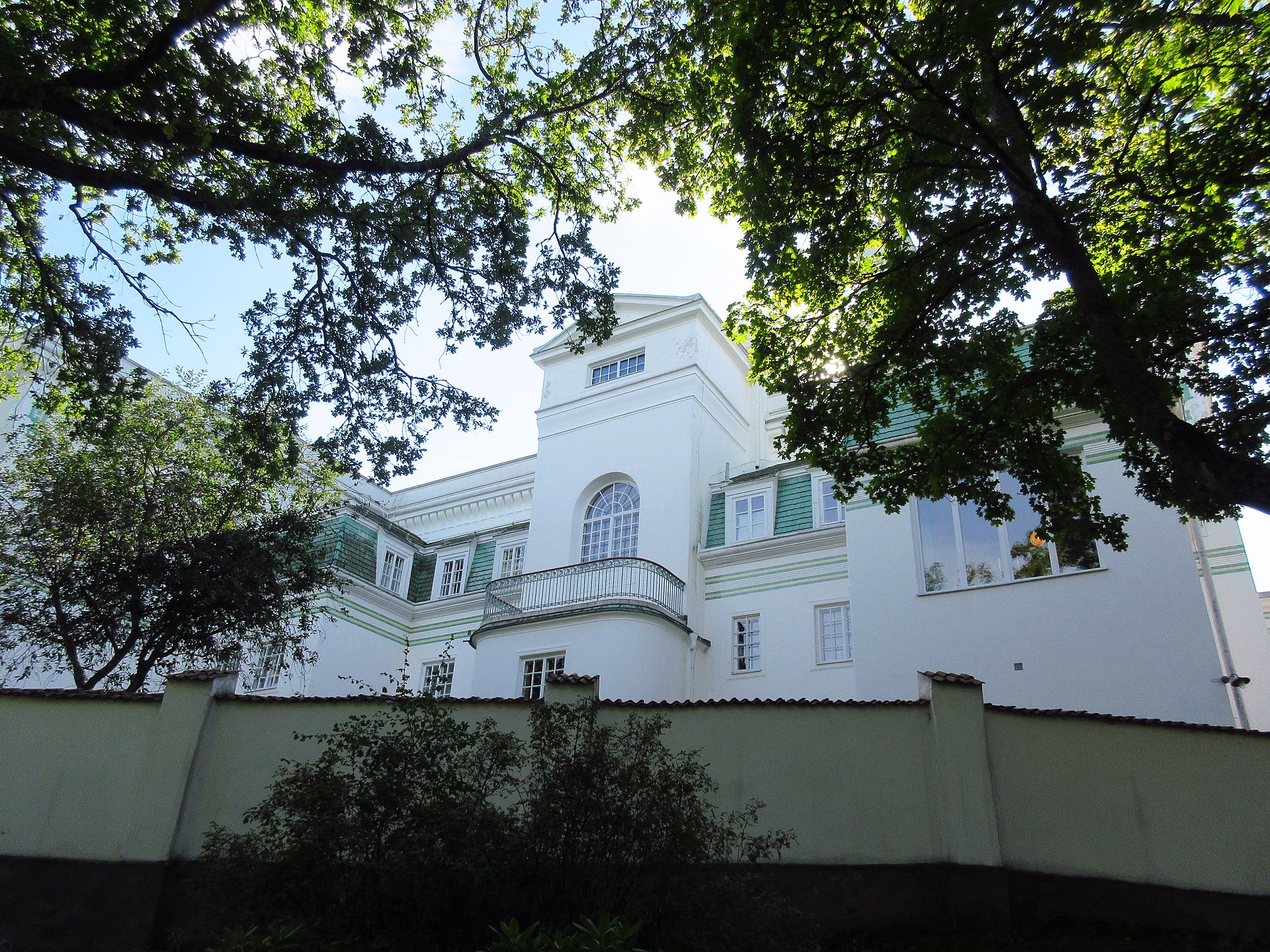
The villa was designed by the architect Ferdinand Boberg, who also designed Rosenbad and the NK department store building in central Stockholm. It was built specifically as an art villa: rooms were planned around how paintings would be lit and hung, not retrofitted afterward, and the building itself is treated by architectural historians as part of the exhibit rather than a neutral container for it.
It sits directly on the water at Blockhusudden, the point where the Djurgården shoreline meets open water toward Lidingö. The setting was deliberate — Thiel wanted a house with views over the strait, and the museum’s position at the edge of the island, away from the denser museum cluster further west, is part of why it functions differently from a city-centre gallery: fewer passing visitors, more people who came specifically to see it.

Where is it, and how do you get there?
Thielska Galleriet stands at the eastern end of Djurgården, past the cluster of larger institutions that includes the Vasa Museum, Skansen and the ABBA Museum. It is reachable from central Stockholm by bus routes that run onto Djurgården, or by the seasonal Djurgården ferry from Slussen or Nybroplan, which is the route many Stockholmers use for this part of the island since it avoids the road traffic onto the peninsula.
Because it sits further out than the main Djurgården museums, it is usually a deliberate destination rather than something folded into a walk between the Vasa Museum and Skansen. Anyone combining a visit with the rest of the island should budget separate time for it rather than assuming it fits into the same afternoon as the larger institutions.
What is the sculpture garden?
The grounds around the villa function as an open-air sculpture park, arranged along the shoreline that Thiel originally had landscaped for the purpose. The garden includes cast sculpture associated with Auguste Rodin, among other works Thiel acquired or commissioned to sit alongside the house rather than inside it.
This outdoor collection is included in a standard museum visit and does not require a separate ticket beyond general admission, though the specific arrangement of pieces should be checked against the museum’s own current information, since outdoor works are sometimes moved for conservation.
When is it open, and what does it cost?
Thielska Galleriet, like most Stockholm museums, keeps a published set of opening days and hours that can change by season, and it should not be assumed open every day of the week. Ticket prices, any free-entry windows, and closures for maintenance or loans are set by the museum itself and revised periodically.
Because these details are the kind that go out of date within months, the reliable approach is to check the museum’s own site directly before visiting rather than rely on a fixed figure printed elsewhere. The Thielska Galleriet website is the primary source for current hours, admission and any special exhibitions layered onto the permanent collection.
How does it compare to Stockholm’s other art museums?
Thielska Galleriet is small and single-collector in origin, which sets it apart from the larger state institutions. Nationalmuseum holds a national collection assembled over more than two centuries; Thielska Galleriet holds what one wealthy individual bought for his own house over roughly three decades, then lost to the state in a financial collapse.
That distinction matters for how the museum reads on a visit. There is no attempt at comprehensive coverage of a period or movement — the collection reflects Thiel’s friendships and preferences, which is why Munch is so heavily represented while other major European figures of the period are largely absent. Readers comparing collecting logic across the city’s museums may also find it useful to look at how Moderna Museet’s modern and contemporary collection was built through acquisition and donation, a different model again from Thiel’s single-collector approach, or how a specialised photography collection is assembled at Fotografiska.
For a broader view of how these institutions sit alongside each other across the city, the Museums & Galleries section groups Stockholm’s major collections — national, municipal, private and specialist — by what each one actually holds rather than by neighbourhood, which is generally the more useful way to decide which ones overlap and which are genuinely distinct. Visitors planning a Djurgården day that also includes maritime history can set expectations against what the Vasa Museum contains, since the two sit on the same island but answer very different questions about Sweden’s past.
Is it worth treating as a separate trip?
For anyone already planning a day around Djurgården’s larger museums, Thielska Galleriet sits apart both geographically and in scale, and treating it as an add-on to a Vasa-and-Skansen day risks running out of time for it. Its own position — a house-museum built around one collector’s taste, on a quiet point of shoreline away from the main cluster — is generally better served by a visit planned on its own terms, checked against the museum’s current hours before setting out.
Access Stockholm is an independent guide written from published, checkable sources. We have not visited the places described here and we do not publish personal recommendations or invented ‘local favourites’ — where something is singled out as notable, we say who says so. Opening times, fares, closures and prices change at short notice, so treat everything here as a starting point and confirm with the museum, operator or venue directly before building a day around it. We give no advice on visas, insurance, health or safety; use your own government’s official guidance for those.
Featured image: Photo by No machine-readable author provided. FriskoKry~commonswiki assumed (based on cop, source, CC BY-SA 2.5
