Daylight in Stockholm runs from around six hours a day in December to close to nineteen in June, because the city sits at roughly 59°N — level with the southern tip of Alaska. That swing changes when things open, how the water looks, when festivals cluster, and how the same street can feel entirely different depending on the month a photograph was taken.
How much daylight does Stockholm actually get across the year?
At Stockholm’s latitude, the length of the day is not a minor seasonal detail — it is close to a threefold difference between the shortest and longest days. Around the winter solstice in late December, the sun rises well into the morning and sets in mid-afternoon, giving somewhere in the region of six hours of daylight. Around the summer solstice in June, the pattern reverses: sunrise is in the small hours and sunset falls close to midnight, giving nearly nineteen hours of daylight and a sky that never gets properly dark in between.
These figures are astronomical, tied to latitude and the calendar, not to anything an operator sets — so they are durable in a way opening hours are not. A reader wanting exact sunrise and sunset times for a specific date is better served by a dedicated almanac or astronomical calculator than by any estimate here.
Why does the light change so much at this latitude?
Stockholm’s swing is a direct consequence of how far north it sits. The tilt of the Earth’s axis matters far more at high latitude than near the equator, which is why London or Paris see a much gentler seasonal swing than Stockholm does, and why Stockholm’s swing is in turn milder than that of northern Sweden, well above the Arctic Circle, where the sun does not set at all for weeks around midsummer and does not rise at all for weeks around midwinter. Stockholm does not reach either extreme, but it leans hard toward both.
What does midsummer light actually look like in the city?
Because sunset falls so late and the sun never drops far below the horizon in June, the period around the solstice is often described as “white nights” — the sky stays a deep dusk-blue rather than going fully dark, and this is a recognised feature of Swedish summer, not a marketing phrase. The public holiday of Midsommar, always falling on a Friday in the window set by Swedish law around the solstice, is built around this light: celebrations traditionally run into the evening because there is effectively no true darkness to end them.
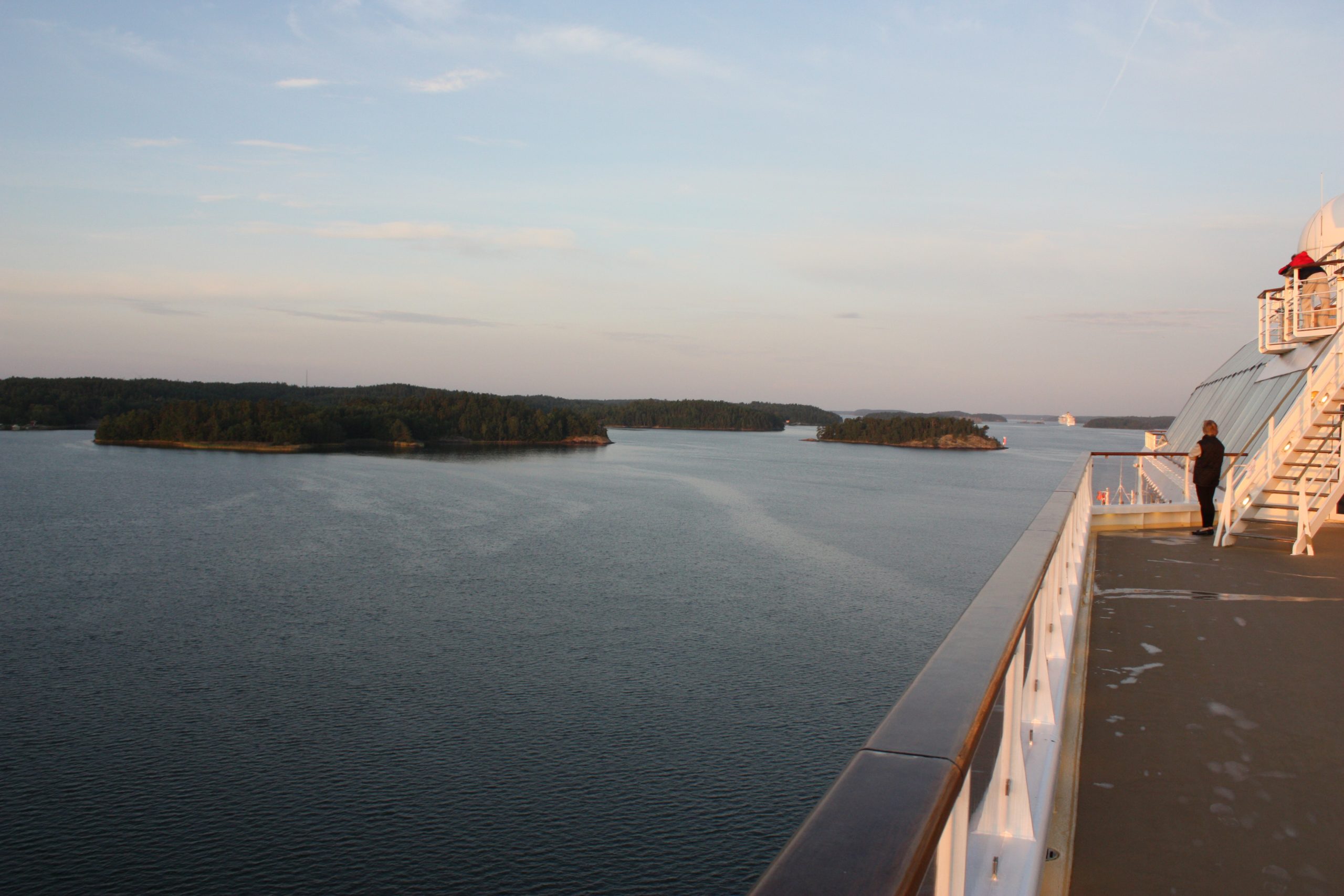
Long daylight also extends what a single day can hold. Ferries into the archipelago run a fuller summer schedule partly because there is simply more usable daylight in which to make the crossing and enjoy the destination — a pattern explained in more detail in the guide to how Stockholm’s archipelago boats work by season. Parkland on Djurgården, much of it former royal hunting ground and now open green space, gets correspondingly heavier use in the evenings, since an evening in June can look and function like an afternoon elsewhere.
What does December light actually look like?
The winter equivalent is a working day that starts and ends in the dark for anyone commuting outside the brightest midday hours. Streetlighting, shop windows and the city’s Christmas market traditions — long-running seasonal markets such as the one at Skansen, described in the guide to Skansen’s open-air museum — become more prominent in the visual experience of the city precisely because there is so little daylight to compete with them.
Low sun angle matters too. Even at midday in December, the sun stays close to the horizon, producing long shadows and a flat, raking light rather than anything overhead. This is a genuine astronomical fact of the latitude, not an atmospheric mood — the sun simply does not climb high in the sky at this time of year, however clear the day.
How does the light affect museums and what’s open?
Museums do not change their collections with the seasons, but many adjust hours around the light and around demand. Some institutions run later evening openings in winter, in part because a dark 4pm makes an indoor collection more appealing than it might be on a long summer evening; others extend hours in summer to make use of tourist volume and long days. The pattern — a museum having a specific late-opening evening, or a seasonal hours change — is genuinely useful to know, but the exact hours belong on the institution’s own site, since they are exactly the kind of detail this site will not guess at. The Museums & Galleries section covers what specific collections hold; operators’ own pages are the source for current hours.
Sweden’s system of free entry to national museums, covered separately in the site’s coverage of how that policy works, is unaffected by season — it is a funding and access policy, not a seasonal one — but a visitor timing a trip around free entry should still confirm current hours before travelling.
How does the light affect getting around and being outdoors?
Central Stockholm is compact enough to walk across in well under an hour in good conditions, as set out in the piece on how walkable central Stockholm actually is, and long summer daylight makes that walking window enormous — a visitor can reasonably plan an evening walk at what would be full dark elsewhere. In winter, the same distances are entirely walkable but happen mostly in darkness outside a narrow midday band, which is worth factoring into any itinerary built around outdoor viewpoints.
Cliffside viewpoints such as Monteliusvägen and Fjällgatan depend entirely on available light for their appeal — a viewpoint over water and rooftops functions very differently under a long, low winter sun than under the near-permanent daylight of a June evening. Cycling, covered in the guide to how cycling works in Stockholm, follows the same pattern: usage rises sharply with daylight hours, and lit cycle infrastructure matters far more in the winter months.
How does the light shape the festival and event calendar?
Much of Stockholm’s annual calendar clusters around the light rather than against it. Midsummer sits at the solstice by design. Outdoor concerts, open-air markets and much of the city’s café and restaurant terrace culture concentrate in the long-daylight months roughly from May to September, because outdoor space is genuinely more usable then. Winter’s cultural calendar leans toward indoor and lit events — Christmas markets, indoor concerts, museum evenings — precisely because the daylight does not support long outdoor programming. None of this is fixed to specific dates from year to year, and any reader planning around a particular event should check the organiser’s own current schedule; the broader shape of the seasonal calendar is covered in the guide to the best time of year to visit Stockholm.
Does the light affect residents differently than visitors?
Yes, mainly through routine rather than novelty. A resident’s commute, exercise habits and social calendar are built around the same swing a visitor notices only briefly — many Stockholmers structure summer around outdoor time deliberately, taking holidays in July when daylight and warmth coincide, and shift indoors for structured winter routines involving gyms, saunas and the kind of indoor cultural programming museums lean into. This pattern is covered in more depth in the hub on what it is actually like to live in Stockholm, which treats the seasonal light swing as a fact of daily life rather than a travel detail.
For a visitor, the practical takeaway is simpler: the same city, the same distances and the same collections behave differently depending on when in the year a trip falls, and the broader planning implications — including transport, weather and what closes off-season — are set out in the practical planning hub and the wider guide to Stockholm’s museums, landmarks and neighbourhoods.
Access Stockholm is an independent guide written from published, checkable sources. We have not visited the places described here and we do not publish personal recommendations or invented ‘local favourites’ — where something is singled out as notable, we say who says so. Opening times, fares, closures and prices change at short notice, so treat everything here as a starting point and confirm with the museum, operator or venue directly before building a day around it. We give no advice on visas, insurance, health or safety; use your own government’s official guidance for those.
Featured image: Photo by Jordgubbe, source, CC BY-SA 2.0
