Pendeltåg is Stockholm’s commuter rail network — full-size trains running on mainline tracks, not the underground metro (Tunnelbana). It covers far greater distances than the metro, reaching towns well outside the city, and is usually the better choice whenever a journey is long, crosses into the outer region, or starts or ends near a mainline station rather than a metro one.
What is Pendeltåg, exactly?
Pendeltåg (literally “commuter train”) is Stockholm’s regional rail service, run on standard railway track shared in places with regional and long-distance trains operated by other companies. It is not part of the Tunnelbana system, even though both are planned and ticketed together by the region’s public transport authority, SL (Storstockholms Lokaltrafik).
Where the metro runs on dedicated tracks built specifically for it, Pendeltåg uses the same physical infrastructure as trains heading much further afield — toward Uppsala, or south past Södertälje. That single fact explains almost everything about when it is useful and when it is not.
How is Pendeltåg different from the Stockholm metro?
The core difference is scale of stop spacing and reach. The metro, described in detail in coverage of T-Centralen, its central hub, is built around three lines with closely spaced stations threading through the inner city and inner suburbs. Pendeltåg stations are spaced much further apart and the network extends considerably further outward.
The metro is also the network known for its decorated stations — a point covered separately in the piece on why the Stockholm metro is called the world’s longest art gallery. Pendeltåg stations, by contrast, are functional rail platforms rather than a curated art programme; the two systems were built to different briefs and it shows.
A second difference is the vehicle itself. Pendeltåg trains are longer and heavier than metro carriages, built to mainline standards, and they run less frequently outside peak hours than metro trains do in the inner city.
Who operates Pendeltåg, and how does it fit into SL?
SL sets the routes, fares and ticketing rules for Pendeltåg, exactly as it does for the metro, buses and most ferries — a structure explained in the overview of how the Stockholm travel card works across transport. Day-to-day operation of the trains, however, is contracted out to a rail operator under an agreement that is periodically retendered. Because the operator can change between contract periods, this article does not name one — readers who want the current operator, along with live timetables, should check SL’s own site directly.
What does not change is the underlying principle: Pendeltåg tickets are integrated into the same zone-based fare system as the rest of SL’s network, detailed in Stockholm metro zones and fares. A traveller does not need a separate ticket to switch between metro and Pendeltåg within a single journey, provided the zones are covered.
Which lines does Pendeltåg run, and where do they go?
Pendeltåg lines converge on central Stockholm and fan outward in both directions along the regional rail corridors. In broad terms, the network extends:
- North toward Märsta and, on one line, as far as Uppsala — a separate city outside Stockholm County.
- South toward Södertälje, and further still to Nynäshamn on the coast.
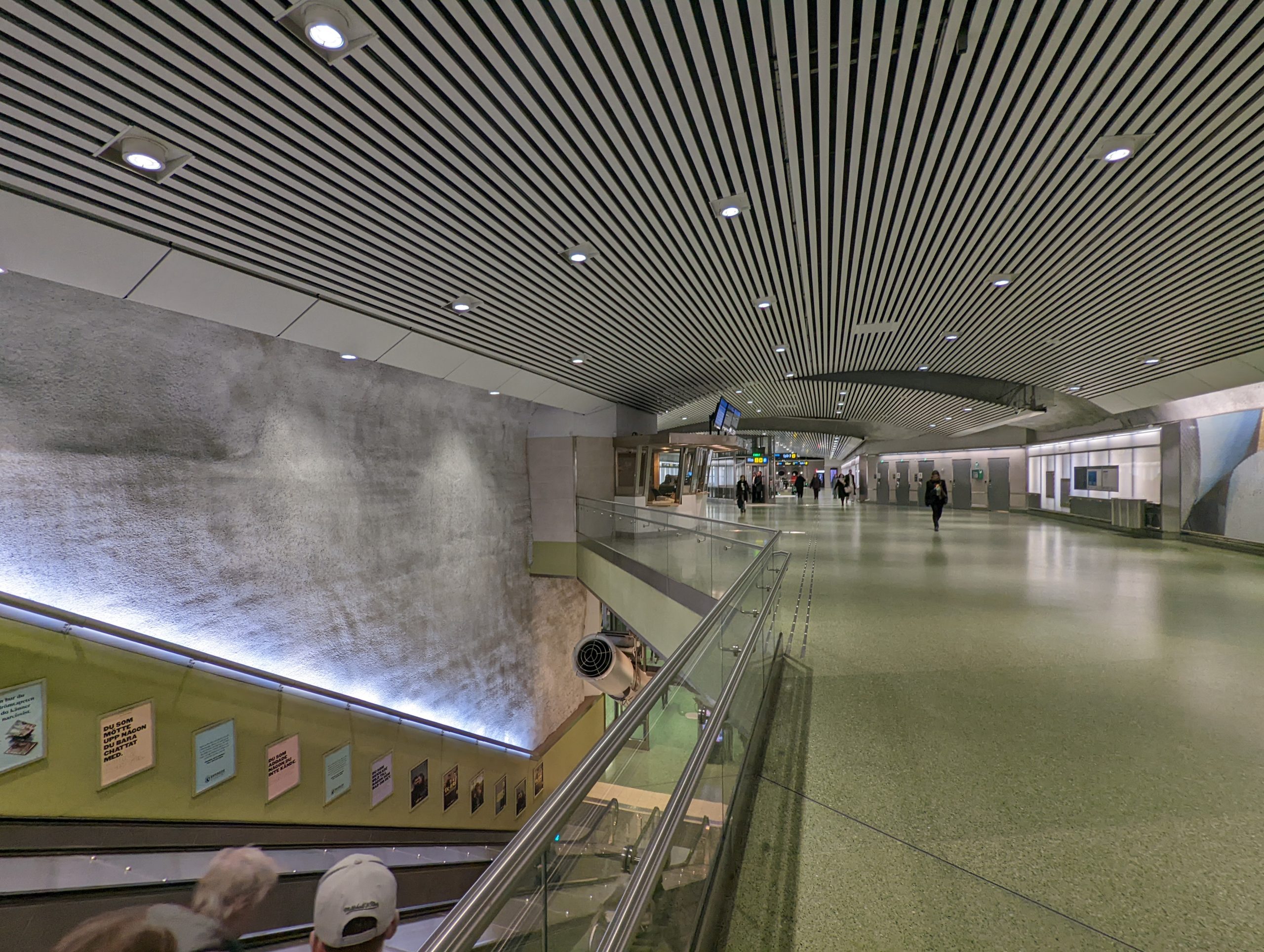
- Through the city centre via the Citybanan tunnel, opened in 2017, which gave Pendeltåg its own underground route beneath central Stockholm and eased pressure on the older surface tracks into Stockholm Central.
Citybanan created two dedicated underground Pendeltåg stations in the centre: Stockholm City, beneath Stockholm Central Station, and Odenplan. These are separate structures from the metro’s own stations at T-Centralen and Odenplan, even though they sit close by and are linked by passageways — a distinction worth knowing before assuming “the same station name” means “the same platform”.
Pendeltåg also serves Södra Station, on the southern edge of the inner city, covered in more detail in the piece on what Södra Station is and what surrounds it.
When is Pendeltåg actually better than the metro?
Pendeltåg wins whenever the metro simply does not go where a traveller needs to be, or covers the distance far less directly. Concretely, that means:
- Longer suburban and cross-region trips. Reaching Södertälje, Märsta or Nynäshamn by metro would mean transferring onto other services at the network’s edge, if it is possible at all. Pendeltåg runs there directly.
- Fewer stops over greater distance. Because Pendeltåg stations are spaced much further apart than metro stations, a journey covering many kilometres is often faster on Pendeltåg even where both networks technically run in parallel for part of the route.
- Arriving at or near Stockholm Central. Anyone connecting onward to regional or long-distance rail benefits from Pendeltåg’s direct link into the same station complex, rather than a metro ride followed by a walk.
- Avoiding surface congestion through the centre. The Citybanan tunnel gives Pendeltåg its own dedicated route under the city, separate from both road traffic and the older shared rail tracks.
This makes Pendeltåg the natural choice for anyone commuting from further out in the region, and for day-trip style journeys to towns the metro was never built to reach — a pattern discussed more broadly in the overview of the difference between Stockholm’s inner city and its suburbs.
When is the metro the better choice?
Within the inner city and its immediate suburbs, the metro is almost always the more convenient option, for a straightforward reason: its stations are closer together and its lines were purpose-built to move people around exactly this area.
The metro is generally the better pick when:
- The trip stays within central districts such as Södermalm, Kungsholmen, Norrmalm or Östermalm, where metro stations are dense and walking distances between them are short.
- Frequency matters more than speed over distance — metro trains typically run more often through the day than Pendeltåg does outside peak commuting hours.
- The destination is one of the many inner and outer suburbs built directly around a metro line, including several of the Million Programme suburbs constructed from the 1960s onward specifically along the expanding Tunnelbana network.
In short: metro for density, Pendeltåg for distance. Neither replaces the other; they were built to solve different problems at different scales, and the useful skill is recognising which problem a given trip actually is.
Does the same ticket work on both?
Yes, within the standard SL zone system. A valid ticket or loaded travel card covering the relevant zones is usable across metro, Pendeltåg, buses and most SL ferries without buying separately for each mode — the mechanics of this are set out fully in the guide to how the Stockholm travel card works across transport.
Where it gets more specific is the outer edges of the Pendeltåg network. Trips reaching far beyond the core SL zones — toward Uppsala, for instance, which sits outside Stockholm County entirely — may involve a different regional ticket or operator arrangement. Fares and zone boundaries are exactly the kind of detail that shifts over time, so the reliable move is to check current zones and prices directly through SL’s own site before travelling, rather than rely on a fixed figure printed here.
Does this distinction matter more to residents or visitors?
Both, but in different ways. A visitor is mostly likely to meet Pendeltåg by accident — changing at Stockholm Central for an airport or intercity connection, or making a single day trip somewhere the metro map doesn’t reach. For that kind of use, the main thing to know is simply that Pendeltåg exists, uses the same ticketing, and is not the same system as the coloured metro lines shown on tourist maps.
For a resident, the distinction is closer to a daily fact of life. Choosing to live along a Pendeltåg line rather than a metro line changes the shape of a commute noticeably — generally faster over distance, but with longer gaps between trains outside peak hours and a station further from the door in many outer towns. It is one of the quieter structural facts that shapes where people in the region actually choose to live, alongside the broader questions covered in the overview of what it is actually like to live in Stockholm and the wider transport picture set out in Getting Around Stockholm.
Neither network is “the” way to move around the city. Pendeltåg and the metro were built for different jobs, run on different tracks, and read together — rather than as competitors — they explain a fair amount about how Stockholm as a region, not just a city, actually holds together.
Access Stockholm is an independent guide written from published, checkable sources. We have not visited the places described here and we do not publish personal recommendations or invented ‘local favourites’ — where something is singled out as notable, we say who says so. Opening times, fares, closures and prices change at short notice, so treat everything here as a starting point and confirm with the museum, operator or venue directly before building a day around it. We give no advice on visas, insurance, health or safety; use your own government’s official guidance for those.
Featured image: Photo by Holger.Ellgaard, source, CC BY-SA 3.0

Related reading
Stockholm’s Four Airports Compared: Two Are Not Near Stockholm.