Skogskyrkogården — the name translates literally as “the Woodland Cemetery” — is a working burial ground in southern Stockholm, designed between 1915 and 1940 by the architects Gunnar Asplund and Sigurd Lewerentz. UNESCO added it to the World Heritage List in 1994, describing it as a landscape and set of buildings that “exercised a considerable influence” on cemetery design worldwide.
What exactly is Skogskyrkogården?
Skogskyrkogården is a cemetery in the Enskede district, roughly ten kilometres south of central Stockholm, built into an existing pine forest and former gravel quarry. It remains an active burial site administered by the Stockholm Cemeteries Administration (Stockholms kyrkogårdsförvaltning), not a museum or a historic ruin.
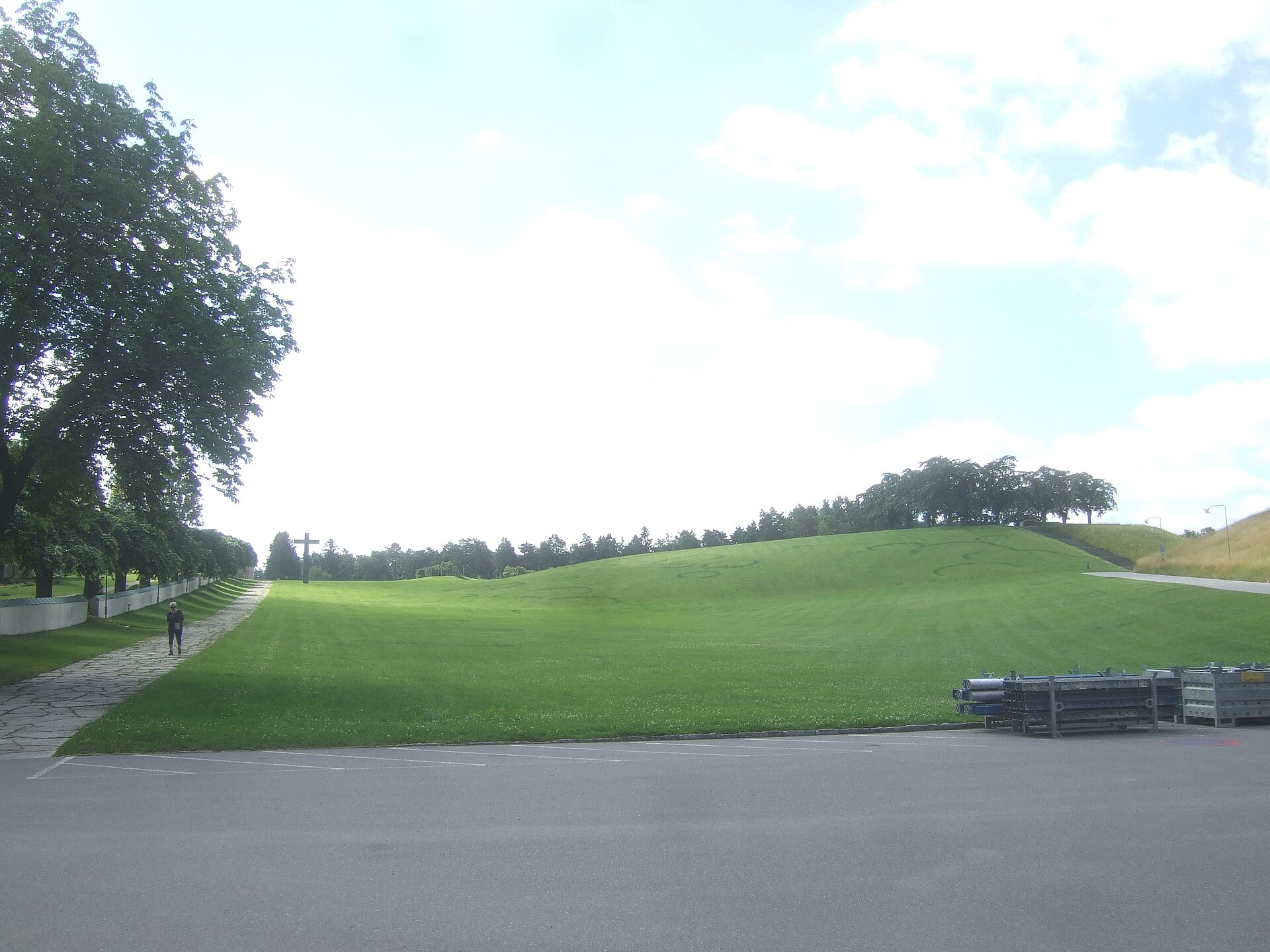
The site combines several chapels, a crematorium, and open woodland and meadow with a formal entrance sequence. Its best-known structures are the Woodland Chapel (Skogskapellet), completed by Asplund in 1920, and the Woodland Crematorium (Skogskrematoriet), completed in 1940 and containing the Chapel of the Holy Cross, the Chapel of Faith and the Chapel of Hope. A tall granite cross stands at the head of the main approach, and a low mounded hill known as Meditationslunden (the Meditation Grove) is one of the cemetery’s most photographed features, though it functions as a burial area rather than a viewpoint.
Why is a cemetery a UNESCO World Heritage Site?
UNESCO’s inscription rests on the argument that Skogskyrkogården represents a coherent, highly influential fusion of landscape and architecture designed as a single work. The organisation’s own listing states that the cemetery had “a profound impact on cemetery design across the world” over the following decades.
The competition that produced the design was held in 1915, and the winning proposal — submitted jointly by Asplund and Lewerentz under the title “Tallum,” referring to the pine grove — treated the whole site, not just individual buildings, as the object of design. Paths, sightlines, changes in ground level, and the placement of forest against open meadow were composed with the same deliberateness as the chapels themselves. UNESCO’s designation covers this entire ensemble: the topography and planting as much as the built structures.
This is different from most heritage listings in Stockholm, which tend to protect a single building or a historic street pattern. At Skogskyrkogården, the protected “monument” is a designed landscape, comparable in principle to the way UNESCO treats a historic garden or a planned townscape elsewhere in the world.
Who designed it, and what did they change about cemetery design?
Gunnar Asplund and Sigurd Lewerentz won the 1915 competition and then worked — separately and sometimes in tension with each other — on different parts of the site for the next twenty-five years. Asplund is generally credited with the Woodland Chapel and the Woodland Crematorium; Lewerentz with the Chapel of Resurrection (Uppståndelsekapellet), completed in 1925, and much of the surrounding landscape design, including the long approach avenue and the elm-lined main path.
Before this, European cemetery design in the early twentieth century tended toward dense rows of monuments in formal grids, often modelled on nineteenth-century garden cemeteries. Asplund and Lewerentz instead used the existing pine forest as a structural element, kept much of the ground informal and unmarked, and concentrated architectural incident at a small number of points — the chapels, the cross, the crematorium — connected by long, quiet approaches. The effect was widely studied and copied by architects and cemetery planners in the decades that followed, which is part of what UNESCO’s inscription cites as grounds for World Heritage status.
Who is buried there?
Skogskyrkogården holds several hundred thousand burials and remains in active use for new interments and cremations. Notable graves include those of the film director Greta Garbo, who is buried in a memorial grove added after her death in 1990, and the actress and singer Zarah Leander. The cemetery’s own administrative body maintains records and a burial register, as it does for other Stockholm cemeteries.
Because it is a functioning cemetery rather than a heritage attraction built for visitors, ceremonies and funerals take place on site regularly, and the surrounding calm is a working condition of the place rather than an atmosphere staged for tourism.

How do you get to Skogskyrkogården?
The cemetery has its own stop, Skogskyrkogården, on the Stockholm metro’s red line, making it a direct journey from the city centre without changes. The station entrance sits close to the main approach avenue, so the walk from platform to the Woodland Chapel is short.
Storstockholms Lokaltrafik (SL), which operates Stockholm’s metro, buses and commuter trains, publishes current timetables and fare zone information on its own site, and that is the source to check before travelling, since fares and schedules change. General patterns of how the city’s transport card and zone system work are covered in Access Stockholm’s Getting Around hub.
What is there to see, and how is it organised for a visit?
The site is large and largely outdoors, so a visit is closer to a walk through forest and open ground punctuated by a few buildings than a tour of a single monument. Key points along the main route include the entrance and the granite cross, the Woodland Chapel, the Meditation Grove, and the Woodland Crematorium with its three chapels.
Some of the chapels are used for services and may not be open to casual entry at all times; opening arrangements are set by the Stockholm Cemeteries Administration and can change around funerals and religious observances, so anyone planning a visit to see the interiors specifically should check the administration’s own published information beforehand rather than assume standard museum-style hours.
There is a visitor centre near the main entrance with exhibition material explaining the design history and the UNESCO listing, which is the most reliable on-site source for background beyond what is posted at individual structures.
How does it compare with Stockholm’s other historic sites?
Stockholm holds relatively few UNESCO World Heritage Sites, and most of the city’s protected historic fabric — Gamla Stan’s medieval street pattern, the royal palaces — falls under national heritage protection rather than UNESCO status. Skogskyrkogården stands alongside Stockholm’s Royal Palace and the royal residence at Drottningholm as one of the few sites in the region carrying the UNESCO designation itself, rather than simply being old or well known.
Its scale and function also distinguish it from central landmarks covered elsewhere on this site. Where Riddarholmen holds royal burials inside a compact medieval church, Skogskyrkogården is a twentieth-century landscape design spread across open ground, built for the ordinary population of the city rather than for monarchy.
Is it part of the same visit as Stockholm’s museums?
Skogskyrkogården sits outside the museum districts most visitors associate with the city. It is not on Djurgården, where the bulk of Stockholm’s national museums cluster — a pattern explained in Access Stockholm’s piece on why so many of Stockholm’s museums are on Djurgården — and it is not covered by the free-entry arrangements that apply to several state-run collections, explained in the site’s guide to how Sweden’s free-entry museum policies work. It is administered separately, as a cemetery, by the city’s own cemeteries authority.
Readers assembling an itinerary around Stockholm’s architecture and design history more broadly can find related material in Access Stockholm’s Landmarks & Sights and Museums & Galleries hubs, and background on how the city’s outlying districts function in the Neighbourhoods section.
What should a visitor keep in mind before going?
Because Skogskyrkogården is an active cemetery, ordinary visitor etiquette applies more strictly than at a typical sight: quiet is expected throughout, and areas near open graves or in-progress services should be avoided regardless of whether they are formally marked. This is not a matter of local custom so much as the basic condition of visiting a place where people are actively mourning.
Readers checking practicalities — current opening arrangements for the chapels, accessibility information, or guided walks — should consult the Stockholm Cemeteries Administration’s own published material, since these details are set by the operator and subject to change without much public notice.
Anyone travelling from outside Sweden should also check their own government’s current travel guidance for the country before departure, as a general matter unrelated to the cemetery itself.
Access Stockholm is an independent guide written from published, checkable sources. We have not visited the places described here and we do not publish personal recommendations or invented ‘local favourites’ — where something is singled out as notable, we say who says so. Opening times, fares, closures and prices change at short notice, so treat everything here as a starting point and confirm with the museum, operator or venue directly before building a day around it. We give no advice on visas, insurance, health or safety; use your own government’s official guidance for those.
Featured image: Photo by Nemo bis, source, CC BY-SA 3.0
