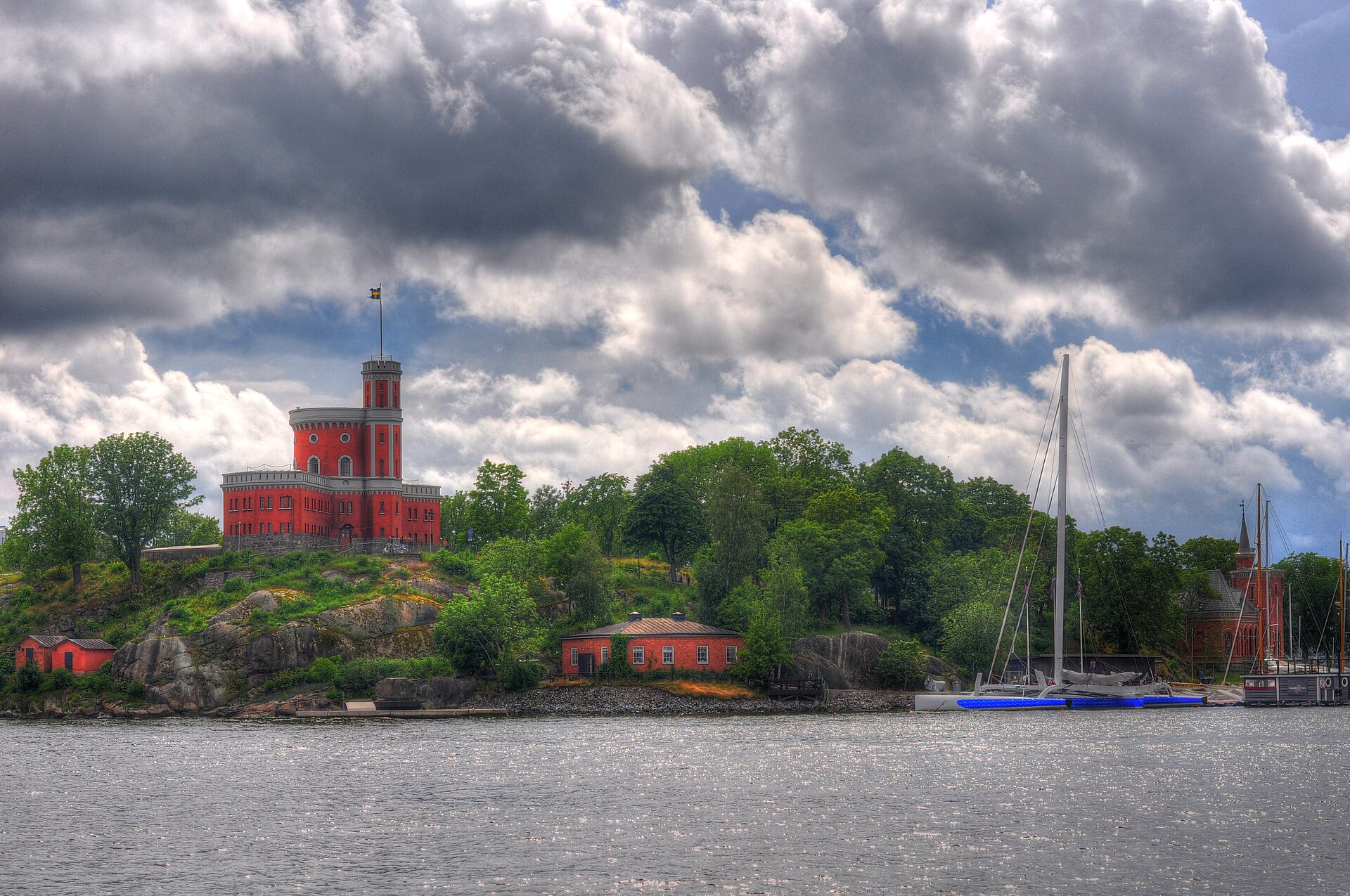
Kastellholmen is a small island in central Stockholm, just east of Skeppsholmen and reached from it by a short iron footbridge. Its landmark is Kastellet, a 19th-century brick citadel that flies the Swedish naval ensign and is the point from which the Swedish Navy fires ceremonial gun salutes on royal and state occasions.
Where is Kastellholmen and how do you get there?
Kastellholmen sits at the eastern edge of the cluster of small islands between Blasieholmen and Djurgården — the same stretch of water crossed by the Vasa Bridge and the other bridges that stitch Stockholm’s islands together. It is the last link in a short chain: the mainland at Blasieholmen connects to Skeppsholmen by Skeppsholmsbron, and Skeppsholmen connects to Kastellholmen by a smaller bridge, Kastellholmsbron, built in the 1870s.
There is no metro or bus stop on the island itself. It is reached on foot, usually as an extension of a walk across Skeppsholmen, or by the seasonal passenger ferries that call at Skeppsholmen as part of Stockholm’s inner-harbour boat routes. Details on current ferry lines and the transit card that covers them are best checked on the operator’s own site, and the general shape of how the city’s public transport fits together is covered in the Getting Around section.
What is the Kastellet building?
Kastellet is a crenellated, castle-like brick building constructed in 1848 to a design by the architect Fredrik Blom, replacing earlier and cruder fortifications that had stood on the same low outcrop since the 17th century. It is not a fort in the functional, defensive sense of Riddarholmen’s medieval walls or a working military installation — it was built primarily as a signal station and a piece of picturesque military architecture, in an era when Stockholm’s harbour approach was already secure.
The building and the island are state property, managed as part of Sweden’s protected built heritage, and Kastellet carries the status of a listed historic building. It is not a museum with a collection and is not generally open for public interior visits in the way that, say, the Moderna Museet or ArkDes on neighbouring Skeppsholmen are. The exterior and the island’s grounds are publicly accessible on foot.
Why does the flag on Kastellholmen matter?
The direct answer: Kastellet flies the Swedish naval ensign, and the raising and lowering of that flag has historically served as a signal to shipping and to the rest of the city — a visible marker tied to the presence of the monarch, state ceremony, and the tradition of gun salutes fired by the Swedish Armed Forces.
Stockholm marks certain royal birthdays, state visits, and national occasions with ceremonial salutes fired from batteries on Kastellholmen and Skeppsholmen. This is a long-standing military and court tradition administered by the Swedish Armed Forces rather than a tourist spectacle staged for visitors, and the specific calendar of salute days should be checked against the Armed Forces’ own published schedule rather than assumed. The flag itself functions as the everyday version of the same signal: a naval ensign flown from a small citadel island, visible across the harbour.

Is Kastellholmen open to the public?
The island’s grounds are open and free to walk, and this is largely how it is used — as a quiet extension of a walk across Skeppsholmen, with views back toward Gamla Stan, Djurgården, and the harbour. The citadel building itself is a different matter: it is not a walk-in attraction, and it has at times been made available for private hire for functions rather than run as a publicly ticketed site. Anyone considering the building for an event, or wanting confirmation of current access, should go to the managing authority’s own information rather than rely on assumptions here, since arrangements for state-owned heritage buildings like this change.
There is no equivalent here to the free-entry arrangements that apply at Sweden’s major national museums; Kastellholmen simply isn’t part of that system. Readers curious about how free entry actually works at Sweden’s national collections can see the separate explanation of how Sweden’s free-entry museum policy is structured.
What is the history behind the island’s name and fortifications?
“Kastellholmen” simply means “castle islet” — kastell being the Swedish word for a small fort or citadel. Fortification on the site dates to the second half of the 17th century, under the same broader programme of harbour defence that shaped Skeppsholmen as the Swedish Navy’s principal base in Stockholm for two centuries. The original earthworks and the buildings that followed were rebuilt and altered repeatedly; the brick citadel visible today, from 1848, is a later, more decorative phase of that history rather than the original military structure.
Skeppsholmen itself, to which Kastellholmen is physically and administratively tied, was the Swedish Navy’s shipyard and base until the mid-20th century, after which the island was gradually given over to cultural institutions. Kastellholmen, smaller and largely undevelopable, kept its single building and its ceremonial function while its larger neighbour changed use.
How does Kastellholmen fit with Skeppsholmen and the Djurgården museums?
Kastellholmen is best understood as the tail end of Skeppsholmen rather than a destination in its own right. Skeppsholmen holds Moderna Museet, Sweden’s national museum of modern and contemporary art, and ArkDes, the national centre for architecture and design — both discussed in the site’s separate account of what Moderna Museet’s collection contains. The wider question of why so much of Stockholm’s museum landscape clusters on this side of the harbour, on Skeppsholmen and across the water on Djurgården, is addressed directly in the explanation of why so many of Stockholm’s museums sit on Djurgården.
Kastellholmen does not have a museum of its own, and it is not part of that cluster of collections. Its interest is architectural and ceremonial rather than curatorial: a small fortified building, a naval flag, and a strip of walkable ground at the point where the old naval base meets open water toward Djurgården and the outer harbour.
How does Kastellholmen compare to Stockholm’s other small islands?
Central Stockholm has several islets with a similarly narrow, single-purpose history — small enough to be defined by one building or one function rather than by streets and neighbourhoods. Riddarholmen, across the water, is defined by its church and its role as the burial place of Swedish monarchs, covered in the separate piece on why Sweden’s kings are buried on Riddarholmen. Kastellholmen belongs to the same category of place: not a district to explore so much as a single structure with a specific, checkable institutional role, sitting at a hinge point in the city’s geography.
For readers working out how these smaller islands relate to the larger neighbourhoods around them — Gamla Stan, Djurgården, Östermalm — the Neighbourhoods section sets out how Stockholm’s built-up areas are organised, while the broader run of the city’s landmarks, including the fortified and ceremonial sites like Kastellet, is gathered in Landmarks & Sights. Anyone planning to combine a walk out to Kastellholmen with a museum visit on Skeppsholmen or Djurgården can find the wider collection of Stockholm’s museum coverage in Museums & Galleries.
Access Stockholm is an independent guide written from published, checkable sources. We have not visited the places described here and we do not publish personal recommendations or invented ‘local favourites’ — where something is singled out as notable, we say who says so. Opening times, fares, closures and prices change at short notice, so treat everything here as a starting point and confirm with the museum, operator or venue directly before building a day around it. We give no advice on visas, insurance, health or safety; use your own government’s official guidance for those.
Featured image: Photo by Arild, source, CC BY-SA 2.0
