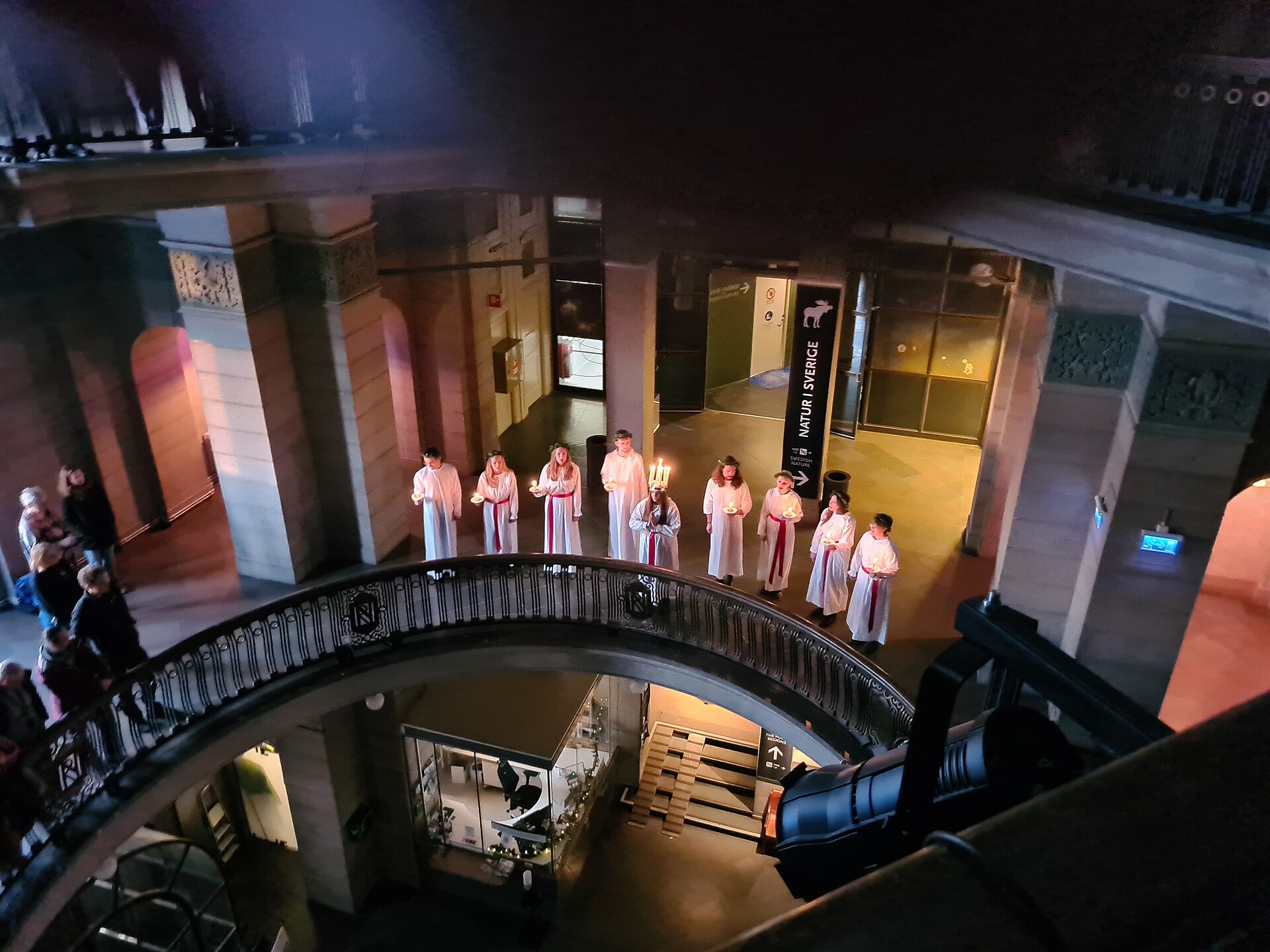
The Naturhistoriska Riksmuseet — the Swedish Museum of Natural History — is a state-run museum at Frescati, on the northern edge of central Stockholm, holding the national collections of zoology, botany, geology and palaeontology. It displays dinosaur skeletons, mineral and meteorite collections, and exhibitions on evolution and biodiversity, and shares its site with Cosmonova, a giant-screen cinema and planetarium.
Where is the museum, and how do you get there?
The museum stands in Frescati, inside the Royal National City Park, north of central Stockholm and close to the main Stockholm University campus. It is not part of the central museum cluster on Skeppsholmen or in the Djurgården area — it sits well outside the city centre, reached by the red-line metro to Universitetet station, from which the museum building is a short walk. Local buses also serve the area. A standard SL travel card covers the journey; for anyone visiting several times a year, the travel card’s value for residents is worth working out separately from any museum ticket.
What is the history behind the collection?
The museum’s roots go back to the cabinet of natural specimens kept by the Royal Swedish Academy of Sciences (Kungliga Vetenskapsakademien), founded in 1739 in the era of Carl Linnaeus, whose classification system underpins much of the museum’s botanical and zoological cataloguing. The Academy’s natural history collections grew for well over a century before the museum was established as its own institution and moved into the purpose-built Frescati building, opened in 1916. It has operated as a Swedish government agency ever since, with a mandate that combines public exhibition with active scientific research and specimen conservation.
What does the collection actually contain?
According to the museum’s own account of its holdings, the collections run to roughly 21 million objects across four main departments — zoology, botany, geology (including mineralogy) and palaeontology. The overwhelming majority of this material is never on public display: it exists as a research and reference collection, used by scientists in Sweden and abroad, and includes type specimens (the reference examples against which a species is formally defined) alongside meteorites, fossils, preserved animals, herbarium sheets and rock samples gathered over nearly three centuries.
- Zoology: preserved and mounted animals, insect and bird collections, marine specimens.
- Botany: herbarium sheets and plant specimens, some dating to the 18th century.
- Geology and mineralogy: rock and mineral samples, including meteorites.
- Palaeontology: fossils and dinosaur material, including full mounted skeletons.
What is on show in the permanent exhibitions?
The public galleries translate that research collection into themed halls. A palaeontology and dinosaur exhibition displays mounted skeletons and casts alongside explanations of Sweden’s own fossil record, which is thin compared with countries that had exposed dinosaur-age rock, so much of the material on display represents global rather than purely Swedish finds. Other permanent exhibitions cover human evolution, biodiversity and the diversity of life, and the Earth’s mineral and geological record, with a section aimed specifically at younger visitors built around live and preserved animals.
Outside the main building stands a life-size concrete model of a blue whale, built in the 1930s as an early piece of public science communication; it has long been a recognisable feature of the Frescati site even though its interior has at times been closed to visitors. The building and grounds sit within the wider parkland of the Royal National City Park, alongside the Bergius Botanic Garden (Bergianska trädgården), which is administered separately but adjoins the museum site.

What is Cosmonova?
Cosmonova is a giant-screen cinema and planetarium built into the same Frescati complex, showing science and nature documentaries on a large domed screen and running planetarium programmes about astronomy. It operates on its own ticketing, separate from entry to the museum’s exhibition halls, and its programme changes periodically — anyone planning a visit around a specific film or show should check current listings on the museum’s own site rather than rely on a fixed schedule here.
Is entry to the museum free?
Swedish state museums have, at various points, operated under government free-entry policies for their permanent collections, and the Naturhistoriska Riksmuseet’s own site is the authority on what currently applies to its main exhibitions, Cosmonova, and any temporary shows, since admission rules and prices for state museums have changed more than once in recent years. Readers should confirm current admission terms directly on the museum’s website before planning a visit around cost.
How does a visit here fit into a wider trip to Stockholm?
Because the museum sits outside the central city, it tends to work best as a dedicated half-day rather than something folded into a walk around Gamla Stan or Djurgården. Families weighing up how to structure time with children in Stockholm may find it useful alongside other ideas in the guide to spending a day in Stockholm with children, given the scale of the dinosaur and animal halls and the separate draw of Cosmonova. For context on how this museum sits among the city’s wider institutions, the Museums & Galleries archive and the broader Stockholm guide hub cover museums, landmarks and neighbourhoods across the city, including the more centrally located collections on Skeppsholmen and Djurgården.
What else is nearby, if time allows?
The Frescati area sits inside the Royal National City Park, a large protected landscape that also takes in Hagaparken and stretches of shoreline and woodland north of the city — covered in more detail in the guide to what the Royal National City Park actually is. The Bergius Botanic Garden, immediately adjacent, is a separate institution with its own greenhouses and outdoor plantings, run by Stockholm University and the Academy of Sciences. Neither site is a quick add-on to a city-centre itinerary; both reward being planned as their own outing, reached by the same metro line out to Universitetet.
Related reading
what the city is like to actually live in, Stockholm, Practically
Access Stockholm is an independent guide written from published, checkable sources. We have not visited the places described here and we do not publish personal recommendations or invented ‘local favourites’ — where something is singled out as notable, we say who says so. Opening times, fares, closures and prices change at short notice, so treat everything here as a starting point and confirm with the museum, operator or venue directly before building a day around it. We give no advice on visas, insurance, health or safety; use your own government’s official guidance for those.
Featured image: Photo by IngimarE, source, CC BY-SA 4.0
