Stortorget is Stockholm’s oldest public square, sitting at the highest point of Gamla Stan, the medieval island that forms the historic core of the city. It was the site of the town’s original marketplace and, in 1520, of a mass execution known as the Stockholm Bloodbath. Today it holds the former Stock Exchange building, now the Nobel Prize Museum, and some of the most photographed merchant houses in the city.
What is Stortorget, exactly?
Stortorget — literally “the Great Square” — is a small, roughly square plaza in the middle of Gamla Stan, Stockholm’s Old Town. It occupies the highest ground on the island, which is why the town’s earliest marketplace was established there rather than closer to the water. A well, Stortorgsbrunnen, marks the centre; it was built in the 18th century as a cistern for firefighting rather than for drinking water, and still stands today as the square’s focal point.
The square is small by the standards of most European capitals — more a widened junction of streets than a grand civic plaza — but its position at the summit of Gamla Stan, and its role in the city’s founding-era commerce, made it the natural centre of medieval Stockholm. Streets radiate from it toward Stockholm Cathedral (Storkyrkan), the Royal Palace, and the harbour.
What happened at the Stockholm Bloodbath?
In November 1520, King Christian II of Denmark had somewhere between 80 and 90 Swedish noblemen, bishops and burghers publicly executed in Stortorget over two days, following his coronation as King of Sweden. The event is known in Swedish as Stockholms blodbad, the Stockholm Bloodbath, and it followed the defeat of the Sture faction that had resisted Danish rule under the Kalmar Union, the political union that had joined Denmark, Norway and Sweden under one crown since the 14th century.
The killings were carried out on charges of heresy brought against Christian II’s opponents, but they are understood by historians as a political purge intended to eliminate resistance to Danish authority. The reaction against the massacre helped fuel the rebellion led by Gustav Vasa, which within three years ended the Kalmar Union and established Vasa as King of an independent Sweden — a turning point commemorated across the country’s institutions, including the collections at the Historiska museet, which covers this period of Swedish state formation.
No single monument marks the Bloodbath in the square itself, though the events are documented in city histories and referenced in guides to Gamla Stan’s medieval street plan.
What buildings surround the square?
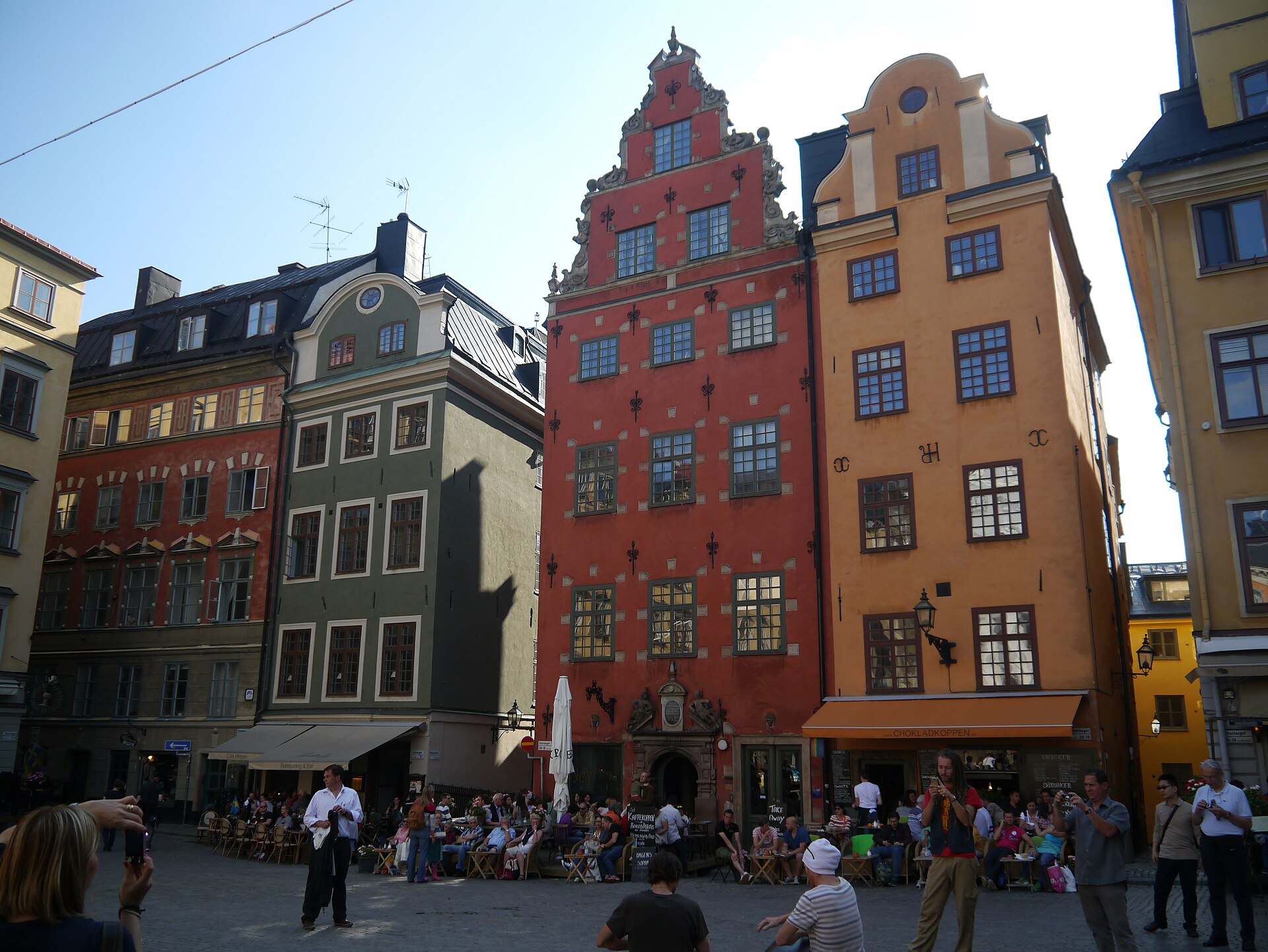
Stortorget is lined on most sides by tall, narrow merchant houses in the Stockholm style — several storeys of stuccoed façades in ochre, red and grey, with steep roofs and dates from the 17th and 18th centuries visible on some frontages. These buildings were originally the homes and warehouses of the city’s trading elite, reflecting the square’s original role as the commercial heart of the town.
The dominant building on the square is the former Stockholm Stock Exchange (Börshuset), an 18th-century building on the north side. It now serves several institutions at once:
- It is the seat of the Swedish Academy (Svenska Akademien), the body that awards the Nobel Prize in Literature.
- It houses the Nobel Library, a research collection used by the Academy.
- Part of the building holds the Nobel Prize Museum, which is covered in detail in a separate explainer on the Nobel Prize Museum.
The Swedish Academy’s own site sets out its history and role in the Nobel Prize in Literature; readers wanting the current detail on the Academy’s public functions should consult it directly.

What is inside the Nobel Prize Museum?
The Nobel Prize Museum, occupying part of the former Stock Exchange building, presents the history of the Nobel Prizes and profiles laureates across the sciences, literature, and peace. According to the museum’s own site, its exhibitions cover the life of Alfred Nobel, the selection process behind the prizes, and objects and stories connected to individual laureates.
Because the museum sits inside a working civic building — the Swedish Academy still meets there — access to some areas is limited to museum opening hours rather than the building as a whole. Current hours, ticket information and any temporary exhibitions should be confirmed on the museum’s own site rather than assumed from older listings, in line with how practical details are treated across this guide.
Why are the merchant houses on Stortorget so often photographed?
The row of gabled, brightly coloured buildings on the eastern side of the square is one of the most reproduced images of Stockholm, appearing on postcards, guidebook covers and tourism material from Sweden’s national and municipal bodies. The buildings are genuine 17th- and 18th-century merchant houses, not reconstructions, which is part of why they are cited by architectural historians as a rare surviving example of the townscape of pre-industrial Stockholm.
Their prominence in photographs is a function of the square’s compact shape and elevated position: from ground level, the facades fill the frame in a way that larger, more open squares elsewhere in the city do not.
Is Stortorget still used as a market or public square?
Stortorget’s original function as a marketplace ended centuries ago as commercial activity in Stockholm shifted to larger, purpose-built venues elsewhere in the city. Today it operates as a pedestrian civic space rather than a trading site — used for public gatherings, seasonal markets around Christmas in some years, and as a through-route for the dense network of streets that make up Gamla Stan.
Because Gamla Stan’s street plan predates motor traffic, Stortorget and the lanes leading into it are pedestrian in practice, if not always by formal restriction. This is consistent with the rest of the district, which is covered in general terms in the guide to what Gamla Stan is and how old it is.
How does Stortorget fit into a visit to Gamla Stan?
Stortorget sits within walking distance of most of Gamla Stan’s other historic sites, including Stockholm Cathedral and the Royal Palace, and is often treated as a natural midpoint for exploring the district on foot. It is not, on its own, a destination that requires a long visit — the square itself can be seen in a few minutes — but its buildings, the Nobel Prize Museum, and its role in national history make it a point most walking routes through the Old Town pass through rather than around.
Visitors interested in what lies beneath the medieval street level, including archaeological remains of the city’s earliest fortifications, are better served by the Medeltidsmuseet, the museum built around Stockholm’s medieval foundations, a short distance away near the Riksdag building. Those looking to place Stortorget within Stockholm’s wider museum landscape can consult the Museums & Galleries section, and readers wanting a broader sense of how Gamla Stan compares to the city’s other historic districts can start from the Neighbourhoods archive.
What should a reader check before visiting?
Because Stortorget sits inside a working government and cultural building — the Swedish Academy still convenes in the Börshuset — some areas are not open to the general public year-round, and museum hours can shift around Swedish public holidays and the Nobel season each December. The Nobel Prize Museum’s own site is the reliable source for current hours, admission, and any closures tied to Academy business, rather than any fixed schedule repeated elsewhere.
As with anywhere in central Stockholm, travellers should also rely on their own government’s official travel guidance for any entry or safety-related questions, rather than tourism sites, including this one.
Access Stockholm is an independent guide written from published, checkable sources. We have not visited the places described here and we do not publish personal recommendations or invented ‘local favourites’ — where something is singled out as notable, we say who says so. Opening times, fares, closures and prices change at short notice, so treat everything here as a starting point and confirm with the museum, operator or venue directly before building a day around it. We give no advice on visas, insurance, health or safety; use your own government’s official guidance for those.