Drottningholm is a royal palace on the island of Lovön in Lake Mälaren, about 11 kilometres west of central Stockholm, built from 1662 for Queen Hedvig Eleonora and still partly used as a private residence by the Swedish royal family. UNESCO inscribed it in 1991 as Sweden’s first World Heritage Site, citing it as an outstanding and largely intact example of a European royal residence of its period.
What exactly is Drottningholm?
Drottningholm is not a single building but an ensemble. The name covers the main palace, its formal baroque garden and later English-style park, a court theatre, and a Chinese-style pavilion built as a royal retreat within the grounds. All of it sits together on Lovön, within Ekerö municipality, and all of it is managed today by a combination of the Royal Court and Statens fastighetsverk, the National Property Board that maintains Sweden’s state-owned historic buildings.
The palace and its component buildings developed over roughly a century, from the 1660s into the 1770s, which is part of why UNESCO treats the site as a coherent record of a particular architectural period rather than a single monument.
Where is Drottningholm, and how do you get there?
Drottningholm stands on Lovön in Lake Mälaren, west of the city centre, in Ekerö municipality rather than Stockholm municipality itself. It is reachable from central Stockholm by boat, by bus, or by car, and it is commonly treated as a half-day trip out of the city rather than an inner-district visit.
Seasonal boat services run from central Stockholm to Drottningholm; bus routes connect from Brommaplan, which sits on the Stockholm metro’s blue line. Timetables and operators change by season, so this is one of those details worth confirming directly with the transport operator before travelling — a pattern covered more generally in the site’s Getting Around coverage.
Why is Drottningholm a UNESCO World Heritage Site?
UNESCO’s listing, issued in 1991, describes Drottningholm as an outstanding example of a European royal residence built in the manner of its period, with its palace, theatre, park and Chinese pavilion surviving together as a complete ensemble rather than as fragments. It was the first site in Sweden to be added to the World Heritage List, a distinction that predates most of the country’s other inscriptions, including Skogskyrkogården in Stockholm itself.
The completeness of the site is central to its case. Many European royal residences of the seventeenth and eighteenth centuries survive only in part — a palace shell without its theatre, or gardens without the buildings that gave them purpose. Drottningholm’s palace, garden, working theatre and pavilion all remain, largely as they were built.
What does the palace itself contain?
The palace holds a sequence of state apartments dating largely from the late seventeenth century, including rooms associated with Queen Hedvig Eleonora, who commissioned the rebuilding after a fire destroyed an earlier structure on the site. Karl XI’s Gallery, modelled in part on the Hall of Mirrors at Versailles, is among its best-known interiors.
The building itself was designed by the architect Nicodemus Tessin the Elder, with later work carried out by his son, Nicodemus Tessin the Younger — the same family responsible for major work on the Royal Palace in Gamla Stan. Sections of Drottningholm open to the public function as a museum on a schedule set by the Royal Court; other sections remain a private, working residence.
What is Drottningholms Slottsteater, the court theatre?
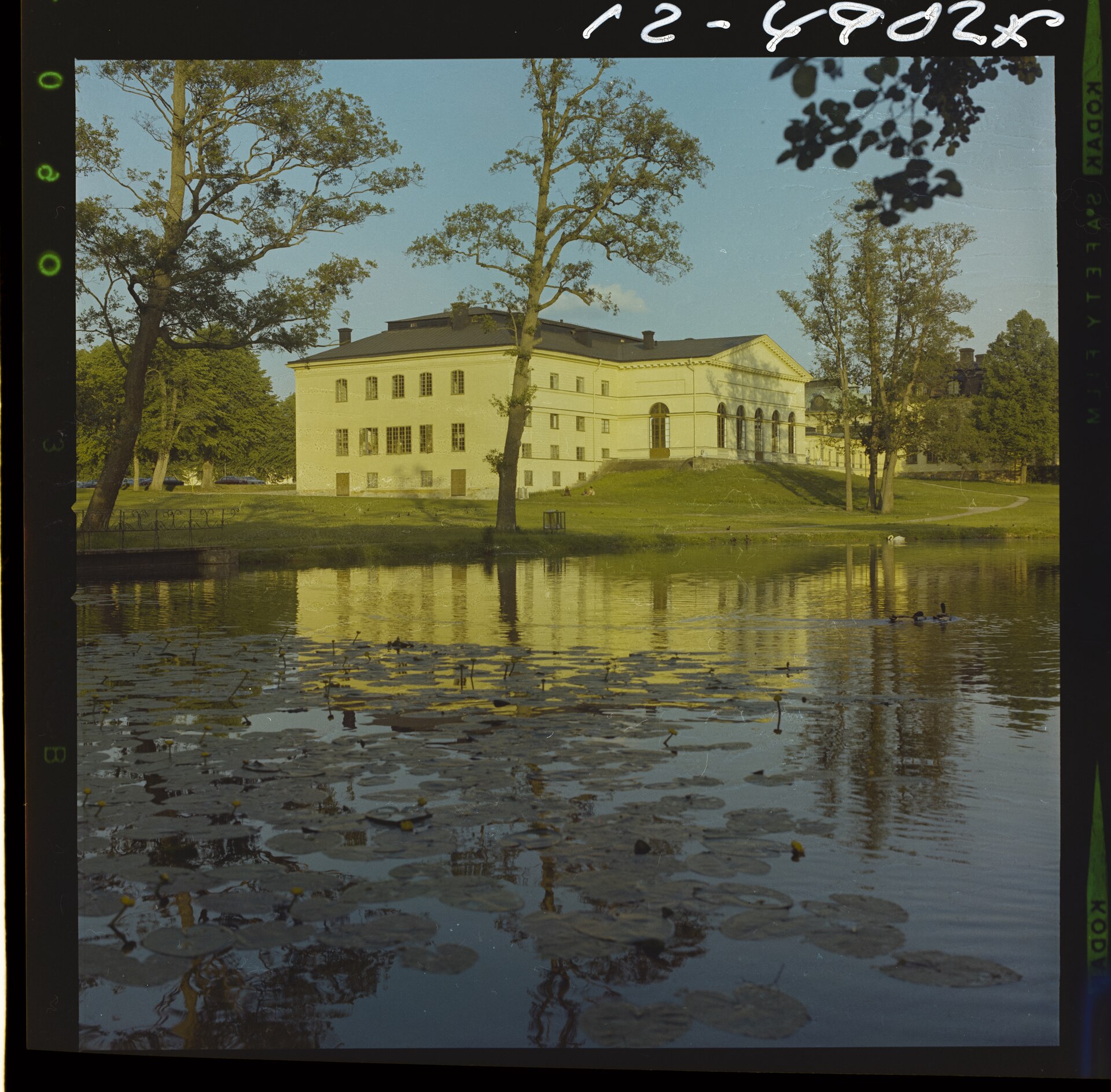
Drottningholms Slottsteater was built in 1766 and is one of the oldest theatres in the world still using its original eighteenth-century stage machinery. Painted backdrops, wind and thunder machines, and a system of wing flats designed for rapid scene changes survive largely intact, and the theatre is used for actual performances during summer seasons, not preserved purely as an exhibit.
That combination — a historic stage that still functions as a stage — is unusual, and it is one of the specific features UNESCO’s assessment points to when describing the completeness of the wider site.
What is Kina Slott, the Chinese Pavilion?
Kina Slott, the Chinese Pavilion, was built within the grounds in 1753 as a birthday gift from King Adolf Frederick to Queen Lovisa Ulrika, and rebuilt in a sturdier form in stone in the 1760s. It reflects a broader eighteenth-century European fashion for chinoiserie — European interpretations of Chinese design — rather than any direct architectural import, and it functioned as a private retreat within the wider palace grounds rather than a public building.
What are the gardens like?
Drottningholm has two distinct garden styles side by side. Closest to the palace is a formal baroque garden, laid out with straight axes, clipped hedges and sculpture, largely the work of Nicodemus Tessin the Younger. Beyond it lies an English-style park, landscaped later in the eighteenth century in a deliberately more naturalistic style, following a fashion that was spreading across European royal gardens at the time.
The grounds themselves are generally open to the public without a ticket, distinct from the palace interiors, theatre and pavilion, which typically require separate admission on schedules set by the operators managing them.
Is Drottningholm still a working royal residence?
Yes. King Carl XVI Gustaf and Queen Silvia have used Drottningholm as their permanent home since 1981, a fact stated on the Swedish Royal Court’s own site. The private residential wing is closed to visitors; the state apartments, theatre and Chinese Pavilion are managed separately as visitor attractions, open on schedules that change seasonally.
This split — private residence and public museum sharing one site — is not unusual for European royal palaces, but it does mean opening hours and ticketed sections can shift with royal use of the building, which is another reason to check current details with the Royal Court or Statens fastighetsverk directly rather than relying on a fixed schedule.
How does a visit to Drottningholm fit into a Stockholm trip?
Because Drottningholm sits outside the city centre, on a different island and in a different municipality, it is usually treated as a dedicated half-day excursion rather than something folded into a walk through central Stockholm. It appears often in itineraries built around a third or fourth day in the city, once the central sights — Gamla Stan, the Vasa Museum, Skansen — have been covered; the site’s guidance on what a third day in Stockholm makes room for covers this kind of pacing in more detail.
Some travel passes covering Stockholm’s attractions include Drottningholm among their sites; the mechanics of how such passes work, and what they typically cover, are explained in the site’s piece on what the Stockholm Pass covers. For the wider question of what else counts as essential viewing in the city, the Stockholm guide hub sets out museums, landmarks and neighbourhoods on their own terms, and the Landmarks & Sights archive covers individual sites in the same register as this one. Getting-around specifics, including how boat and bus links to Lovön are structured, sit within the Getting Around archive, and day-trip framing generally — how to weigh a half-day out of the centre against time spent in it — is covered in the Day Trips archive.
Opening hours, ticket prices and seasonal closures for Drottningholm’s palace, theatre and pavilion change year to year and are set independently by the Royal Court and Statens fastighetsverk. Readers planning a visit should confirm current details directly on those bodies’ own sites, and consult UNESCO’s official listing for the full case behind the site’s World Heritage status, rather than relying on any fixed figure repeated elsewhere.
Access Stockholm is an independent guide written from published, checkable sources. We have not visited the places described here and we do not publish personal recommendations or invented ‘local favourites’ — where something is singled out as notable, we say who says so. Opening times, fares, closures and prices change at short notice, so treat everything here as a starting point and confirm with the museum, operator or venue directly before building a day around it. We give no advice on visas, insurance, health or safety; use your own government’s official guidance for those.
Featured image: Photo by Mastad, source, CC BY-SA 3.0

Related reading
What Is Skogskyrkogården, and Why Is It a World Heritage Site?, Living in Stockholm, Stockholm, Practically