Kungsträdgården — literally “the King’s Garden” — is a public park and square in central Stockholm, on the Norrmalm side of the water facing Gamla Stan. It began as a royal kitchen and pleasure garden in the 16th century and has been open to the public since the 18th century. Today it functions as the city’s civic living room: part park, part event space, part transport hub.
Where is Kungsträdgården located?
Kungsträdgården sits on the Norrmalm side of central Stockholm, running roughly north to south between Hamngatan and the waterfront at Strömmen, the channel that separates Norrmalm from Gamla Stan. It is bordered by the NK department store and Sweden House (Sverigehuset), and lies within easy walking distance of Sergels torg to the north and Gamla Stan across the water to the south.
Because it connects several of the city’s busiest streets, Kungsträdgården functions less as a destination in itself and more as a route through which most visitors to central Stockholm pass without necessarily naming it. For orientation, it helps to read it alongside the city’s other major public square; the guide to what Sergels torg is and why it looks the way it does covers the adjoining pedestrian hub.
How did Kungsträdgården get its name and history?
The name reflects its origin as a working royal garden. In the 1500s, under King Gustav Vasa’s successors, the site was laid out as a kitchen garden supplying the nearby royal residence with vegetables, herbs and fruit. Queen Christina later had it developed into a more formal pleasure garden in the 17th century, with avenues and an orangery, in the French and Dutch style fashionable among European courts of the period.
The garden’s royal function faded as the city grew around it, and by the 18th century it had been opened for public use, gradually taking on the form of a civic square with formal plantings, statues and fountains rather than a working garden. The name stuck even after the vegetables disappeared.
The royal connection is still visible in the square’s monuments. A statue of King Karl XII stands at the southern end, facing east — traditionally read as facing toward Russia, a reference to his campaigns during the Great Northern War. A separate monument to Karl XIII stands near the square’s centre. For the broader royal context these figures sit within, the guide to what can be visited at Stockholm’s Royal Palace explains the residence the garden once served.
What was the Almstriden, and why does it matter?
The Almstriden — the “Elm Conflict” — was a 1971 public protest that stopped the city from felling a stand of mature elm trees in Kungsträdgården to build an entrance to the Kungsträdgården metro station. It is one of the defining moments in modern Swedish urban-planning history and is widely credited with shifting public attitudes toward development in central Stockholm.
City planners had approved the removal of the elms to make way for the station entrance and an expansion of nearby commercial buildings. Protesters occupied the trees, and the resulting standoff drew national attention. The plan was reversed, the elms were kept, and the episode is generally cited by Swedish historians of the city as a turning point that strengthened environmental and heritage protections in later Stockholm planning decisions. The trees that were saved still stand in the park today.
What happens at Kungsträdgården today?
Kungsträdgården functions as a year-round event space rather than a fixed attraction, and what is happening there depends heavily on the season.
- Spring: the park is known for a row of ornamental cherry trees near its centre, which draw large numbers of visitors when they blossom, typically over a short window in April or early May depending on that year’s weather.
- Summer: the square regularly hosts open-air festivals, concerts and food events, often organised around a temporary stage or pavilion structure.
- Winter: an open-air ice rink is typically installed in the square, alongside market stalls, making it one of the more visible winter gathering points in central Stockholm.
Because none of these events run to a fixed annual date, readers planning around a particular festival, the cherry blossom or the ice rink’s opening should confirm current dates directly with the City of Stockholm or the event organiser rather than relying on a fixed calendar; timing shifts from year to year with the weather and with municipal scheduling.
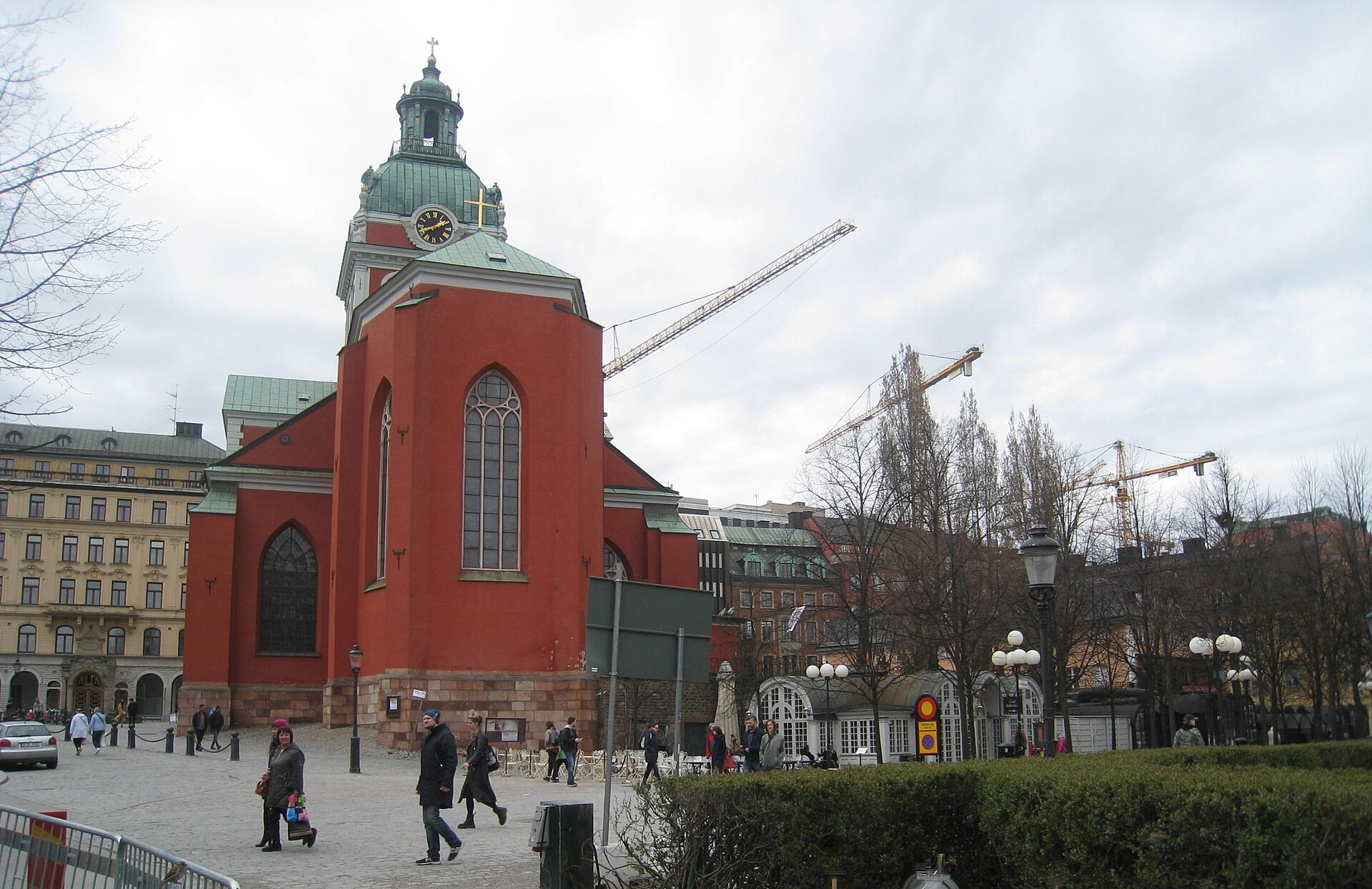

What is the Kungsträdgården metro station?
Kungsträdgården is also the name of a metro (T-bana) station on the Blue Line, one of the deepest and most architecturally distinctive stations in Stockholm’s system, built into bedrock beneath the square. Its platforms are treated as an unfinished cave space rather than a conventional tiled station, with exposed rock surfaces and sculptural elements — a style shared with several other Blue Line stations built in the same period.
Details of current lines, service patterns and fares are set and updated by SL (Storstockholms Lokaltrafik), the regional transport operator; readers should confirm current information on SL’s own site rather than relying on fixed figures, since fares and timetables change.
How does Kungsträdgården fit with the rest of central Stockholm?
Kungsträdgården works best understood as a hinge rather than a stop: it links Norrmalm’s commercial core to Gamla Stan across the water, and to Sergels torg’s pedestrian precinct to the north. Visitors moving between the old town and the department stores and offices of Norrmalm will generally cross it without a detour.
For residents, the square’s role is more functional still — a shortcut, a lunch spot near office buildings, a meeting point before a metro connection, and a seasonal gathering place for festivals and the winter rink. Its history as a protected green space, following the Almstriden, also makes it a reference point in local discussions about development and heritage protection in the city centre.
Readers interested in how this fits into the old town on the opposite bank can read the account of Gamla Stan’s age and layout, while those mapping the wider museum landscape nearby may find the collection at Nationalmuseum, a short walk along the waterfront, a useful next stop.
Is Kungsträdgården part of a museum or protected site?
No — Kungsträdgården is a municipally managed public park and square, not a museum, gallery or listed monument in its own right, though its elms and layout are protected as a result of the 1971 dispute. It sits within the broader category of Stockholm’s central landmarks and public squares rather than its museum institutions; the wider Landmarks & Sights archive and Neighbourhoods archive cover how it relates to comparable public spaces and districts across the city.
Anyone planning a route through central Stockholm’s institutions is likely to pass through or near Kungsträdgården regardless of whether it appears on a formal itinerary — which is largely the point of the square’s design, then and now.
Access Stockholm is an independent guide written from published, checkable sources. We have not visited the places described here and we do not publish personal recommendations or invented ‘local favourites’ — where something is singled out as notable, we say who says so. Opening times, fares, closures and prices change at short notice, so treat everything here as a starting point and confirm with the museum, operator or venue directly before building a day around it. We give no advice on visas, insurance, health or safety; use your own government’s official guidance for those.
Featured image: Photo by Bysmon, source, CC BY-SA 4.0
