Liljevalchs Konsthall is a municipally run exhibition hall on Djurgården in Stockholm. It holds no permanent collection. Instead it stages a rotating program of temporary art exhibitions, chosen by its own curators, plus one fixed annual event: Vårsalongen, the open-submission spring salon. That structure matters more than the building’s age if you are deciding whether to go.
What makes Liljevalchs different from Stockholm’s other art museums?
Most visitors assume any named art institution has something on the walls year-round. Liljevalchs doesn’t work that way. It is a konsthall — an exhibition hall, not a collecting museum.
Nationalmuseum and Moderna Museet both hold large permanent collections. A visitor can turn up on an ordinary Tuesday and see the Rembrandts, the Picassos, the national painting survey. Liljevalchs has none of that. Its galleries are emptied and reset between shows. Between exhibitions, the hall can be closed to the public entirely, sometimes for weeks.
This is a deliberate model, not a gap in funding. The hall exists to show changing contemporary and historical exhibitions curated for a limited run, usually a few months. When a show ends and the next hasn’t opened, there is often nothing to see.
Who built Liljevalchs, and when?
The building opened in 1916, designed by the Swedish architect Carl Bergsten. It was commissioned using a bequest from the merchant Carl Fredrik Liljevalch, after whom it is named.
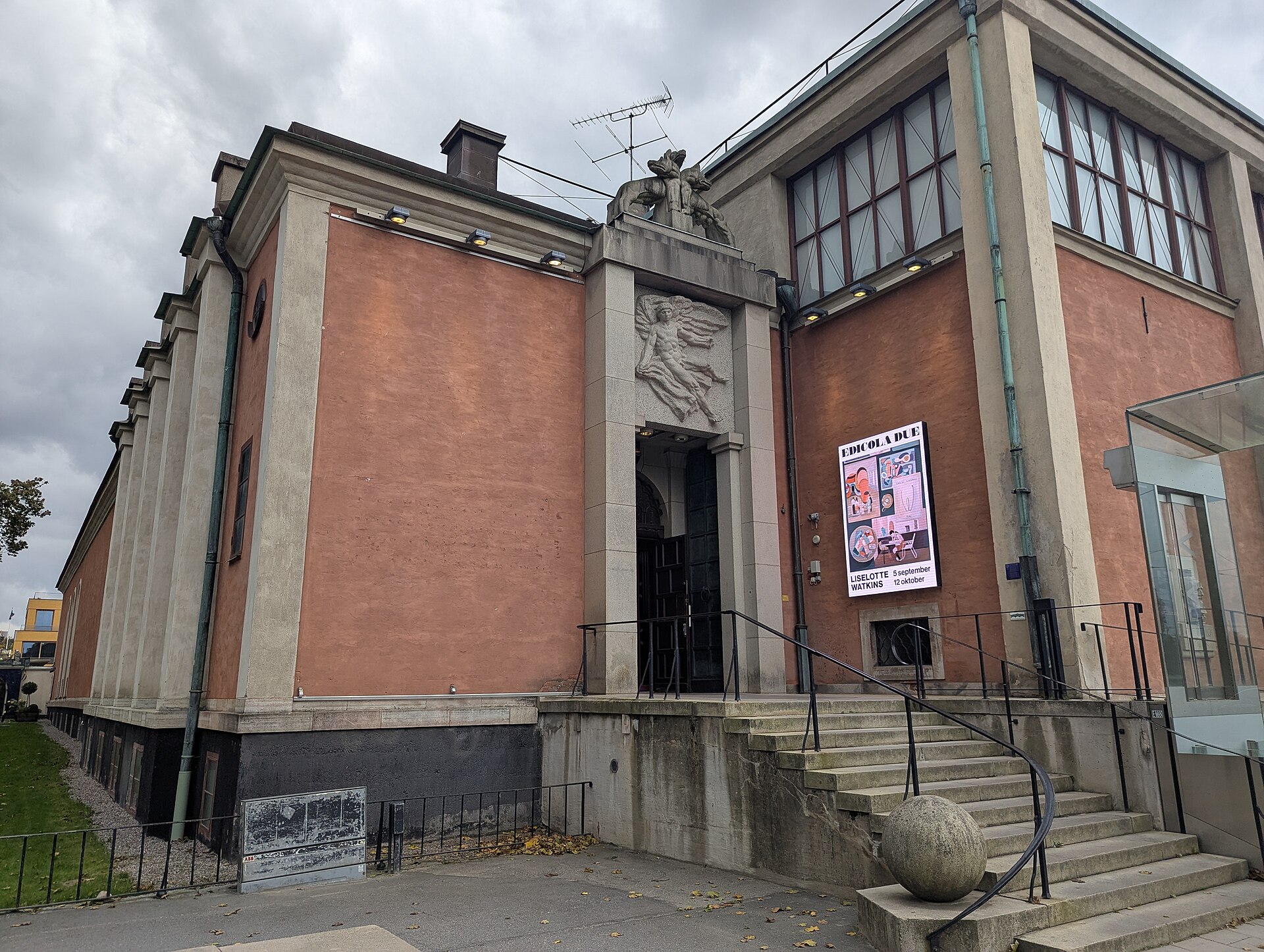
Bergsten’s design is a long, colonnaded neoclassical building with a strong horizontal roofline and a sequence of top-lit gallery rooms. The top lighting was a specific technical choice: it lets daylight into the exhibition spaces without direct sun hitting the art. Architectural historians generally cite it as an early and influential example of Swedish 20th-century neoclassicism applied to a public exhibition building, a style sometimes called Swedish Grace.
The hall sits within Stockholm’s wider museum cluster on Djurgården, an easy walk from Skansen, Vasamuseet and Nordiska museet. For context on the park itself rather than its museums, see this guide to Djurgården as a park, not just a museum district.
What is Vårsalongen, and when does it run?
Vårsalongen is Liljevalchs’s annual open-submission exhibition. Any artist can submit work for consideration by a jury, regardless of training or gallery representation. It typically runs across February and March, though exact dates shift each year and should be checked on the hall’s own site.
The salon has run since 1921, making it one of the longest-standing recurring art exhibitions in Sweden. Thousands of works are typically submitted each year; only a fraction are selected for display, and the selection process itself is often covered in Swedish arts press as a story in its own right.
For a visitor, Vårsalongen is the one fixed point in an otherwise unpredictable calendar. It is the closest thing Liljevalchs has to a guaranteed, recurring event — but it still falls within a specific window, not year-round.

Is it worth going? A decision rule before you plan around it
The single most useful fact about Liljevalchs is this: there is no fallback exhibition. A pass or a “we’ll just drop by” approach, which works fine at Nationalmuseum or Moderna Museet, does not work here.
Before including Liljevalchs in a day plan, check two things on its own website: whether an exhibition is currently open, and whether the dates overlap with a visit. The table below sets out the logic.
| Situation | What it means for a visit |
|---|---|
| A named exhibition is listed as currently open | Worth checking ticket details and hours; this is a normal visit window |
| Dates fall in February or March | Vårsalongen may be running — check exact dates, since they move year to year |
| No exhibition listed, or site shows a gap between shows | The hall may be closed to the public; do not plan around it without confirming |
| Comparing to Nationalmuseum or Moderna Museet | Those hold permanent collections and are open-ended; Liljevalchs is not a like-for-like substitute |
This is also why Liljevalchs rarely features on combined museum passes in the same way as collection-holding institutions. For how those passes compare more broadly, see this breakdown of free versus paid museums and whether an attraction pass pays off.
What is the Liljevalchs+ extension?
Liljevalchs+ is a newer annex built alongside the 1916 hall, designed by the architect Gert Wingårdh. It added further exhibition space without altering Bergsten’s original building, which remains the main public entrance and principal gallery sequence.
The addition reflects a common pattern in Stockholm’s older public buildings: a protected historic structure extended rather than replaced, so a 1916 neoclassical hall and a contemporary annex now sit on the same site. Readers interested in how Stockholm treats its older civic buildings more generally can find related context in the Landmarks & Sights archive.
Where is Liljevalchs, and how do you get there?
Liljevalchs sits on Djurgårdsvägen on Djurgården, within walking distance of the island’s other major museums. Djurgården is reached by tram, bus, the seasonal Djurgården ferry from Slussen or Nybroplan, or on foot across Djurgårdsbron from Strandvägen.
Public transport to the island runs on standard SL fares; there is no separate island ticket. For how the fare zones and card work in general, see this explainer on Stockholm metro zones and fares. Residents weighing up an annual travel card against pay-per-ride can check whether the SL travel card is worth it for a Stockholm resident.
Because Djurgården has no permanent residential population to speak of and several major museums close together in low season, it’s worth reading how the island functions as a park before building a day around a single hall. See this guide to Djurgården as a park for that context.
What should a first-time visitor check before going?
Three things, in order: current exhibition status, opening hours for that specific week, and ticket price. All three are set and changed by Liljevalchs itself, and none should be assumed from a general sense of how Stockholm museums work.
- Exhibition calendar: confirm something is actually on, not just that the building exists.
- Opening hours: these can differ between an active exhibition period and a gap between shows.
- Ticket price: confirmed on the hall’s own site, since prices and any free-entry windows change over time.
This pattern — a fixed historic building with a genuinely variable program — is unusual among Stockholm’s major museums, most of which hold stable, year-round collections. For a wider view of how the city’s museums are organized and what each one actually holds, the Museums & Galleries archive is a useful starting point, and the Stockholm guide hub sets Liljevalchs in context against the city’s landmarks and neighborhoods more broadly.
Access Stockholm is an independent guide written from published, checkable sources. We have not visited the places described here and we do not publish personal recommendations or invented ‘local favourites’ — where something is singled out as notable, we say who says so. Opening times, fares, closures and prices change at short notice, so treat everything here as a starting point and confirm with the museum, operator or venue directly before building a day around it. We give no advice on visas, insurance, health or safety; use your own government’s official guidance for those.
Featured image: Photo by AleWi, source, CC BY-SA 4.0
