Östermalms Saluhall is Stockholm’s oldest purpose-built indoor market hall, opened in 1888 on Östermalmstorg square. It was built as a permanent, hygienic alternative to open-air food markets. After a long renovation that closed the building for several years, it reopened as a restored market hall that mixes traditional food counters with sit-down eating — closer to a food hall than a plain grocery market.
What was Östermalms Saluhall originally built to do?
It was built to move perishable food trade indoors, off the street stalls that had supplied central Stockholm until the late 19th century. Open-air markets were considered a public health problem — meat, fish and dairy sold without refrigeration or drainage — and the city’s response, in several districts, was to build enclosed halls with running water, proper drainage and stone or tiled interiors that could be hosed down.
Östermalms Saluhall was one of these purpose-built halls, designed for the well-off residential district growing up around it as Östermalm was laid out with wide boulevards in the late 1800s. The building itself is a red-brick market hall with a steel-framed interior, a style shared by other market halls built in European cities during the same decades for the same sanitary reasons.
Who designed it, and is the building protected?
The hall was designed by the architect Isak Gustaf Clason, who also designed Nordiska museet on Djurgården. Its exterior is a deliberately monumental red-brick facade, in keeping with the grander architecture Clason applied to public buildings of the period, while the interior structure uses iron and steel to create the open span needed for market stalls.
The building carries heritage protection under Sweden’s cultural-monument rules, administered through Stockholm City Museum’s classification system, which rates buildings of historical and architectural significance on a colour-coded scale. A hall of this age, by this architect, on this site falls into the category of buildings the city treats as part of its protected built heritage — meaning any renovation has to work within strict constraints on the historic fabric, rather than simply gutting and rebuilding.
Why did it close, and what happened during the renovation?
The hall was closed for a multi-year renovation because the building’s structure — brick, ironwork and roof — needed conservation work that could not be done around an operating market. Stockholm’s municipal property arm led the restoration, working within the constraints of the building’s protected status, which meant repairing rather than replacing original materials wherever the historic fabric allowed it.
During the closure, traders relocated to a temporary structure built nearby so that regular customers were not left without a market for the duration of the works. That kind of stopgap arrangement is a familiar pattern in central Stockholm, where the city’s own heritage rules mean listed buildings are conserved on a much longer timeline than an ordinary commercial refit would take.

What is Östermalms Saluhall now?
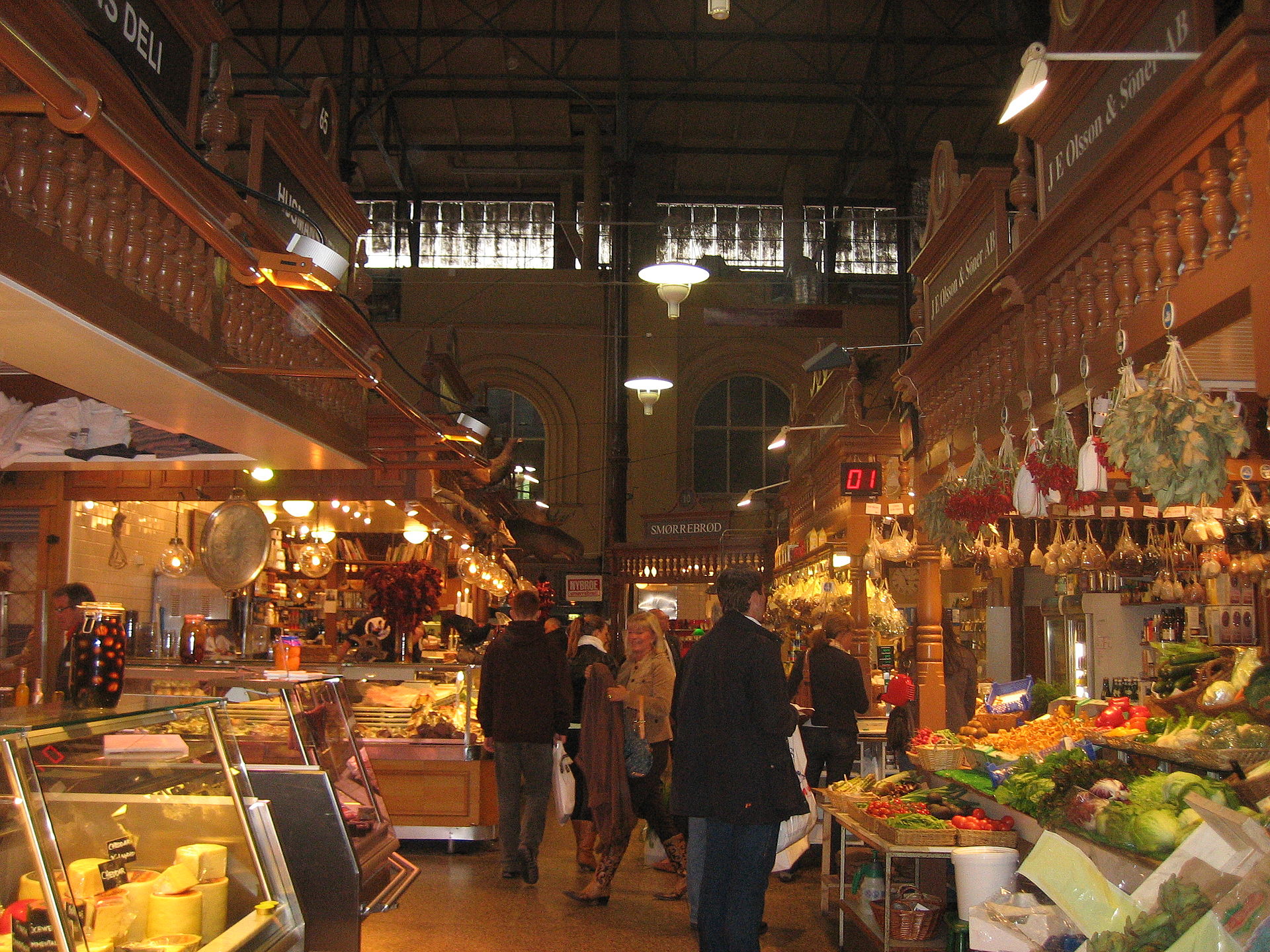
Since reopening, the hall functions as a mix of traditional market counters — fishmongers, butchers, cheese specialists, delicatessens — and food stalls with seating, meant for eating on the spot rather than only buying to take home. The building’s own operators describe the post-renovation hall as combining its original role as a food market with a stronger emphasis on dining inside the building itself.
This is a real shift from the hall’s 19th-century function, where the point was to buy raw ingredients for cooking at home. The current mix still includes traders selling meat, fish, bread and cheese by weight, but a significant part of the floor is now given over to counters designed to be eaten from directly, with shared tables under the original iron roof structure.
Because the specific traders inside any market hall change over time — leases end, businesses turn over — this is not the kind of detail that stays fixed for long. What is durable is the building’s dual identity: a listed 1888 market hall that still trades food, now operating with a heavier weighting toward eating in rather than shopping to cook.
Is it aimed at residents or at visitors?
It serves both, but its original customer base was the residential district around it. Östermalm was, and largely remains, one of central Stockholm’s more affluent inner-city areas, and the hall was built to serve exactly that kind of neighbourhood grocery demand — a role covered in more detail in this guide to how Östermalm is laid out.
Since the renovation, the balance has shifted further toward visitors and lunch trade, given the added seating and food-stall format, but the market counters selling raw fish, meat and cheese are still stocked for people doing ordinary household shopping, not only for people eating a single meal there. Both uses coexist under the same roof, which is part of what distinguishes a working market hall from a food court built purely for tourism.
How does it fit into the wider pattern of Stockholm’s food markets?
Stockholm built several enclosed market halls in the same period, for the same sanitary reasons, and Östermalms Saluhall is the best known survivor of that wave still operating largely on its original site and in its original building. Other Swedish cities built comparable halls in the same decades, part of a broader European movement toward covered, regulated food markets.
For a reader trying to understand Stockholm’s food culture more broadly — including where fresh produce, fish and prepared food fit into daily life in the city — the pattern is covered across Access Stockholm’s food and markets coverage, and the hall’s role as a fixture of daily life for people living in the city, as distinct from its appeal to a visitor passing through, is part of what the living-in-Stockholm hub sets out to explain.
Where is it, and how do you get there?
Östermalms Saluhall stands on Östermalmstorg, a square in the Östermalm district of central Stockholm, within walking distance of the inner-city core. The area is covered in Access Stockholm’s neighbourhood guides, and how far it sits from other central landmarks is a matter of a few hundred metres rather than a journey — a distance set out in general terms in this guide to walking distances in central Stockholm.
As with any market hall, opening times and which individual traders are operating on a given day should be confirmed directly, since both are the kind of detail that changes without notice. The building’s role as a place people actually eat rather than just shop connects to the wider pattern of eating out in the city, including the fixed daily habit covered in this explanation of fika.
What should a first-time visitor understand about it?
The short version: it is not a curated tourist market built to look historic — it is an actual 1888 market hall, protected as heritage, that has been renovated to keep functioning as a market while adding more space for eating on site. Anyone comparing it to other Stockholm landmarks and museums can find that broader context in Access Stockholm’s guide to the city’s museums, landmarks and neighbourhoods.
What makes it worth understanding, rather than just visiting, is that it shows how Stockholm treats its 19th-century commercial buildings: not as museum pieces frozen in time, but as working buildings kept in continuous use under heritage rules that shape how much of them can change.
Access Stockholm is an independent guide written from published, checkable sources. We have not visited the places described here and we do not publish personal recommendations or invented ‘local favourites’ — where something is singled out as notable, we say who says so. Opening times, fares, closures and prices change at short notice, so treat everything here as a starting point and confirm with the museum, operator or venue directly before building a day around it. We give no advice on visas, insurance, health or safety; use your own government’s official guidance for those.
Featured image: Photo by Manuel Velazquez, source, CC BY 3.0
