Hötorgshallen is an indoor food market built underground beneath Hötorget, a square in Stockholm’s Norrmalm district. It opened in 1958 as part of a large postwar rebuilding of the area, and today holds fishmongers, butchers, cheese counters, spice and grocery traders, and a scatter of small eateries inside a single hall — distinct from the open-air fruit, vegetable and flower stalls that still operate on the square directly above it.
Where is Hötorgshallen located?
Hötorgshallen sits beneath Hötorget, a square in central Norrmalm on the edge of Stockholm’s main shopping streets. The name Hötorget translates literally as “hay square” — a reference to its centuries-old role as a market for hay and farm produce before it became a food and produce market in the modern sense. The hall occupies a basement level directly under the square, reached by stairways from street level.
The square sits close to Sergels torg and Drottninggatan, both central reference points for anyone finding their way around this part of the city, and within the district covered in more detail in the site’s guide to Norrmalm and its postwar rebuilding.
How did Hötorgshallen come to be built?
Hötorgshallen dates from 1958, built as part of a wider mid-20th-century redevelopment of this stretch of Norrmalm. That programme — often referred to in Swedish planning history as the Norrmalm regulation — demolished large parts of the old Klara district and replaced them with the five high-rise office blocks known as the Hötorgsskraporna, along with Sergels torg and, later, Kulturhuset. The underground market hall was built into this same plan, giving the square a food market that operated below ground while the towers rose above it.
This makes Hötorgshallen a product of the same era of large-scale city planning that reshaped central Stockholm’s street pattern, an era covered from a different angle in the site’s coverage of Sergels torg, the plaza that anchors the same redevelopment a short walk away.
What is inside Hötorgshallen today?
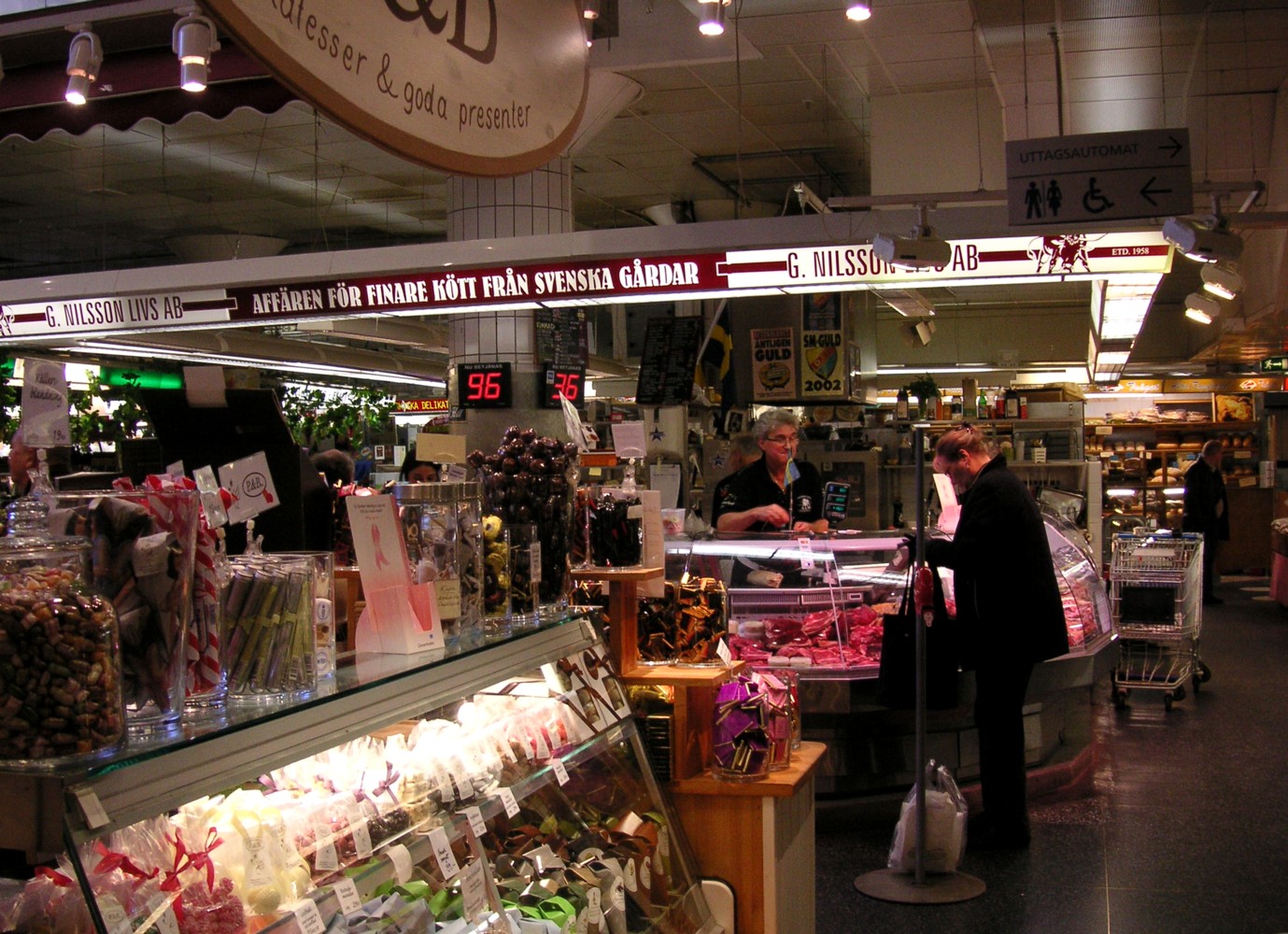
The hall is organised as a run of independent stalls and small shops rather than a single retailer, a format shared with Stockholm’s other historic saluhallar (market halls). Typical counters include:
- Fishmongers selling fresh and preserved fish and shellfish
- Butchers, including halal counters reflecting the hall’s long-standing mix of traders
- Cheese and deli counters
- Spice, grain and dried-goods traders serving Middle Eastern, North African and Asian cooking
- A small number of counters and cafés selling prepared food for eating on the spot
Visit Stockholm, the city’s official tourism site, lists Hötorgshallen among Stockholm’s indoor food markets and notes its concentration of international grocers alongside more traditional Swedish fish and meat counters — a mix that has defined the hall for decades and set it apart from the more uniformly upmarket reputation of some of the city’s other market halls.

How is Hötorgshallen different from Östermalms Saluhall?
Stockholm has more than one historic indoor market hall, and they are not interchangeable. Östermalms Saluhall, in the affluent Östermalm district, is a listed 19th-century building with a reputation — documented in the site’s own separate article on what Östermalms Saluhall is and what it is now — built around specialist fishmongers, high-end delis and formal restaurants inside an ornate brick hall.
Hötorgshallen is architecturally and commercially a different proposition: a mid-20th-century underground hall built for practicality rather than display, and long associated with the everyday, multicultural retail that grew up in central Stockholm as the city’s population diversified through the later 20th century. Both halls sell fresh food; the buildings, dates and clientele they were designed around differ substantially, and that difference is part of what makes each one a legitimate entry point into a different slice of the city’s history.
What is the outdoor market at Hötorget?
Above Hötorgshallen, on the square itself, an open-air market continues to operate, selling fruit, vegetables and cut flowers from stalls set up in the open air. This street-level market has a much longer continuous history than the underground hall, tracing back to the square’s original role as a produce market before the postwar towers were built. The outdoor stalls and the underground hall are frequently described together as “Hötorget’s market” but are two physically separate operations — one at street level, exposed to the weather and Stockholm’s seasonal daylight described in the site’s piece on how light changes through a Stockholm year, the other indoors and unaffected by season.
How do you get to Hötorgshallen?
Hötorget has its own metro station on Stockholm’s green line, putting the square within a short walk of central connections including T-Centralen, the city’s main metro hub. The wider fare and zone structure that governs a single-ride or day ticket for reaching the area is explained in the site’s guide to Stockholm metro zones and fares; as with all current fares, the operator SL’s own site should be checked for up-to-date prices.
The square is also within reasonable walking distance of Drottninggatan, one of central Stockholm’s principal pedestrian shopping streets, covered separately in the site’s article on Drottninggatan.
What is near Hötorget besides the market?
Hötorget square is also home to Konserthuset, the blue-fronted Stockholm Concert Hall that is the venue for the Nobel Prize award ceremony each December and the base of the Royal Stockholm Philharmonic Orchestra. The five Hötorgsskraporna office towers built in the same redevelopment still stand around the square, and Kulturhuset, the city’s public culture and library building, sits a short walk away toward Sergels torg. Together these buildings make Hötorget a useful anchor point for understanding how central Stockholm was rebuilt in the mid-20th century, a subject explored further in the site’s broader coverage of Stockholm’s neighbourhoods and in the general guide to the city under Stockholm Guide.
Does Hötorgshallen matter to residents as well as visitors?
Yes, and arguably more so. Unlike some of the city’s more tourist-oriented market halls, Hötorgshallen’s trader mix — spice merchants, halal butchers, cheese counters serving a wide range of cuisines — reflects everyday grocery shopping patterns for residents of central and inner Stockholm rather than a curated visitor experience. Its underground, all-weather setting also makes it a practical stop regardless of season, relevant to the kind of planning covered in the site’s guide to planning a Stockholm day in the rain. For anyone building a broader picture of how food shopping actually works in the city day to day, the site’s Food & Markets archive and its hub on what it is like to actually live in Stockholm both go into more detail.
Access Stockholm is an independent guide written from published, checkable sources. We have not visited the places described here and we do not publish personal recommendations or invented ‘local favourites’ — where something is singled out as notable, we say who says so. Opening times, fares, closures and prices change at short notice, so treat everything here as a starting point and confirm with the museum, operator or venue directly before building a day around it. We give no advice on visas, insurance, health or safety; use your own government’s official guidance for those.
Featured image: Photo by Holger Ellgaard, source, CC BY-SA 3.0
