Stockholm City Hall — Stadshuset in Swedish — is the building where Stockholm’s municipal council and administration are based. It is a working seat of local government, not a royal or national building, and it is also where the Nobel Prize banquet is held each December. Parts of it can be visited on guided tours.
What is Stockholm City Hall, exactly?
Stadshuset is the headquarters of Stockholm’s municipality: the city council chamber, the offices of elected officials, and ceremonial halls used for civic functions are all housed inside it. It was designed by the architect Ragnar Östberg and built between 1911 and 1923, in a style now generally described as National Romantic — a Swedish architectural movement that drew on medieval and Nordic motifs rather than classical ones.
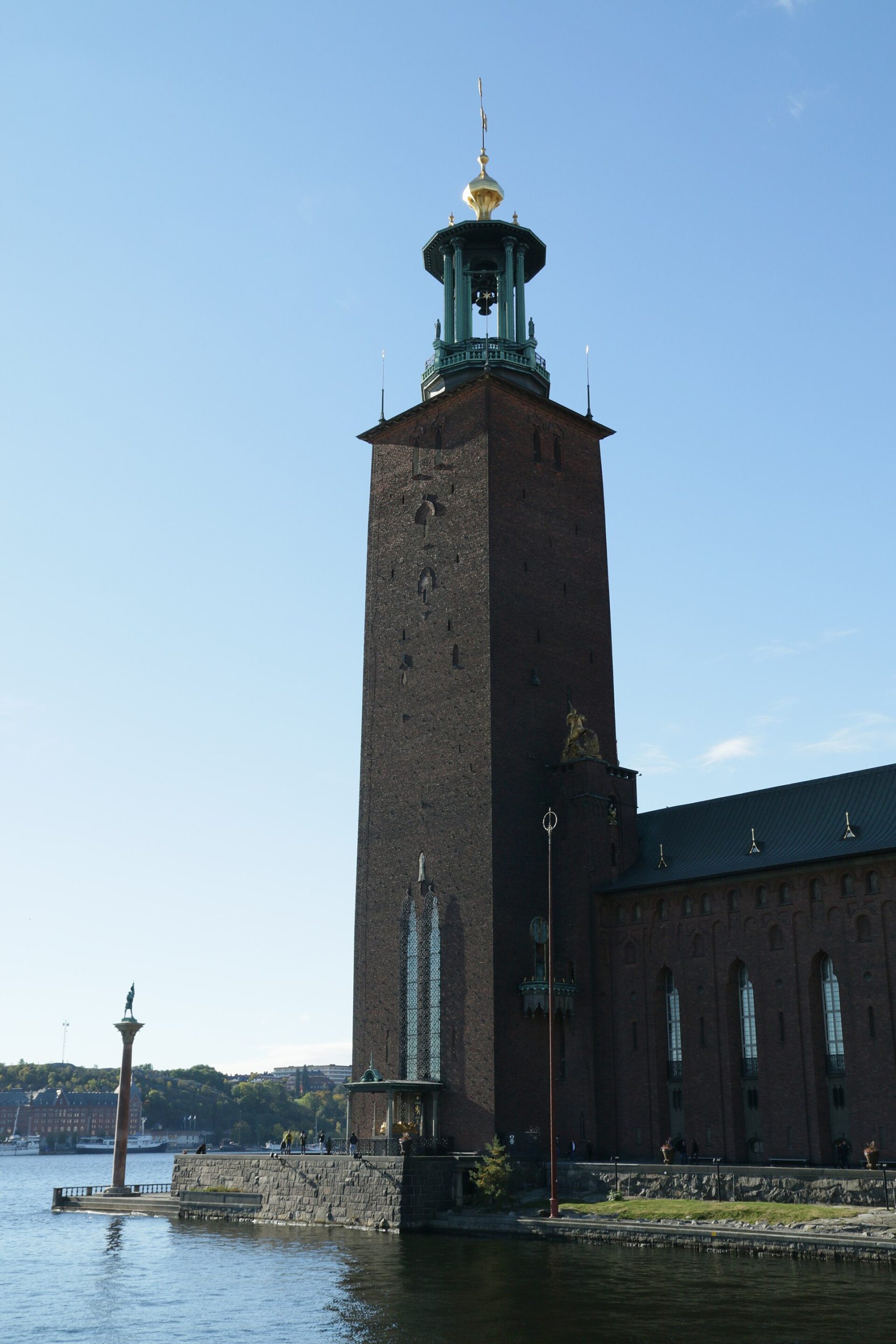
The building sits on the eastern tip of Kungsholmen, facing the water of Riddarfjärden, a bay of Lake Mälaren. Roughly eight million red bricks were used in its construction, along with granite and, in its most decorated interiors, imported and gilded materials. It is one of the most photographed buildings in the city, but its primary function has never changed: it is city hall in the literal sense, the administrative centre of Stockholm’s local government.
Why was it built where it is?
The site was chosen partly for visibility and partly for practicality: a prominent waterfront position on Kungsholmen, close to the older government and commercial districts across the water, gave the new municipal building a civic presence without placing it inside the historic core. Kungsholmen itself is covered in more detail in the neighbourhoods archive, which sets out how Stockholm’s individual islands and districts developed.
The result is a building meant to be seen from across the water as much as approached on foot — the tower in particular was designed as a landmark visible from the lake and from Södermalm to the south.
What actually happens inside Stockholm City Hall?
Day to day, Stadshuset functions as an office building for elected representatives and municipal staff. Stockholm’s city council — the elected body responsible for local government — meets in the Council Chamber, a room whose open timber ceiling was designed to evoke a Viking longhouse turned upside down. This is where policy on schools, housing, transport and other municipal responsibilities is formally debated and voted on.
Beyond routine government business, the building hosts civic ceremonies, official receptions, and — most famously outside Sweden — the Nobel Prize banquet. It is not a museum in the conventional sense, and unlike the institutions covered in the museums and galleries archive, its principal purpose is administrative rather than curatorial. Visitors see it because of what the building is used for, not because it holds a collection.
What is the Blue Hall?
The Blå hallen, or Blue Hall, is the large ground-floor hall used for banquets, including the Nobel Prize dinner. Despite the name, it was never painted blue — Östberg reportedly changed his plans once he saw how the exposed brick looked in natural light, and left it unpainted, though the name stuck.
It is a double-height space with a monumental open staircase, built to hold large formal dinners and civic events. Its brick surfaces and scale are part of what distinguishes Stadshuset from the gilded palace interiors elsewhere in the city, such as those described in the piece on the Hallwyl Museum’s preserved palace rooms.
What is the Golden Hall?
The Gyllene salen, or Golden Hall, sits above the Blue Hall and is used for receptions and dancing, including the Nobel Prize ball that follows the banquet. Its walls are covered in mosaics made from around 18 million pieces of glass and gold, designed by the Swedish artist Einar Forseth. The mosaics depict figures from Swedish history and myth, including a large central image generally identified as the “Queen of Lake Mälaren,” a symbolic figure representing Stockholm itself.
The scale and material of the Golden Hall put it in the same category as a handful of other richly decorated Stockholm interiors — alongside the state rooms described in the article on what can be visited inside Stockholm’s Royal Palace — though Stadshuset is a municipal, not royal, building.

How does City Hall relate to the Nobel Prize?
Since the 1930s, the Nobel Prize banquet — the formal dinner held after the prizes are awarded — has taken place in the Blue Hall, with the subsequent dance in the Golden Hall. The prizes themselves are awarded at separate ceremonies elsewhere in the city (the Nobel Prize in literature, peace, and sciences are handled through distinct events and venues), but the banquet at Stadshuset is the event most associated internationally with the building.
Details of the prize, its history, and its associated award ceremonies are set out by the Nobel Foundation on its own site, nobelprize.org, which is the primary authoritative source for how the ceremonies are organised each year. Stockholm’s dedicated museum on the subject is covered separately in the article on what the Nobel Prize Museum in Stockholm holds, which is a different institution from City Hall itself and should not be confused with it.
Can visitors go inside Stockholm City Hall?
Parts of the interior — including the Blue Hall, the Golden Hall, and the Council Chamber — are generally open to the public via guided tours run by the City of Stockholm, though access can be restricted around official functions and events. Because Stadshuset remains a working government building, opening arrangements and tour schedules are set and changed by the city administration rather than by a museum or tourism board.
Given how often such arrangements shift — and because this is a functioning municipal building rather than a static heritage site — readers should confirm current tour times, group sizes and any closures directly with the City of Stockholm before planning a visit, rather than relying on a fixed schedule published elsewhere.
What about the tower?
Stadshuset’s tower rises roughly 106 metres above the waterline and is topped by three gilded crowns, a recurring symbol in Swedish civic heraldry known as Tre Kronor (“Three Crowns”). The tower can typically be climbed separately from the ground-floor halls, usually on a seasonal basis, and offers a view over central Stockholm, Riddarfjärden and the surrounding islands.
Because the tower’s opening months and ticketing are set independently of the hall tours and can change from year to year, exact current arrangements should be checked with the operator rather than assumed from past visits.
How does City Hall compare to Stockholm’s other landmark buildings?
Stadshuset is often mentioned alongside Stockholm’s other major historic structures, but its role is distinct. It is neither a royal residence, like the Royal Palace, nor an ecclesiastical building, like Storkyrkan, Stockholm’s cathedral, nor a burial site for monarchs, like Riddarholmen’s royal church. It is a twentieth-century civic building whose entire design brief was to house elected local government and give it a fitting public face.
That distinction matters for anyone trying to map Stockholm’s landmarks by function rather than by appearance: several of the city’s most photographed buildings — City Hall among them — are still in active daily use for the purposes they were built for, rather than preserved as museum pieces. A broader survey of how the city’s landmark buildings differ in function is set out in the landmarks and sights archive.
How does City Hall fit into a visit to central Stockholm?
Geographically, Stadshuset sits on the edge of Kungsholmen, within walking distance of Norrmalm and within view of Södermalm and Riddarholmen across the water. It is often visited in combination with the older core of the city, including Gamla Stan, Stockholm’s Old Town, though the two are separated by open water and are best treated as distinct stops rather than a single combined route.
For residents, the building is a more concrete presence than a tourist landmark: it is where local council decisions affecting housing, schools and transport are actually made, and its public tours are one of relatively few ways for the general public to see the working interior of a European city government up close.
As with any operational government building, the reliable approach is to treat published tour times, ticket arrangements and any seasonal closures as provisional until confirmed on the City of Stockholm’s own current information, particularly around December, when Nobel-related events can restrict public access at short notice.
Access Stockholm is an independent guide written from published, checkable sources. We have not visited the places described here and we do not publish personal recommendations or invented ‘local favourites’ — where something is singled out as notable, we say who says so. Opening times, fares, closures and prices change at short notice, so treat everything here as a starting point and confirm with the museum, operator or venue directly before building a day around it. We give no advice on visas, insurance, health or safety; use your own government’s official guidance for those.
Featured image: Photo by Arild Vågen, source, CC BY-SA 3.0
