Vaxholm is a small town on the island of Vaxön, about 35 kilometres northeast of central Stockholm, sitting at the point where the main shipping channel from the Baltic narrows before reaching the capital. It was fortified because that narrow channel, Vaxholmsleden, was for centuries the obvious route for any hostile fleet to take into Stockholm, and a fortress there could block or delay an attack before it reached the city.
What is Vaxholm today?
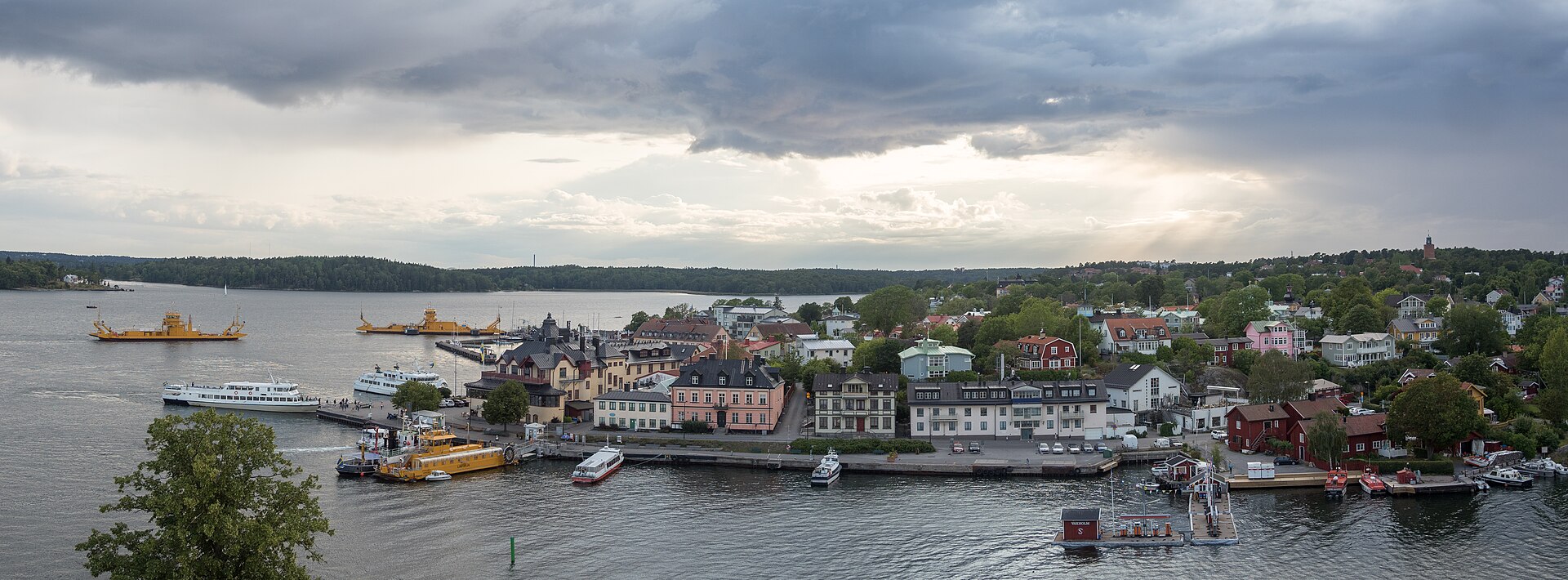
Vaxholm is both a town and, loosely, a name attached to the strait it guards. The town occupies Vaxön, one of the larger islands in the inner ring of the Stockholm archipelago, and functions as the archipelago’s unofficial gateway — the point where road traffic from the mainland meets the network of ferries fanning out to the outer islands.
The town itself dates to 1652, when it was granted municipal status (stadsprivilegier), largely to serve and supply the garrison already stationed there. Much of its older waterfront consists of wooden 19th-century buildings, a scale and character typical of archipelago towns that grew up around a customs post, a harbour, and a military installation rather than around trade or industry.
Why was Vaxholm fortified in the first place?
Stockholm has no direct sea frontage on the open Baltic — every approach by water runs through a maze of islands, and Vaxholmsleden was historically the deepest and most navigable of those channels, the one a warship could actually use. Whoever controlled that strait controlled whether an enemy fleet could reach the capital at all.
The first fortification order for Vaxholm is generally dated to 1548, under King Gustav Vasa, as part of a wider effort to defend Stockholm against Danish and other Baltic naval powers during a period of near-constant rivalry between Sweden and its neighbours. A timber and earth structure gave way over the following centuries to stone, and the fortress was rebuilt and enlarged repeatedly as artillery ranges increased and the definition of an adequate defensive perimeter changed.
What is the fortress that stands there now?
The current structure, Vaxholms kastell (often called Vaxholms fästning, “Vaxholm fortress”), is a round, thick-walled granite fort built mainly in the 1830s–60s, replacing older works on the same small islet just off Vaxön. Its heavy circular form and casemated walls reflect mid-19th-century fears — sharpened by events like the Crimean War — that a modern naval power, chiefly Russia, could bring ironclad ships and long-range guns against Stockholm’s approaches.
Despite that scale of preparation, the fortress’s own museum record, maintained by the organisation that runs it today, describes a defensive installation that was never seriously tested in full combat; its role was largely to make an attack on Stockholm by sea look too costly to attempt, and periodically to fire warning shots at unidentified or unauthorised vessels during tense periods, including both world wars. Confirm current details of the museum’s exhibits and access on its own site before planning a visit.
Today the fortress houses a museum devoted to the defence of Stockholm’s sea approaches — coastal artillery, mine warfare, and the broader history of Sweden’s archipelago fortifications — reachable by a short boat crossing from Vaxholm town rather than on foot, since the fort itself occupies its own small islet in the strait.
p.jpg)
Why does a town this size matter to the wider archipelago?
Vaxholm’s military role explains its layout, but its practical role today is as a transport hub. The regional ferry operator that serves the Stockholm archipelago, Waxholmsbolaget, takes its name directly from the town, a reflection of how central Vaxholm has long been to movement through the islands — first as a checkpoint and garrison, later as a harbour where routes to the outer archipelago converge.
For a visitor working out how to actually get into the archipelago rather than just look at it from the mainland, Vaxholm functions as a natural first stop: close enough for a half-day out from the city, and a junction point for boats continuing further out. The mechanics of that boat network — routes, seasons, and how timetables thin out in winter — are covered in a piece on how the archipelago boats actually work by season, and the broader logistics of fitting an archipelago stop into a limited itinerary are set out in a separate guide on fitting the archipelago into a short trip.
How do you get to Vaxholm?
There is no rail line to Vaxholm; access is by road or by water. Buses run from Stockholm’s northern suburbs to the town, and passenger boats — usually Waxholmsbolaget services — connect it to central Stockholm and to islands further out. Because it sits on a strait rather than the open sea, the crossing to the fortress islet itself is short, typically a few minutes by a small dedicated ferry that runs alongside the museum’s opening pattern.
As with most of Sweden’s public transport, timetables and fares change with the season and should be confirmed on the operator’s own site rather than assumed from a previous visit. The wider question of how boat-based transport in the region is structured, including whether standard Stockholm travel cards apply on archipelago routes, is covered in the site’s overview of how to actually visit the Stockholm archipelago.
Is Vaxholm part of Stockholm, administratively?
No. Vaxholm is its own municipality (Vaxholms stad), separate from the City of Stockholm, one of the smaller municipalities in Stockholm County. It is worth noting for residents and repeat visitors trying to map the region: Stockholm’s own city boundaries, and the difference between the inner city and its surrounding municipalities, are explained in the site’s piece on how Stockholm is divided administratively. Vaxholm sits well outside that inner boundary, closer in character to the archipelago municipalities than to any Stockholm suburb.
Does Vaxholm’s fortress fit into a wider pattern of Stockholm defences?
Yes. Vaxholm was one node in a layered system of coastal defence rather than a single isolated fort. Stockholm’s approaches were guarded by multiple fortified points at different periods, and the city’s own inner islands carried military installations of their own — a reminder that Stockholm’s geography, built across a cluster of islands, made naval approach both a hazard to defend against and the reason the city could be defended at all in the first place. General background on the islands the capital itself occupies is set out in the site’s explainer on which islands Stockholm is built on.
Read alongside that, Vaxholm makes more sense as a single, well-preserved example of a defensive logic that shaped much of the region: control the channel, and you control access to the capital behind it. For visitors weighing a fortress and a working small town against the archipelago’s other day-trip options, background on the categories those trips fall into is gathered on the site’s day trips and landmarks and sights sections, and broader planning context sits on the practicalities hub.
Access Stockholm is an independent guide written from published, checkable sources. We have not visited the places described here and we do not publish personal recommendations or invented ‘local favourites’ — where something is singled out as notable, we say who says so. Opening times, fares, closures and prices change at short notice, so treat everything here as a starting point and confirm with the museum, operator or venue directly before building a day around it. We give no advice on visas, insurance, health or safety; use your own government’s official guidance for those.
Featured image: Photo by Liberaler Humanist, source, CC BY-SA 3.0
