The Historiska Museet — the Swedish History Museum — is the national museum of Swedish archaeology and history, holding artefacts from the Stone Age through the Viking Age and into the Middle Ages. The Gold Room, or Guldrummet, is its underground vault, a purpose-built strongroom that displays the museum’s collection of prehistoric and medieval gold and silver objects, including hoards, jewellery and church treasure.
What is the Historiska Museet?
It is Sweden’s national museum for archaeology, run by the state agency Statens historiska museer. The museum’s collection covers roughly 12,000 years of human presence in what is now Sweden, drawn largely from archaeological excavations across the country rather than from purchased art or decorative objects.
The building sits on Narvavägen in Östermalm, close to the bridge onto Djurgården but not on the island itself — a distinction worth noting, since so much of Stockholm’s museum landscape is clustered there. The article on why so many Stockholm museums sit on Djurgården explains that cluster and how the Historiska Museet relates to it as a near neighbour rather than a member.
The current museum building dates from the mid-20th century, but the institution’s collections go back much further, built up through the work of Swedish antiquarian societies and state-sponsored archaeology since the 17th century, when Sweden first began systematically recording and protecting ancient monuments.
What does the museum’s collection actually cover?
The permanent displays are organised broadly by period rather than by object type, moving from prehistoric Sweden through the Viking Age and into the medieval Christian period.
- Stone Age, Bronze Age and Iron Age material recovered from Swedish excavations, including tools, weapons and burial goods.
- Viking Age objects — rune stones, weapons, jewellery and trade goods that reflect Scandinavia’s contact with the wider Baltic, Russian and Byzantine world.
- Medieval material, including church art, sculpture and religious objects from the period when Sweden was formally Christianised.
This gives the museum a different character from Stockholm’s other historical institutions. Where the Nordiska Museet’s collections concentrate on Nordic folk life and material culture from roughly the 16th century onward, the Historiska Museet reaches much further back, into the archaeological and prehistoric record. And where the Medeltidsmuseet documents what lies under central Stockholm from the medieval city itself, the Historiska Museet’s medieval holdings are national in scope rather than tied to one excavation site.
What is the Gold Room, specifically?
The Gold Room is a dedicated underground vault within the museum, built to hold and display its collection of gold and silver objects under secure, climate-controlled conditions. It opened as a distinct exhibition space in the 1990s and functions as both a treasury and an exhibition — the objects are shown, not simply stored.
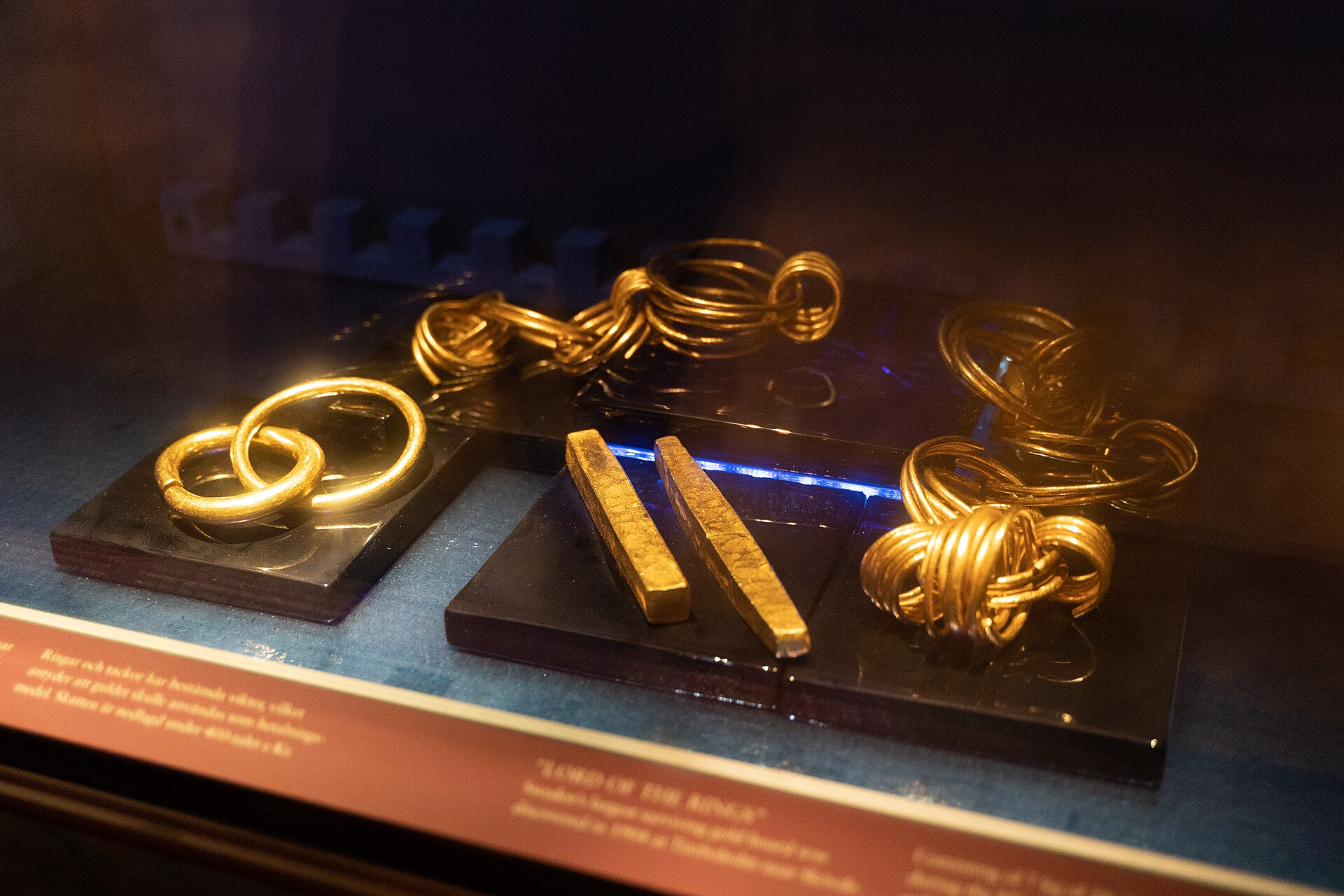
The vault holds two broad categories of material: prehistoric gold, largely from hoards buried during the Migration Period and Viking Age, and medieval silver, largely ecclesiastical — chalices, reliquaries and other church silver accumulated over centuries and later brought into state custody.
According to the museum’s own account of the collection, the gold objects include some of the finest surviving examples of prehistoric Scandinavian gold-working, among them elaborately patterned neck rings and collars produced by Iron Age goldsmiths using techniques — filigree and granulation — that required exceptional skill with very limited tools. Readers wanting the museum’s own description of specific pieces, weights and dating should consult Historiska Museet’s own site, since this is exactly the kind of detail that is updated as research continues.

What kind of objects are actually in the Gold Room?
The room is built around hoards — groups of objects buried together, usually for safekeeping, and never recovered by whoever buried them. This is a recurring pattern in Scandinavian archaeology: unstable periods produced buried wealth that was, for whatever reason, never reclaimed, and modern excavation or accidental discovery brought it back to light centuries later.
- Gold collars and neck rings from the Migration Period (roughly the 4th to 6th centuries AD), among the most technically accomplished gold objects to survive from prehistoric Scandinavia.
- Viking Age silver hoards, often containing a mix of coins, ingots and jewellery, reflecting the trade networks Vikings maintained across the Baltic and beyond.
- Medieval ecclesiastical silver — chalices, reliquaries and processional objects — accumulated by Swedish churches before the Reformation and later transferred into national collections.
The combination of pagan-era gold and Christian-era silver in a single vault is itself a kind of compressed timeline: it puts the pre-Christian and Christian material culture of Sweden in the same room, under the same security, rather than separating them by period as the rest of the museum does.
Why does a history museum need a vault at all?
Precious-metal objects present a different conservation and security problem from ceramics, textiles or stone. Gold does not corrode the way iron or bronze does, but its market value makes secure display a genuine operational requirement, not a curatorial affectation.
Building the Gold Room underground allowed the museum to combine display with the kind of physical security — controlled access, monitored environment — that a ground-floor gallery cannot easily provide. It is a fairly common solution internationally for museums holding comparable state treasuries; the same logic separates crown jewels and comparable regalia from a museum’s general galleries elsewhere in Europe.
Does the Historiska Museet charge for entry?
Sweden’s national museums, including the Historiska Museet, have operated under state free-entry policies for their permanent collections at various points, though the details and exceptions change with government funding decisions. The explainer on how Sweden’s free-entry museum policy works covers what “free entry” actually means in practice — which museums are covered, what is typically excluded, such as temporary exhibitions, and how the policy has shifted over time. Because funding policy is a political decision, not a fixed rule, readers should check current terms on Historiska Museet’s own site before visiting rather than assume free entry applies indefinitely.
How does it compare with Stockholm’s other big collections?
Stockholm has several museums that could loosely be called “national” and it helps to know what separates them.
- The Nationalmuseum holds fine art and design — painting, sculpture, applied arts — rather than archaeology.
- The Moderna Museet covers modern and contemporary art, a different collecting period entirely.
- The Vasa Museum is built around a single 17th-century warship, a much narrower and more recent slice of Swedish history than the Historiska Museet’s prehistoric and medieval scope.
The Historiska Museet’s distinguishing feature is depth of time: no other Stockholm museum reaches as far back into the archaeological record, and none holds a comparable concentration of prehistoric gold.
What should a visitor actually expect from a visit?
The museum is organised for slow, chronological viewing rather than a single headline object, though the Gold Room functions as an obvious anchor point within that route. Visitors interested primarily in Viking Age and medieval material will find the museum’s core strength there; those looking for Stockholm’s broader museum landscape can start from the museums and galleries archive, which lays out how the city’s major collections divide up by period and subject.
As with all opening hours, ticketing and any temporary exhibition charges, these details change and should be confirmed directly with Historiska Museet before a visit, since this article — like the rest of the site — is built from published sources rather than a staff visit, and practical details of this kind are the first thing to go out of date.
Access Stockholm is an independent guide written from published, checkable sources. We have not visited the places described here and we do not publish personal recommendations or invented ‘local favourites’ — where something is singled out as notable, we say who says so. Opening times, fares, closures and prices change at short notice, so treat everything here as a starting point and confirm with the museum, operator or venue directly before building a day around it. We give no advice on visas, insurance, health or safety; use your own government’s official guidance for those.
Featured image: Photo by Ronny Ueckermann, source, CC BY-SA 4.0
