Gamla Stan is Stockholm’s old town — the small island where the city was founded, built up with narrow streets and merchant houses from the medieval and early-modern periods. The City of Stockholm dates the settlement here to around 1252, making Gamla Stan roughly 770 years old as a continuously inhabited urban core.
Where is Gamla Stan, exactly?
Gamla Stan occupies its own island, Stadsholmen, in the channel where Lake Mälaren meets the Baltic Sea. It sits between the districts of Norrmalm to the north and Södermalm to the south, connected to both by bridges, and shares its small cluster of islands with two neighbours, Riddarholmen and Helgeandsholmen.
Riddarholmen holds Riddarholmskyrkan, the burial church of Swedish monarchs, and is usually treated as part of the same old-town area even though it is administratively separate. Helgeandsholmen, the smallest of the three, is occupied almost entirely by the Riksdag, Sweden’s parliament building.
How old is Gamla Stan, and how do we know?
The City of Stockholm’s own historical account places the founding of the city on this island at around 1252, traditionally associated with the regent Birger Jarl, though archaeological evidence shows settlement activity on and around Stadsholmen predating that date. The 1252 date marks the point at which Stockholm is first recorded as a fortified trading town rather than the moment people first arrived on the island.
Much of what stands in Gamla Stan today is not medieval in construction, even where the street pattern is. The narrow lanes and irregular plot boundaries are largely unchanged from the medieval town, but most of the visible facades date from the 17th and 18th centuries, when Stockholm’s merchant class rebuilt in stone after a series of fires. Layered underneath both is the archaeological record: foundations, harbour structures and everyday objects excavated from beneath the streets, which is the specific subject the Medeltidsmuseet was built to hold and display.
What does the district actually contain?
Gamla Stan functions today as a mixed district: part residential, part administrative, part commercial, with a resident population that has lived through the island’s shift from a working medieval town to a protected heritage core.
- Stortorget — the old town’s main square, historically the site of the town’s market and, in 1520, the mass execution known as the Stockholm Bloodbath.
- Storkyrkan — Stockholm’s cathedral, used for coronations and, more recently, royal weddings.
- Kungliga Slottet — the Royal Palace, the official residence of the Swedish monarch and one of Europe’s largest palaces by room count, still used for state functions and part of it open to visitors as a museum complex.
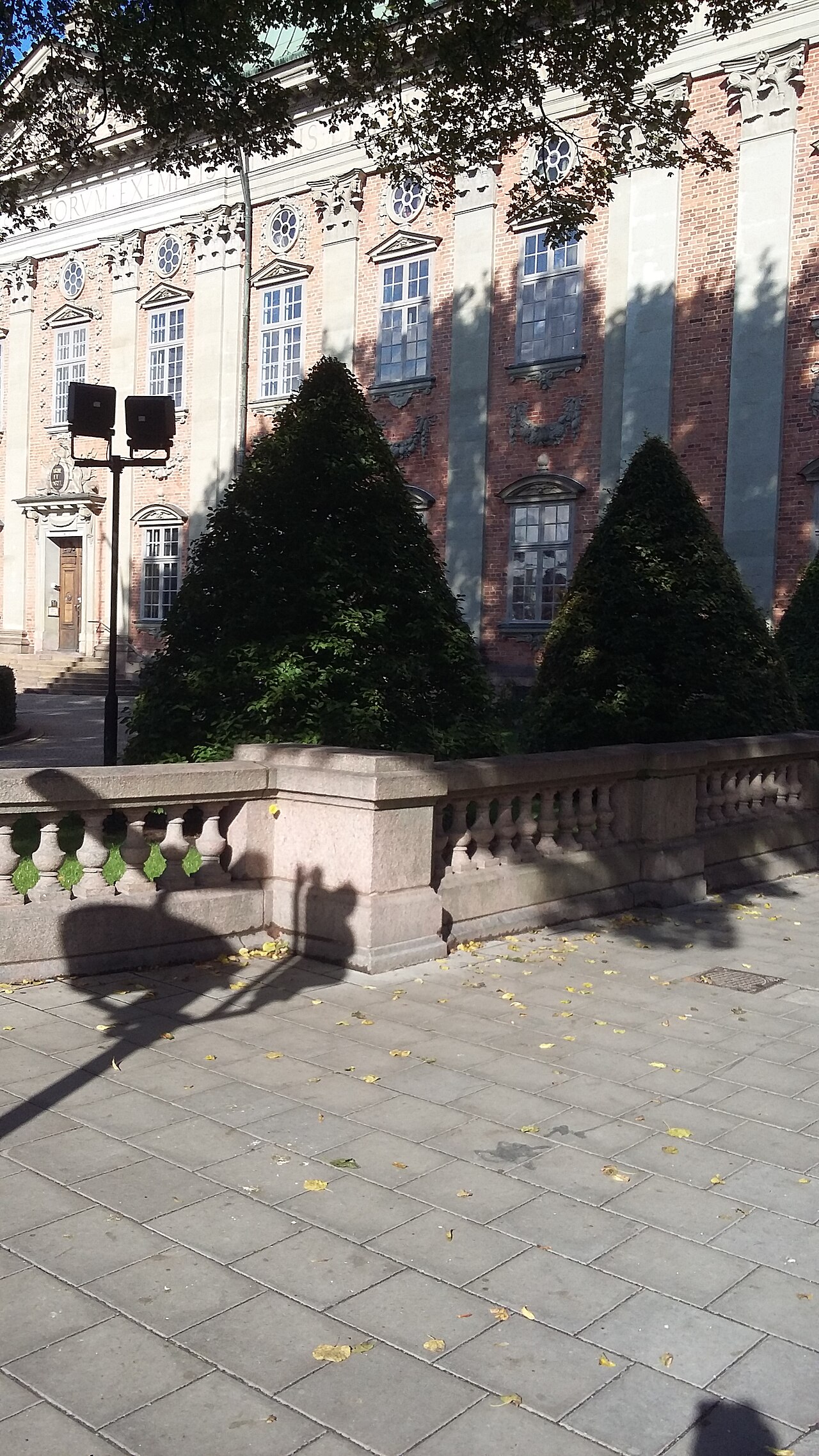
- Riddarhuset — the House of Nobility, built in the 17th century as the assembly hall of the Swedish nobility.
The island’s street plan is largely pedestrian, with vehicle access restricted on many of the narrowest lanes — a function of the streets themselves being too tight for regular traffic rather than a formal pedestrianisation scheme.

Is Gamla Stan a protected heritage area?
Gamla Stan is subject to building protection under Swedish heritage law, which restricts alterations to facades and structures across the island. It is not, however, listed by UNESCO — Stockholm’s own UNESCO World Heritage Site is Drottningholm Palace, on the outskirts of the city, which UNESCO’s own listing describes for its intact 18th-century royal setting. Gamla Stan’s protection instead comes through Swedish national and municipal heritage designation rather than an international body.
How does Gamla Stan fit into the wider museum landscape?
Several of Stockholm’s national collections sit in or immediately around the old town, distinct from the concentration of museums on the island of Djurgården. The Royal Palace itself houses the Royal Armoury, and Riddarholmskyrkan functions as a church museum documenting royal burials.
For readers building a wider museum itinerary, it’s worth understanding how the city’s major collections are distributed and how free entry is structured. The rules governing free entry to Sweden’s national museums apply to several institutions near Gamla Stan as well as the larger cluster on Djurgården, and the pattern of why so many national collections ended up on that island is explained separately in the piece on why so many of Stockholm’s museums are on Djurgården.
Two collections that sit closer to Gamla Stan’s own historical material are worth naming directly. The Historiska Museet and its Gold Room holds archaeological finds from across Sweden, including material connected to the same medieval period that shaped Gamla Stan’s founding. The Medeltidsmuseet, built directly around excavated remains beneath Norrmalm, is the museum most specifically dedicated to explaining what medieval Stockholm looked like below street level.
Beyond the old town’s immediate archaeology, the city’s wider museum landscape — from the Nationalmuseum’s fine art collection to the Vasa Museum’s 17th-century warship — is catalogued on the site’s Museums & Galleries archive, which is the starting point for readers planning a broader visit rather than a single district.
How does Gamla Stan work for someone who actually lives in Stockholm?
For residents, Gamla Stan reads differently than it does to a first-time visitor. It is a genuine residential district with its own apartment stock, some of it among the oldest continuously occupied housing in the city, alongside government buildings, embassies and small-scale retail.
It also carries the practical friction of any protected historic core: uneven cobbled surfaces, narrow doorways in older buildings, and a housing stock where renovation is constrained by heritage rules. The island sits on two Stockholm metro stations — Gamla Stan on the red and green lines — and is within walking distance of both Norrmalm’s commercial centre and Södermalm’s residential districts, which makes it a connecting point in the city’s geography as much as a destination in itself.
Seasonal rhythm matters here more than in most Stockholm districts. Summer brings a marked rise in foot traffic through the main streets around Stortorget and the palace, while winter sees the same streets function largely as a resident thoroughfare, with shorter opening hours at attractions and markedly quieter lanes once away from the two or three busiest routes.
What should a reader check before visiting?
Opening hours for the Royal Palace, Storkyrkan and Riddarholmskyrkan change by season and around state events, since parts of the palace remain a working royal residence. The Royal Court’s own website is the authoritative source for current hours and any closures tied to official functions, and readers should confirm details there rather than relying on a fixed schedule.
Government travel advice for Sweden, including any current guidance, is best checked through a reader’s own national government’s official travel advisory service rather than through third-party sites.
Access Stockholm is an independent guide written from published, checkable sources. We have not visited the places described here and we do not publish personal recommendations or invented ‘local favourites’ — where something is singled out as notable, we say who says so. Opening times, fares, closures and prices change at short notice, so treat everything here as a starting point and confirm with the museum, operator or venue directly before building a day around it. We give no advice on visas, insurance, health or safety; use your own government’s official guidance for those.
Featured image: Photo by Csisc, source, CC BY-SA 4.0
