Swedish coffee culture is a set of habits built up over roughly 300 years: a drink that was banned by royal decree more than once, a boiled brewing method still used in the north, a coffee break written into labour agreements, and a refill custom that predates any café marketing. Fika is the visible ritual on top of all this. It is not the whole system.
How did coffee arrive in Sweden, and why was it banned?
Coffee reached Sweden in the late 1600s through trade contacts in continental Europe, and it caught on among the aristocracy in Stockholm during the early 1700s. It did not stay a harmless luxury for long. Because coffee had to be imported and paid for in hard currency, successive Swedish governments treated it as a drain on the national economy and a symbol of foreign extravagance.
According to the Swedish historical record, the kingdom banned coffee outright, or taxed it so heavily as to amount to a ban, on several occasions across the 1750s to the early 1800s. Cups, pots and other coffee equipment were, at points, liable to confiscation by the authorities if found in a household. None of the bans held for long — coffee kept being smuggled and re-legalised — but the pattern says something about how seriously the drink was taken as a social and economic issue, not a minor beverage choice.
One story from this period is told repeatedly in Swedish coffee histories, with the usual caveats attached to a good anecdote: that King Gustav III, who reigned from 1771 to 1792, commuted a death sentence for a pair of twin brothers on condition that one drink three pots of coffee daily for life and the other three pots of tea, under medical supervision, to settle which drink was more harmful. The doctors overseeing the experiment reportedly died before either twin did, and the king himself was assassinated in 1792. It is retold as folklore rather than verified clinical history, but it is a fixture of how Swedes talk about their own relationship with the drink.
What is “kokkaffe”, and is it still made?
Kokkaffe — literally “boiled coffee” — is the older Swedish brewing method: coarsely ground coffee added directly to boiling water, simmered briefly, then settled or strained rather than filtered. It predates the filter machine by well over a century and remains a working tradition, particularly associated with the north of Sweden, with camping and outdoor life, and with older rural households.
It is not a museum piece. Boiled coffee over an open fire is a standard part of outdoor culture connected to allemansrätten, Sweden’s right of public access, which is what makes brewing coffee on open land during a hike or a boat trip a normal, unremarkable thing to do rather than a special event.
How is coffee written into Swedish working life?
In much of Sweden, a coffee break during the working day is not an informal courtesy but something closer to an institution. Many Swedish collective bargaining agreements, negotiated between employers and trade unions, specify a paid break — commonly referred to as kaffepaus or kafferast — built into the shift, distinct from the lunch break. The exact terms vary by industry and employer, but the underlying expectation, that the working day stops for coffee at set points rather than coffee being grabbed on the move, is widespread and long-standing.
This is one of the clearest ways Swedish coffee culture differs from a purely social one: it is partly a labour-market fact. A reader interested in how daily rhythms in the city actually work, rather than how they are marketed, can find more on this in the Living in Stockholm hub and the wider Living in Stockholm archive.
.jpg)
How much coffee do Swedes actually drink?
Sweden is consistently placed among the highest per-capita coffee-consuming countries in the world in data published by international coffee-trade bodies, alongside its Nordic neighbours. The precise figure moves year to year and is best checked against current industry data rather than repeated as a fixed statistic here, but the broad position — high consumption, sustained over decades rather than a recent fashion — is well established and not a marketing claim invented for tourism.
That level of consumption is one reason coffee shows up constantly in ordinary Swedish life rather than being reserved for a single daily ritual: at home before work, at the office on a break, after a meal, and again in the afternoon.
What is “påtår”, and why does a free refill matter?
Påtår is the Swedish term for a coffee refill, and in many cafés and workplaces it is offered or assumed as part of the first cup rather than sold separately. It is a small custom, but it says something structural about the culture: coffee is treated less as a discrete, priced product and more as an ongoing presence through the day, topped up rather than repurchased each time.
The practical effect for a visitor is that a single coffee purchase in some settings may come with an unadvertised second cup. Policies vary by venue and are not something this site can verify case by case, so it is worth confirming locally rather than assuming.
Is there a distinct regional coffee culture?
Yes, and it is documented rather than anecdotal. In parts of northern Sweden, particularly Norrland, kaffeost — literally “coffee cheese” — is a traditional practice of placing a cube of a specific squeaky, mild cheese into a cup of coffee and letting it soften slightly before eating it with a spoon, drinking the coffee alongside or afterward. It survives as a regional identity marker as much as a daily habit, referenced in Swedish food writing and regional tourism material covering the north, rather than something practised uniformly across the country.
This kind of regional variation is a useful corrective to treating “Swedish coffee culture” as one flat national ritual. It is closer to a set of related habits — boiled coffee in the north, filter coffee and refills more generally, workplace breaks nationwide — that overlap without being identical everywhere.
How does fika fit into all this — and what is beyond it?
Fika, covered in detail in this site’s separate explainer on what fika actually is, is the named social ritual: a deliberate pause, usually with a baked item, that can happen alone, with colleagues, or with friends. It is the part of Swedish coffee culture that gets exported and photographed.
What sits around it — the legal coffee break, the historical bans, the boiled coffee tradition, the refill custom, the high underlying consumption — is less visible to a visitor but arguably does more to explain why coffee occupies the place it does in Swedish daily life. Fika is the ritual; the rest is the infrastructure that makes the ritual make sense.
Is Stockholm developing a specialty-coffee scene?
Alongside the older customs, Stockholm has been part of the broader Nordic move toward specialty coffee — smaller-batch roasting, single-origin beans, and manual brewing methods — a trend covered extensively in Nordic design and food press over the past decade. This sits on top of, rather than replaces, the older habits described above; a city with a strong existing coffee-break culture and high baseline consumption was well placed to absorb a specialty-roasting movement rather than import one from nothing.
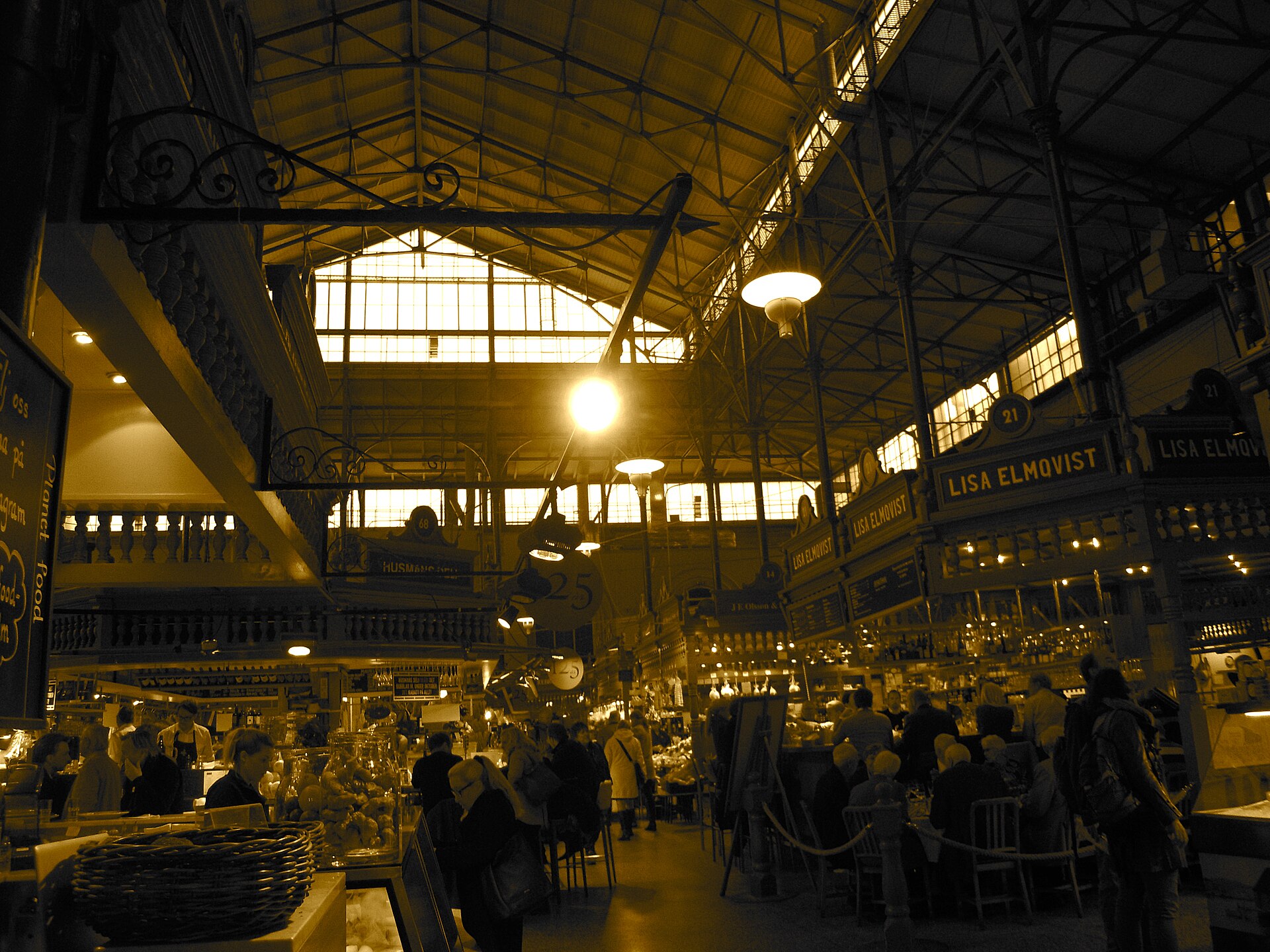
Stockholm’s food halls, including the ones covered in this site’s piece on Hötorgshallen, the city’s underground food hall, and its market halls more broadly in the Food & Markets archive, are among the places where older food traditions and newer specialty retail sit next to each other, coffee included.
What does this mean for a visitor’s day in Stockholm?
Practically, it means coffee is available constantly and is rarely a special-occasion purchase — it is closer to a utility than an event, which affects how cafés operate and how they are staffed through the day. General patterns on when venues open and close, which affect when a coffee stop is realistic, are covered in this site’s guide to typical opening hours in Stockholm.
It also means that paying for a coffee follows the same rules as paying for anything else in the city — overwhelmingly by card, with cash accepted in fewer places than visitors from cash-heavy economies might expect, a pattern explained in how paying works in Stockholm, and whether cash is still used. Broader planning questions around the city’s rhythms sit in the Stockholm practical hub and the Planning & Practicalities archive.
None of this requires seeking out a particular café. It requires noticing that coffee in Stockholm is less a single ritual than a set of overlapping habits — some centuries old, some legally codified, some regional, and one, fika, with its own name.
Access Stockholm is an independent guide written from published, checkable sources. We have not visited the places described here and we do not publish personal recommendations or invented ‘local favourites’ — where something is singled out as notable, we say who says so. Opening times, fares, closures and prices change at short notice, so treat everything here as a starting point and confirm with the museum, operator or venue directly before building a day around it. We give no advice on visas, insurance, health or safety; use your own government’s official guidance for those.
Featured image: Photo by Gustaf Emil Pettersson, source, CC BY-SA 4.0