The Stockholm Public Library — Stockholms stadsbibliotek in Swedish — is the city’s main library building, on Sveavägen in the Vasastan district. It is famous chiefly for its architecture: a cylindrical, copper-domed rotunda designed by Gunnar Asplund and opened in 1928, widely cited by architectural historians as one of the defining works of Nordic Classicism.
What is the Stockholm Public Library, exactly?
It is both a building and an institution. The building at Sveavägen 73 is the flagship of Stockholm’s public library network, operated by the City of Stockholm’s culture administration. Like all public libraries in Sweden, it lends books, provides reading rooms and reference material, and admits anyone without charge — a library card is required to borrow, but entering, reading, and looking around cost nothing.
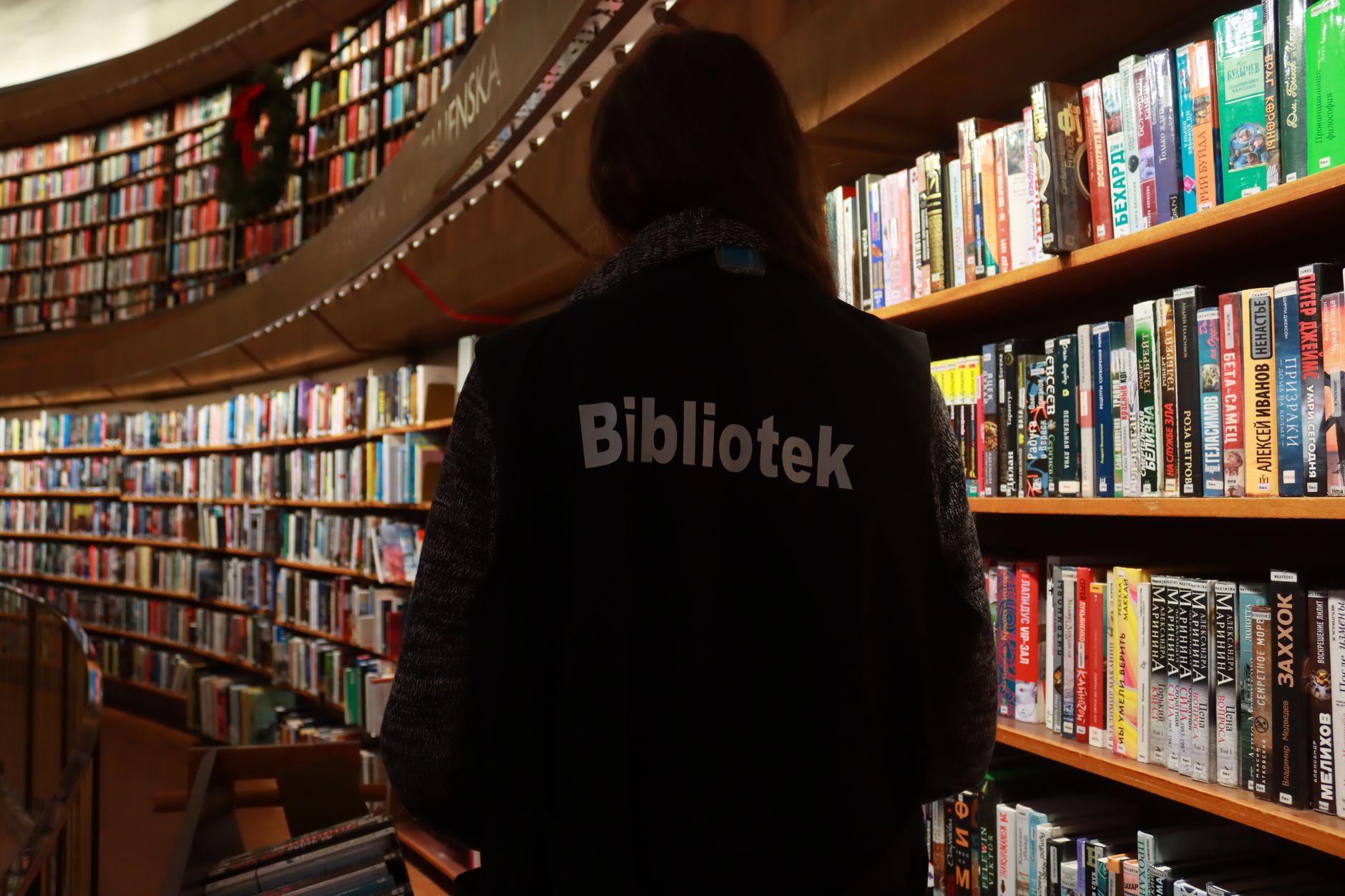
What draws attention beyond its shelves is the form of the central hall: a tall drum-shaped room, lit from a ring of windows near the roofline, lined on three tiers with shelving that curves continuously around the wall. It is this rotunda, rather than any single object inside it, that gives the building its reputation.
Where is it, and what’s around it?
The library stands in Vasastan, a residential district north of the city centre, on Sveavägen — one of Stockholm’s principal north–south streets — at the edge of Observatorielunden, a hilltop park that takes its name from the old Stockholm Observatory building nearby. The area is largely residential and academic rather than a tourist quarter, which is one reason the library reads as a working civic building rather than a monument.
This puts it at some distance from the museum concentration on Djurgården and from the medieval streets of Gamla Stan. Readers building a itinerary around central Stockholm’s other landmark buildings — Stockholm City Hall, built in the same decades and in a related but distinct architectural idiom — will find the library a short trip north by public transport rather than a walkable add-on to Gamla Stan or Djurgården.
Who designed it, and why does it look the way it does?
The architect was Gunnar Asplund, who won the commission through a competition and completed the building in 1928. Asplund is also the architect associated with Skogskyrkogården, the woodland cemetery outside Stockholm that UNESCO has inscribed on its World Heritage List — a separate project, but evidence of the same period’s approach to civic and ceremonial building in Sweden.
The library’s design is generally discussed under the label Nordic Classicism (sometimes “Swedish Grace”): a style that took cues from classical antiquity — plain geometric volumes, restrained ornament, a strong central axis — while stripping away the heavier decoration of 19th-century historicism. ArkDes, Sweden’s national centre for architecture and design, situates Asplund’s library among the key Swedish buildings of this transitional period between historicism and the Functionalism that followed in the 1930s.
The building’s plan is straightforward from the outside: a cylinder rising from a rectangular base, the whole clad in muted ochre render. The approach itself is part of the design — visitors climb a low, dark, deliberately compressed staircase before the space suddenly opens into the tall, bright rotunda, a sequence architectural writers on Asplund’s work regularly single out as intentional and carefully engineered rather than incidental.
What makes the rotunda famous?
The rotunda is a full three-storey cylinder of open shelving, wrapped around a central reading floor and rising to a band of windows below the domed ceiling. The shelves are arranged as a continuous ring rather than in separate aisles, so the room reads as a single unbroken wall of books rather than a series of stacks.
It has become one of the most photographed library interiors in Europe, and is frequently used as a reference point in discussions of 20th-century library design more broadly — cited alongside libraries such as the British Library’s older reading rooms as an example of how a library’s central hall can be designed as civic architecture in its own right, not simply storage with a roof.
What does the collection contain?
As the flagship of a public lending network, the library holds a broad general collection: fiction and non-fiction in Swedish and dozens of other languages, periodicals, children’s literature, reference works, and audio and digital media, reflecting Stockholm’s role as a multilingual, international city. It is not a research library on the scale of the Royal Library (Kungliga biblioteket), Sweden’s national library, and it does not hold rare manuscripts or archival collections in the way a national institution does.
Its role is closer to that of a large civic library serving both browsing readers and students, alongside a network of branch libraries across Stockholm’s districts, including a well-known branch inside Kulturhuset at Sergels Torg in the city centre. Readers looking specifically for rare books, manuscripts, or archival material are better served by the national collections held at institutions such as Nationalmuseum or the Royal Library.
Is it still a working library, or mainly a landmark?
It is a working public library first, and a tourist attraction as a secondary effect of its architecture. Stockholm residents use it for the same reasons anyone uses a city library: borrowing books, reading rooms, study space, and children’s programming. Visitors are welcome to enter the rotunda and look around during opening hours without a ticket, but should expect an active library — quiet-use rules, students working, and staff running an operating institution — rather than a museum laid out for viewing.
The building has undergone renovation work in recent years aimed at preserving Asplund’s original design while updating services for a modern library, which has at times affected which areas are open to visitors. Because renovation schedules and opening hours change, anyone planning a visit around the building specifically should confirm current access on the library’s own website before travelling.
Can anyone visit, and is there a charge?
Entry to look around is free, consistent with the general principle in Sweden that public libraries do not charge admission. A library card, free to apply for, is only needed to borrow items. This differs from the ticketed national museums covered elsewhere on this site — readers wanting a fuller picture of how free entry works at Sweden’s national collections can compare the library’s open-door model against the policies explained in our guide to free entry at Sweden’s national museums.
There is no general public tour of the building in the way some landmark buildings offer, though the city and cultural organisations periodically run guided architecture walks that include the library; details of any such programme are best confirmed directly with the operator rather than assumed.
How do you get there?
The library sits close to Rådmansgatan station on Stockholm’s tunnelbana (metro) network, within walking distance of Sveavägen. It is a short distance north of the central shopping streets around Sergels Torg and the Kungsträdgården area. Readers unfamiliar with how Stockholm’s zoned fare system and travel cards work should see our broader guide to getting around Stockholm before planning a route across districts.
How does it fit into the wider city?
Vasastan is a largely residential grid of late 19th- and early 20th-century apartment blocks, distinct in character from the older core of Gamla Stan or the museum cluster on Djurgården discussed in our piece on why so many of Stockholm’s museums sit on Djurgården. The library is one of the district’s few genuinely landmark buildings, and its presence there is part of why architecture writers treat it as a civic monument built for an ordinary neighbourhood rather than a ceremonial city centre.
Readers assembling a wider view of Stockholm’s landmark buildings and how its districts are organised can start from the site’s hub pages on landmarks and sights and neighbourhoods, both of which place the library in the context of the buildings and districts around it. Those with a particular interest in museum collections proper — as distinct from the library’s lending role — will find a fuller index at museums and galleries.
Access Stockholm is an independent guide written from published, checkable sources. We have not visited the places described here and we do not publish personal recommendations or invented ‘local favourites’ — where something is singled out as notable, we say who says so. Opening times, fares, closures and prices change at short notice, so treat everything here as a starting point and confirm with the museum, operator or venue directly before building a day around it. We give no advice on visas, insurance, health or safety; use your own government’s official guidance for those.